
A lot of living rooms are designed with care right up to the point where the television goes on the wall. The sofa fits the room. The lighting is layered. The millwork, fireplace, rugs, and art all work together. Then the TV goes up, gets turned off, and the room is dominated by a large black rectangle.
That’s the exact problem the 65 inch frame tv was built to solve. It isn’t just a TV with a decorative feature added on top. It’s a design-led display meant to behave like framed art when you’re not watching it, then switch back to a serious 4K television when you are.
For homeowners planning a clean, modern smart home, that difference matters. The purchase isn’t only about screen size or picture quality. It’s about placement, hidden wiring, room lighting, mount depth, bezel choice, control systems, and whether the final result feels intentional instead of improvised.
A good Frame TV project lives at the intersection of interior design and low-voltage planning. If you get both right, the TV disappears into the room when it should, then performs like a premium display when you need it.
You finish a living room exactly the way you want it. The plaster is clean, the sconces are centered, the millwork lines up, and the furniture has room to breathe. Then the TV goes up, and when it is off, the wall turns into a dark glass panel that pulls attention away from everything around it.
A 65 inch frame tv exists to solve that design problem, but the product only works when the whole project is planned properly. The screen, the mount, the wiring path, the trim detail, and the control strategy all affect whether it reads like framed art or just a nicer television.
Samsung’s Frame line helped turn that idea into a real category. Early 65-inch models established the formula: art display when idle, 4K TV when active, and a profile designed to sit close to the wall. The concept caught on because it answered a real request from homeowners and designers. They wanted a display that could live in a formal room, over millwork, or in an open-plan space without making the room feel like it was built around a screen.
From an integrator’s perspective, the right Frame TV client cares as much about the room at 2 p.m. with the screen off as they do about picture quality during a film at night.
That changes the brief from the start. A standard TV install usually begins with screen size and viewing angle. A Frame TV project starts with sightlines, reflected light, wall finish, cable concealment, power location, and what the display should look like during the many more hours it is not playing content.
A successful result usually depends on four decisions:
This is why a basic product review rarely tells the full story. In a high-end home, the television is part of a larger design and technology decision. It affects outlet placement, backing, niche depth, trim reveals, and how the room behaves when you press one button to watch, listen, or leave everything off.
A 65 inch frame tv has a dual identity. It’s a 4K television when active, and a digital art display when idle. That sounds simple, but it’s what separates The Frame from a regular TV running a screensaver.
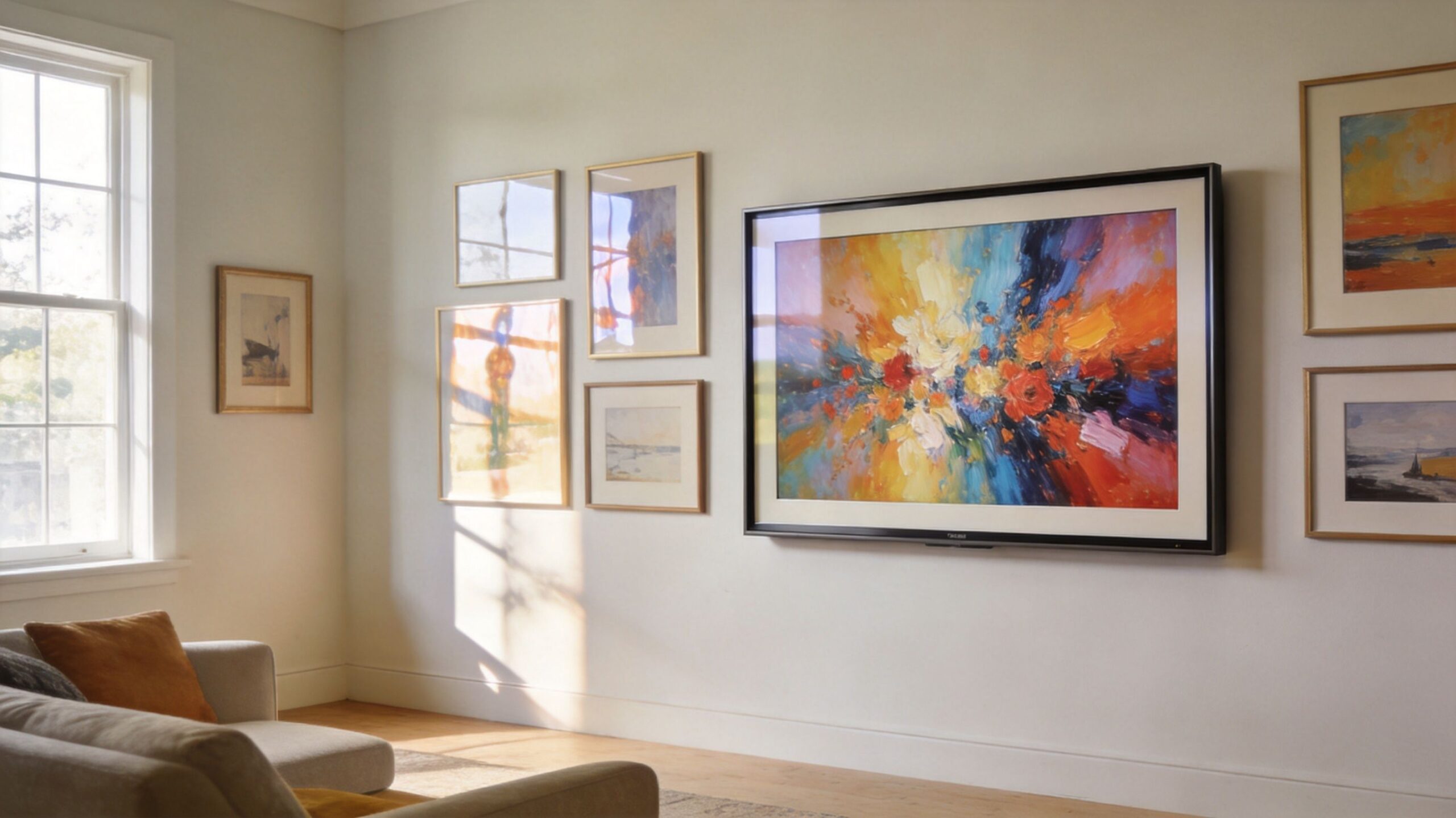
Art Mode is the feature that makes the product category work. Instead of going to a blank black screen, the TV displays artwork or personal photos so the wall still feels finished.
That matters most in rooms where a standard TV feels intrusive. Formal sitting rooms, open family rooms, and fireplaces are the obvious examples. In those spaces, a powered-off display usually looks dead. A Frame TV is trying to look curated instead.
A lifestyle TV still has to be a strong television. On the current 65-inch Frame, Samsung says the QLED panel delivers 100% Color Volume and reproduces the full DCI-P3 color gamut across all brightness levels, while the matte anti-reflection screen reduces glare by up to 70% and maintains over 1,000 nits peak brightness, according to the Samsung Frame spec sheet.
That’s a practical benefit, not just a spec-sheet one. In bright Wisconsin living rooms with large windows, glare is often what makes a TV feel out of place. If the screen turns into a mirror during the day, the whole “art on the wall” concept breaks down. The matte display is one of the biggest reasons The Frame looks convincing in real homes.
People sometimes assume The Frame is mostly cosmetic. It isn’t.
What makes it distinct is the combination of:
For homeowners who want one room to do multiple jobs, that combination is the draw. The same wall can serve as a design focal point all day, then become the main media display at night.
If your priority is hiding the fact that you own a TV, The Frame is one of the few products that makes a serious attempt to solve that problem instead of decorating around it.
For buyers also considering trim and finish options, bezel selection becomes part of the visual result. Samsung’s swappable frame concept is one reason people spend time comparing finish choices before the TV ever goes on the wall. A good overview of those options is this guide to The Frame bezel choices.
A clean Frame TV installation starts long before the screen goes on the wall. The finished look depends on where equipment lives, how the cable path is planned, what the wall is made of, and how closely the display can sit to the surface.
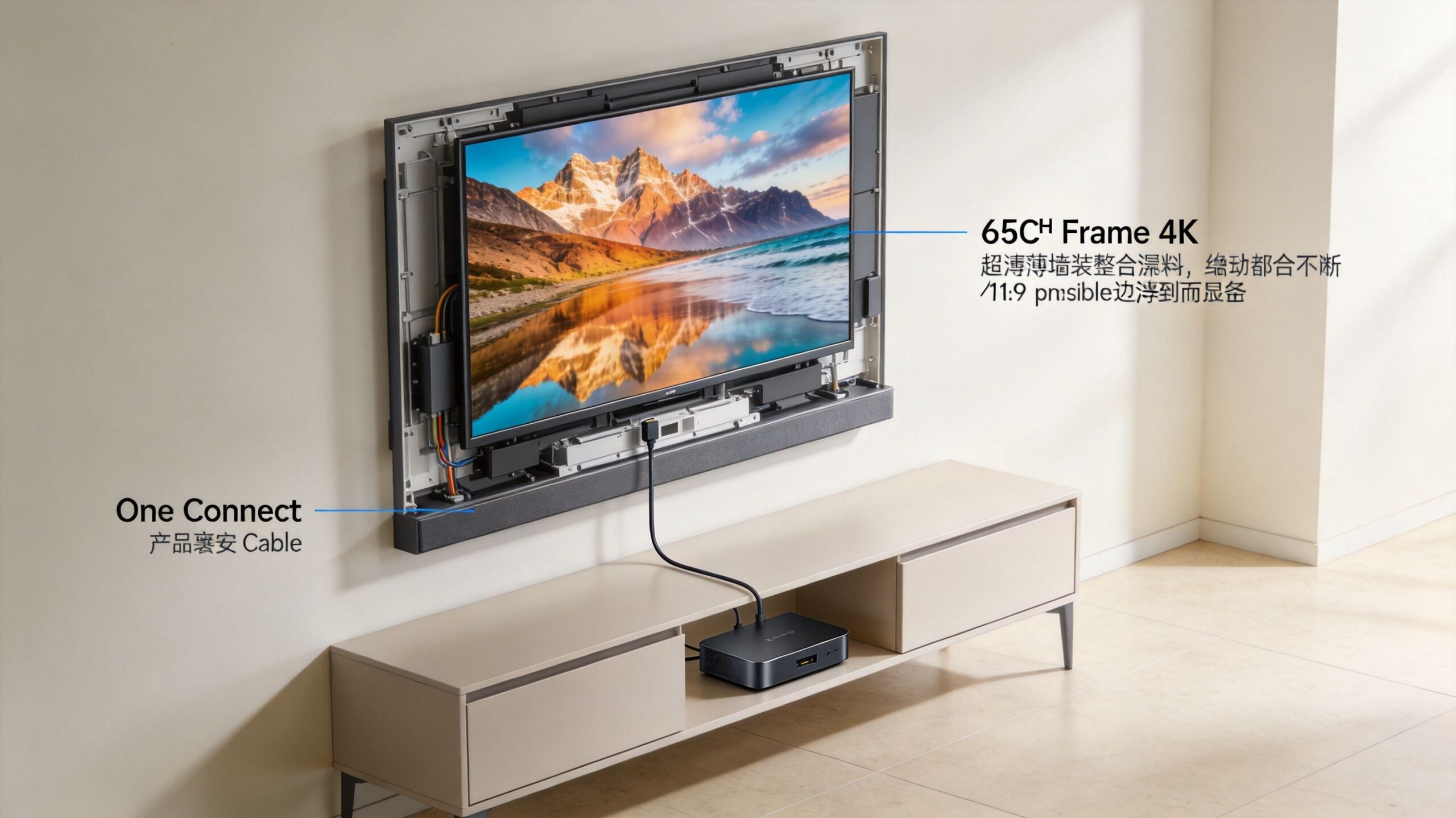
The biggest reason The Frame looks cleaner than a standard TV is simple. The connections do not all terminate behind the panel.
On a conventional television, power, HDMI feeds, source devices, and control wiring collect at the back of the screen. That usually creates one of two problems. The mount has to stand off the wall farther than you want, or the installer has to hide a bundle of cables in surface trim or a visible raceway.
Samsung handles that differently with the One Connect Box. The display stays on the wall while the gear and most of the cable congestion move to a separate location. In practice, that changes the whole project. It gives you options to place the box in a cabinet, inside millwork, or in a recessed media box where service access still exists but visual clutter does not.
That last part matters. A beautiful install can become frustrating if the box is buried somewhere no one can reach when a streamer locks up, an HDMI source changes, or the homeowner adds a new device later.
The wall result depends on more than the TV chassis. It depends on the route of the One Connect cable, the mounting surface, and how carefully the display is shimmed and aligned.
The included Slim Fit Wall Mount is designed to keep the panel close to the wall, but close only looks right when the wall is right. I see problems most often on stone, tile, paneling with proud seams, and older drywall that has a slight bow across the span. Even a small irregularity can break the framed-art effect.
A good install plan accounts for that early:
The frame itself also changes the visual read of the installation. Finish, width, and color should match the room instead of being treated as an afterthought. If you are comparing trim options, this guide to Samsung Frame bezel styles and finish choices is a useful place to start.
A Frame TV still has to work as the main television in the room. If motion handling feels weak or source switching becomes unreliable, the design advantage fades quickly.
That is why I treat this as an integration project, not a decor purchase. The visible part is the screen. The invisible part is the planning around gaming sources, cable boxes, streaming devices, audio handoff, ventilation for the One Connect Box, and service access after the room is finished.
Practical rule: The best Frame TV installs disappear visually when the set is idle and stay out of the way technically when the room shifts to everyday viewing.
A 65 inch frame tv works best when it’s not treated like an isolated device. In a well-planned home, it becomes one visual endpoint inside a larger system that includes lighting, shading, audio, control, and network infrastructure.
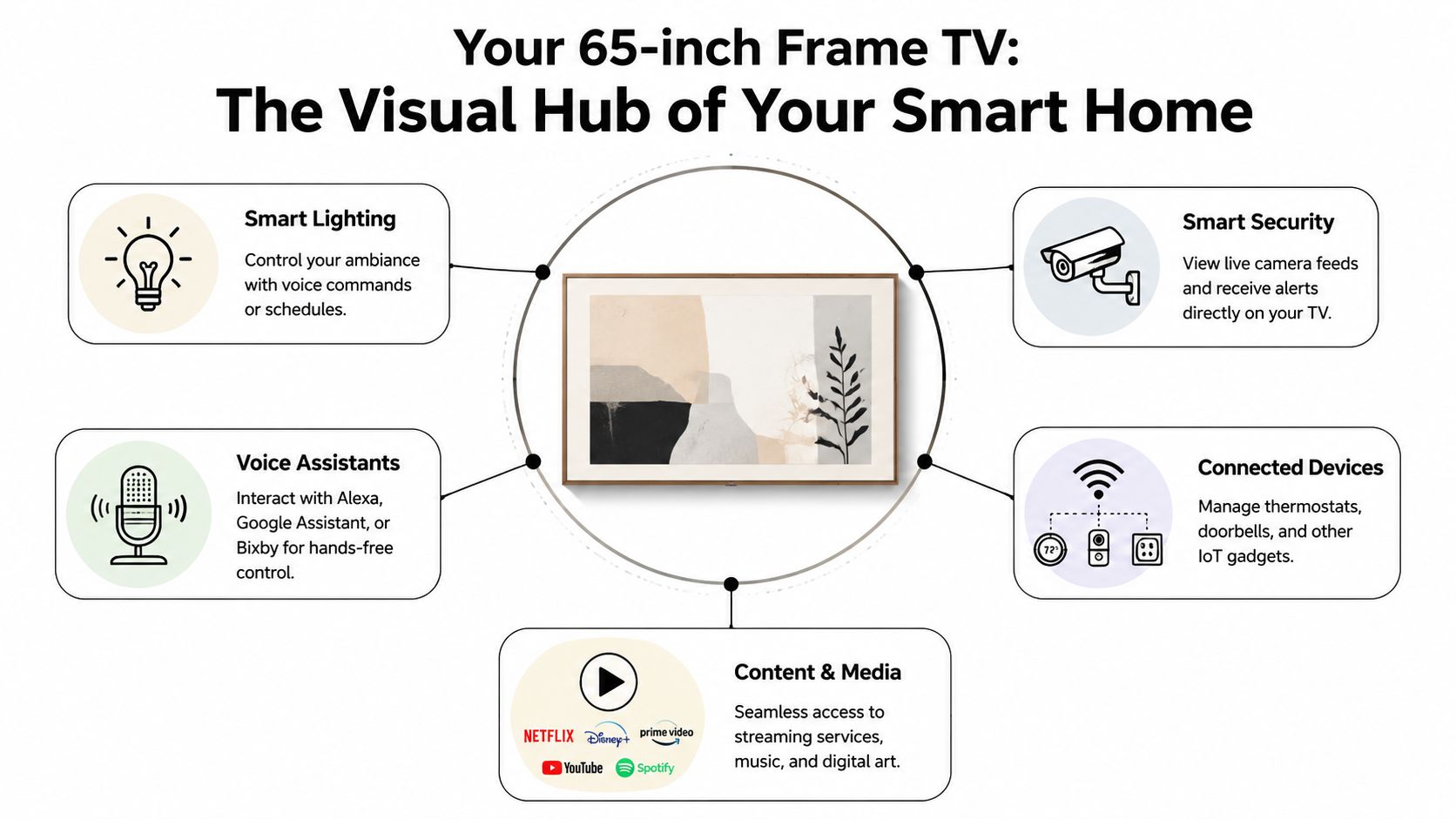
The most overlooked part of a Frame TV project is what happens around the screen. The TV can look beautiful on the wall, but if the room lighting is harsh or uncontrolled, the result still feels wrong.
Automation proves its worth. Motorized shading can reduce daytime glare and preserve the art-like look of the display. Lighting scenes can shift the room from daytime living to evening viewing without anybody walking around adjusting lamps and dimmers.
A homeowner might use one command to trigger a whole sequence:
If you’re weighing control options for shades and scenes, this overview of Lutron and Control4 integration gives a useful sense of how those systems fit into a broader home environment.
A Frame TV belongs in living spaces where people care about simplicity. That’s why voice control platforms like Josh.ai make sense here. The goal isn’t to add novelty. It’s to reduce friction.
A natural voice command can handle multiple actions at once. For example, “turn on movie night” can lower shades, change lighting, call up the right source, and route audio to the proper speakers. In a bedroom or sitting room, a simpler command might return the TV to art display and restore the room’s daytime setting.
That kind of experience feels much better than juggling several apps.
The Frame solves a visual problem. It does not solve the sound problem by itself.
Thin televisions rarely deliver the scale and clarity people expect once they’ve invested in a carefully designed room. That’s why many projects pair a Frame TV with distributed audio or a media-room sound system. Sonos is often part of that conversation for straightforward music and room audio, while dedicated theater spaces may step up into more ambitious speaker layouts and source components like Kaleidescape.
The key is matching the room to the use case:
| Room type | Best audio approach |
|---|---|
| Casual family room | Clean soundbar or simple integrated audio |
| Design-forward living room | Hidden or low-profile audio with careful placement |
| Media room | Full surround system with proper speaker layout |
| Whole-home ecosystem | Shared music and control across multiple zones |
A smart home only feels polished when devices communicate reliably. That makes the network foundational, not optional.
For homes with multiple displays, control processors, cameras, wireless devices, and streaming sources, a stronger network platform like Ubiquiti can make the system behave consistently. That matters whether you’re launching a movie, loading artwork, syncing control commands, or pulling up camera feeds on a screen.
The same planning mindset applies across other residential projects too. Homeowners building out a larger system often combine TV and automation work with custom home theater, new home prewire, home audio, security and networking, exterior lighting and sound, and even exterior lighting solutions like Oelo. The TV is only one visible endpoint in that larger ecosystem.
A 65 inch frame tv can look perfectly scaled in one room and awkward in another. The difference usually comes down to placement discipline, not the product itself.
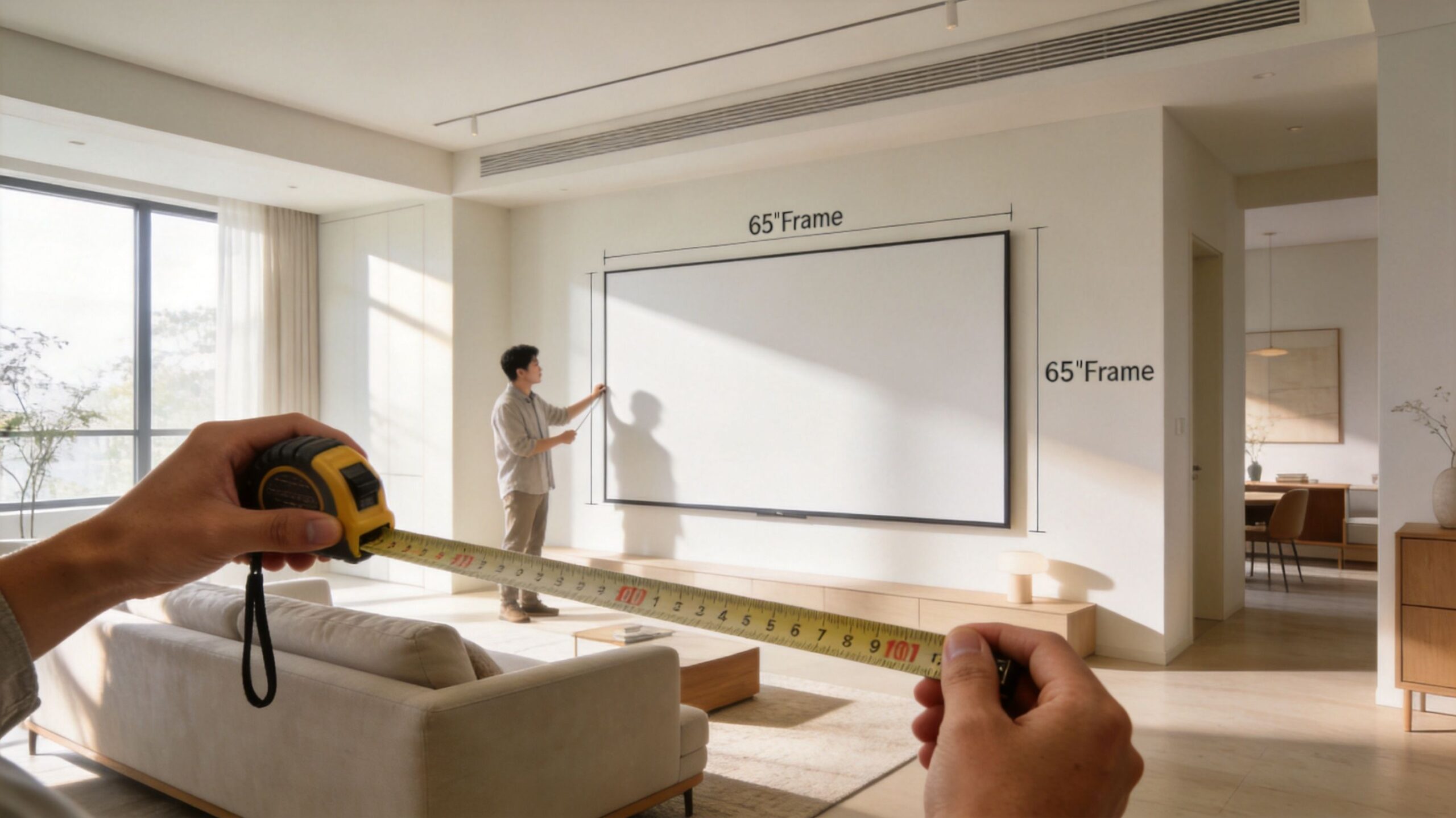
People often choose the TV first and the wall second. It should be the other way around. The architecture, seating plan, viewing angles, windows, fireplace height, and cabinet layout should all inform whether a 65-inch screen is the right answer.
If you want a practical planning tool before mounting anything, this guide can help you calculate optimal television and sofa layout. It’s useful because seating geometry often reveals problems before the first hole is drilled.
For a room-by-room way to think through scale, this guide on how to choose the right TV size is also worth reviewing.
The most requested Frame location is above a fireplace. Sometimes it looks excellent. Sometimes it’s a compromise dressed up as a design choice.
The issue usually isn’t whether the TV fits. It’s whether the viewing height is comfortable and whether the wall can support the kind of finish people expect from a Frame installation. Stone, brick, and heavy texture can all make a flush art-like result harder to achieve.
A good installer should ask questions such as:
Some walls are technically mountable but visually wrong for a Frame TV. A successful install depends on both.
This is also where marketing and real-world performance part ways. While the Frame is praised for design, its edge-lit panel technology can produce “noticeable splotches” or unevenness in dark scenes, as discussed in this How-To Geek review of living with Samsung’s Frame TV.
That doesn’t mean the TV is a bad choice. It means placement and expectation-setting matter.
In practice, the Frame tends to make the most sense in:
It’s less ideal if your top priority is critical dark-room movie performance. In those cases, a homeowner may still choose it for design reasons, but they should do so with eyes open.
A quick visual overview of installation planning can help before final decisions are made:
A 65 inch Frame TV project usually starts with a screen budget and ends as a wall, power, finish, and control-system budget. That shift catches homeowners off guard.
The product price matters, but the finished result is what people live with every day. In a well-executed room, the TV sits tight to the wall, the cable path disappears, the frame choice matches the surrounding finishes, and the set behaves like part of the home instead of a standalone gadget. Each of those decisions adds labor, materials, or programming time.
The TV is one line item. The installation standard you want is the bigger cost driver.
Common project costs include:
A DIY mount can look acceptable from ten feet away. A design-led installation gets judged from three feet away, in daylight, with the room fully finished.
Homeowners often compare the TV price to a basic mounting quote. That is the wrong comparison. The pertinent choice is between a simple hanging job and a coordinated AV and finish project.
| Consideration | DIY Approach | Home AV Pros Professional Install |
|---|---|---|
| TV purchase | You choose the set and handle delivery | Guidance on model selection within the full room plan |
| Mounting | Basic wall mount install | Flush-fit mounting planned around wall type and sightlines |
| Wiring | Surface concealment or limited in-wall planning | Hidden cable routing with power and low-voltage coordination |
| Box placement | One Connect location decided after purchase | One Connect location planned before mounting and trim decisions |
| Aesthetics | Depends on personal skill and wall conditions | Focus on symmetry, reveal lines, and finish quality |
| Smart home integration | Usually separate DIY steps | Coordinated with lighting, control, audio, and network systems |
| Calibration and support | Factory settings and self-troubleshooting | Setup, verification, and post-install support |
For homeowners planning more than a simple wall mount, this is usually the point to bring in an audio visual contractor for integrated TV and smart home planning.
Budget for the room outcome, not just the box that arrives at the door. That is the difference between owning a Frame TV and getting the look people buy it for.
A 65 inch Frame TV can look like part of the architecture or like a nice idea that never came together. The difference usually has nothing to do with the panel itself. It comes from planning decisions made before the TV ever touches the wall.
I see the same pattern in higher-end projects. The homeowner buys the right display, then treats installation like a basic mounting appointment. That approach misses what makes this category different. A Frame TV asks for coordination between finish carpentry, power, low-voltage, lighting, network reliability, and daily control. If any one of those pieces is handled casually, the room shows it.
The Frame is less forgiving than a conventional television. Small errors stand out.
A mount that sits slightly proud of the wall changes the shadow line. A visible cable breaks the art effect immediately. Poorly chosen One Connect placement can create service headaches later, especially when the box ends up in a cabinet with heat, limited access, or no clean path for future upgrades. Light placement matters too, because reflections that are acceptable on a normal TV become distracting when the screen is meant to read like framed art.
That is why experienced installers spend time on conditions behind the wall, not just the wall surface.
A strong installation starts with judgment. The hardware is the easy part.
On larger projects, I also plan for what happens before and after the mount day. During remodeling, flooring work, or a move, homeowners sometimes need reliable fragile item storage solutions for displays, soundbars, and boxed electronics until the room is fully ready.
There is a meaningful difference between a mounting crew and an integrator. A mounting crew gets the TV on the wall. An integrator handles how that TV lives in the house.
That includes control, audio, lighting scenes, network stability, equipment location, and the simple day-to-day experience of turning the room on and having everything respond properly. Homeowners who want that level of coordination should work with an audio visual contractor for full-room AV and smart home planning, especially if the Frame TV is part of a broader renovation or a new-build scope.
A well-installed Frame TV disappears into the room in the best way. Guests notice the wall, the proportions, and the artwork first. The technology stays in the background, which is exactly the point.
If you're planning a 65 inch frame tv and want the result to look intentional, not improvised, talk with Home AV Pros. They design and install clean residential AV systems across southern Wisconsin and nearby northern Illinois, from TV mounting and smart home control to custom theaters, whole-home audio, networking, shades, outdoor lighting, and new home builds.

Copyright © 2026. Home AV pros. All rights reserved.