
A lot of homeowners start in the same place. They’re tired of the room being built around a giant black rectangle. They want the performance of a premium display, but they don’t want a bulky panel, exposed cabling, or a media cabinet that pulls attention away from the space itself.
That’s why the oled wallpaper tv gets so much interest. It promises something most televisions still don’t deliver very well. When it’s off, it doesn’t dominate the room. When it’s on, it looks like a high-end display that belongs to the architecture instead of fighting it.
That promise is real. So are the complications. An oled wallpaper tv can look stunning in the right room, but it also demands better planning than a standard wall-mounted TV. The wall matters. The wiring path matters. The location of the external box matters. If you want the TV to work as part of a larger smart home, the control system, lighting, audio, and network all matter too.
A common scenario looks like this. The living room is finished well. Clean millwork, a fireplace wall, carefully chosen lighting, maybe large windows with a view. Then the TV goes up, and suddenly the room feels more like a media zone than a living space.
That’s the problem an oled wallpaper tv solves better than almost anything else on the market. It sits so close to the wall that it reads more like architectural finish than electronics. For homeowners who’ve considered design-first displays and decorative approaches like The Frame bezel options, the wallpaper concept takes the minimalist idea even further.
This style of display makes the most sense in rooms where visual clutter is the main adversary.
A beautiful room can carry a large display. It just can’t hide a bad installation.
The catch is simple. The cleaner you want the final result to look, the less forgiving the project becomes. A normal TV can hide minor alignment issues, a visible soundbar, or a cable path that isn’t perfect. A wallpaper-style display can’t.
People often think the purchase is the hard part. It usually isn’t. The hard part is making the room support the idea.
That means thinking about wall flatness, mount positioning, nearby power, source equipment, and how the display will behave in daytime viewing. It also means deciding whether this room is supposed to be a casual living space, a serious movie room, or both. The right answer changes the surrounding system.
An oled wallpaper tv is at its best when the room is planned around it, not when it’s treated like just another television swap.
The biggest difference is structural. A traditional TV is one object. You lift it, mount it, plug everything into the back, and manage the mess as best you can. An oled wallpaper tv splits that experience into two parts.
The screen is the visual piece. The processing and connectivity live elsewhere.

LG introduced the Wallpaper TV concept in 2017 with a design built to sit flush to the wall like artwork, and that launch model was 4mm thick according to TechTimes coverage of the Wallpaper TV timeline. The same report notes that the concept returned at CES 2026 as the OLED evo W6 True Wireless model at 9mm thick, with a Zero Connect Box for wireless 4K@165Hz transmission.
That thin panel is what gives the category its identity. It doesn’t look like a framed appliance. It looks more like a display surface attached directly to the wall.
The second half of the system is the external hub. Instead of hanging all your inputs, processing, and source connections on the back of the TV, the W6 uses the Zero Connect Box. That changes the installation conversation in a big way.
Here’s what that means in practice:
For clients comparing a premium TV wall to a projection setup, that distinction matters. A display like this solves visual bulk in a way projection often doesn’t in bright multi-use spaces. There’s a useful baseline comparison in projector vs TV for home theater, especially if you’re deciding between dedicated cinema performance and everyday living-room practicality.
A standard TV still announces itself. Even the thinner models read as electronics mounted on a surface. A wallpaper model changes that relationship. The panel becomes the surface.
Practical rule: If your top priority is making the screen disappear into the room design, the form factor matters almost as much as picture quality.
That’s why this category attracts homeowners, architects, and interior designers who care just as much about the wall composition as the display specs. The product isn’t only about what you watch. It’s about what the room looks like when you aren’t watching anything.
The strongest argument for an oled wallpaper tv isn’t subtle. It looks better on the wall than a conventional premium TV. If that’s the priority, it’s in a category of its own.
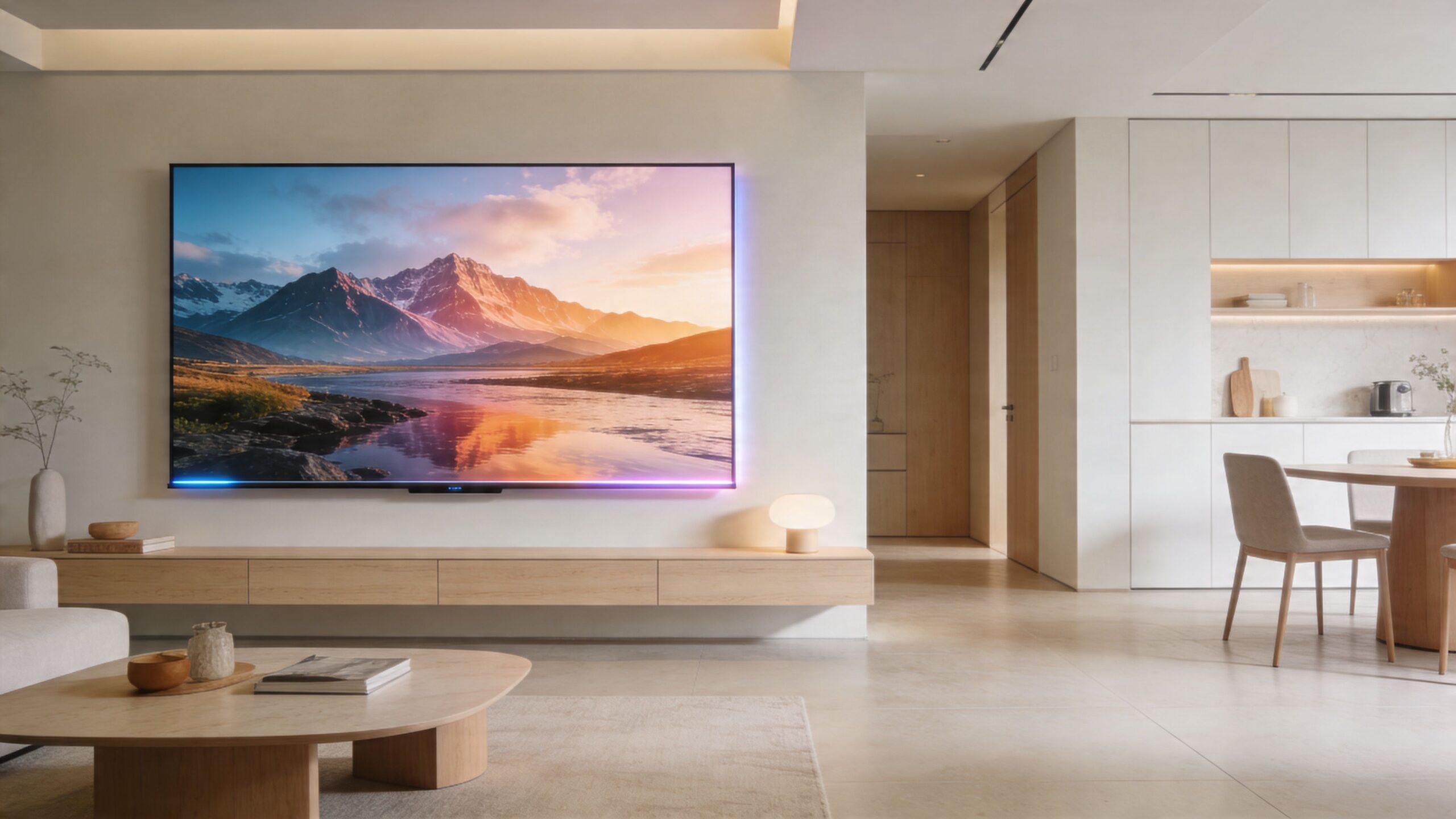
But the visual appeal would be less compelling if the performance lagged behind. It doesn’t.
LG states the OLED evo W6 reaches up to 3.9 times higher peak brightness than conventional OLED panels through its alpha 11 AI Processor Gen3, and the same product page says the Zero Connect Box can transmit visually lossless 4K video and audio from up to 10m away in the wireless setup, as outlined on LG’s OLED W6 product page.
That matters because one of the old objections to OLED in bright rooms was always daylight performance. LG also pairs the set with Reflection-Free Premium certification from Intertek and says reflectance is the lowest among LG TVs on that model page. In real rooms, that translates to fewer compromises when the space has windows, lighter finishes, or mixed daytime and evening use.
The practical upside usually lands in three areas:
The design introduces trade-offs that don’t show up on a showroom wall card.
First, the panel is thin enough that handling it becomes part of the risk profile. Precision matters more during delivery, mount prep, and final placement. Second, “wireless” doesn’t mean “carefree.” You still need a well-planned home for the Zero Connect Box, and that location affects cabinetry, ventilation, access, and source-device layout. Third, this category is about design value, not bargain value. If someone only wants strong picture quality per dollar, there are other premium displays that make more sense.
A short look at the product in motion helps clarify why people are drawn to it in the first place:
This TV fits best when the room has two essential requirements. It needs to look exceptional when the screen is off, and it needs to perform at a premium level when the screen is on.
Most regrets don’t come from the display itself. They come from underestimating the room planning around it.
If your room can absorb a conventional flagship OLED without hurting the design, the wallpaper premium may not feel necessary. If the whole point is to keep the technology visually quiet, the value proposition changes fast.
At this point, the oled wallpaper tv stops being a product choice and becomes a construction question.
LG promotes the flush design, but key technical details around wall compatibility, load-bearing requirements, and special anchoring systems aren’t clearly provided in public-facing materials. That gap is specifically noted in LG’s global Wallpaper TV announcement coverage, which is why a site visit matters before anyone promises a clean outcome.
Homeowners usually focus on screen size and placement height first. For this category, wall condition comes first.
Questions that need real answers include:
If you’re not sure how framing affects mounting decisions, this overview of what is a load bearing wall gives useful background on why wall structure changes what’s possible.
A flush-mounted display only looks effortless after someone has done the hard work behind the wall.
The wireless architecture solves one problem and creates another. The display wall can stay far cleaner, but the external box still needs a smart home.
That means deciding where source gear, network connections, and power will live. In some homes, a nearby cabinet works. In others, a recessed millwork section or adjacent equipment area is better. The right answer depends on room layout and the broader AV system.
For homes in planning or renovation, this is also the stage to think about low voltage wiring for home projects. Even an efficient TV system gets better when control lines, network cabling, and related infrastructure are thought through before finishes are complete.
| Consideration | Requirement / Question to Answer |
|---|---|
| Wall surface | Is the mounting area flat and free of finish irregularities? |
| Wall structure | What framing or backing exists where the bracket will land? |
| Wall material | Is the wall drywall, plaster, brick, stone, or another material? |
| Power location | Where will the display and supporting equipment get power? |
| Zero Connect Box placement | Will the box sit in cabinetry, on shelving, or in a nearby equipment location? |
| Source devices | Where will streamers, gaming consoles, and media players live? |
| Access for service | Can the box and connected devices be reached without disrupting the room? |
| Finish quality | Will the install leave the clean edge detail the design requires? |
A few mistakes show up again and again.
One is choosing the wall based only on sightlines while ignoring structure. Another is assuming wireless video removes the need for disciplined cable planning. A third is forgetting that cabinetry, shelving, and nearby furniture affect where the box can live and how usable the whole system feels day to day.
The best installations treat the TV, wall, power, source gear, and room finishes as one coordinated project.
An oled wallpaper tv gets more valuable when it stops acting like a standalone display and starts acting like part of the house.
That’s especially true in primary living spaces. Most homeowners don’t want to juggle separate remotes, lighting scenes, streaming apps, shades, and audio zones. They want one command that makes the room behave the right way.
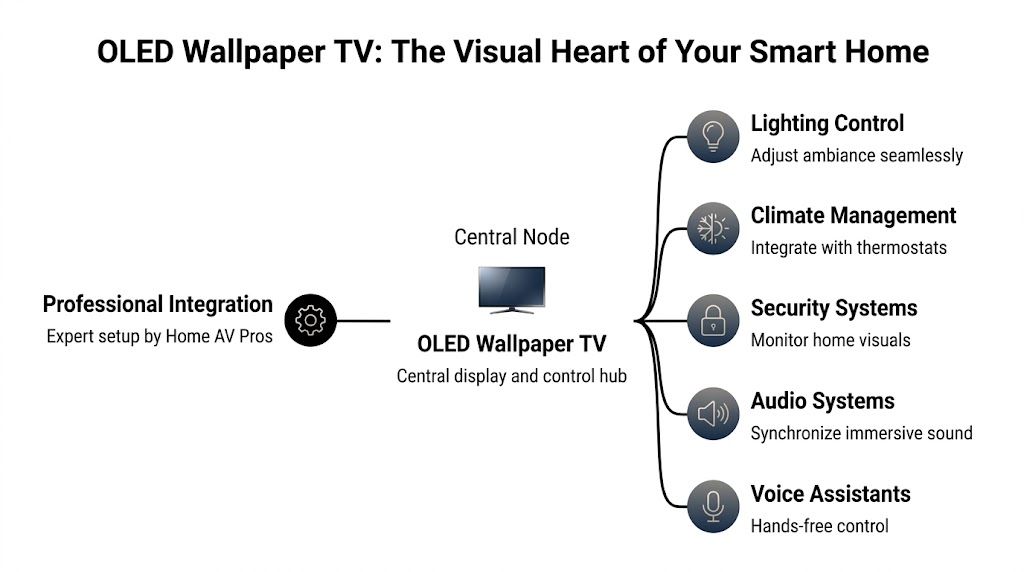
A well-integrated room changes state with a single action. Say movie time, and the display powers on, the correct source opens, the lights dim, and the shades lower. End the session, and the room goes back to normal without a stack of button presses.
That’s where systems like home entertainment automation matter. The display becomes the visible focal point, but the experience depends on the coordination behind it.
The strongest setups usually involve several layers working at once:
That matters because “wireless TV” still leans on a healthy environment around it. The display may receive its signal cleanly, but the total user experience still depends on network stability, source reliability, and control consistency.
Different rooms call for different levels of integration.
In a family room, the best move may be simple scene control. Press one keypad button and the OLED wallpaper tv powers up, the shades move, and the Sonos zone follows the TV automatically.
In a dedicated media lounge, the system can go further. Josh.ai can trigger a Kaleidescape movie scene, Lutron can set layered lighting for pre-show and viewing modes, and the room can hand off to a surround system without anyone changing inputs manually.
The best smart home scenes remove friction you feel every day, not features you show off once.
There’s also value beyond the TV room. In larger homes, the same ecosystem can tie into whole-home audio, security camera viewing, outdoor entertainment, outdoor lighting, and permanent lighting systems such as Oelo. That’s where the wallpaper TV starts to feel less like a premium screen and more like one part of a broader home technology strategy.
A standalone display has to justify itself on picture and design. An integrated display also earns its place through convenience.
That’s important for homeowners building or renovating. The question isn’t only “Do I like this TV?” It’s “Does this room become easier and better to live with when the TV, lighting, shades, audio, and control system all work together?” When the answer is yes, the premium makes more sense.
For some homes, yes. For others, no.
The honest answer depends on what you’re buying. If you’re shopping strictly for picture performance relative to price, a more conventional premium OLED will usually be the more rational choice. If you’re buying for design impact, flush mounting, reduced visual clutter, and flawless architectural integration, the oled wallpaper tv plays a different game.
This upgrade tends to be worth it for homeowners who care a great deal about the room when the TV is off.
That includes:
Not every room needs this level of specialization.
A standard flagship OLED is often the smarter buy if:
The wallpaper category is an investment in the way the room looks and behaves. That’s why it resonates most with homeowners, designers, and builders who see the TV wall as part of the finished architecture, not just a place to hang hardware.
This is not the kind of display you “figure out” on install day.
The panel is delicate, the alignment has to be precise, and the finish standard is much higher than with a conventional TV mount. A small error in bracket location, wall prep, or equipment planning doesn’t just create a minor inconvenience. It can undermine the entire reason for choosing a wallpaper-style display in the first place.
A proper installation team does more than hang a screen.
They assess the wall, plan power and low-voltage paths, decide where the external box belongs, coordinate with finish trades when needed, and make sure the room supports the display visually and functionally. If the TV is part of a broader home system, they also tie it into control, audio, lighting, shades, networking, and outdoor environments without leaving the homeowner to stitch those pieces together.
That matters in single-room upgrades, but it matters even more in larger projects. New home builds, custom theaters, whole-home audio plans, restaurant AV, outdoor lighting and sound, and permanent lighting systems all benefit when one integrator sees the big picture instead of treating the TV as an isolated device.
Clean design always depends on disciplined installation.
An oled wallpaper tv is one of the clearest examples of that rule. The technology is impressive. The finished result can be exceptional. But the outcome depends on the planning and execution behind the wall just as much as the panel on it.
If you’re considering an OLED wallpaper TV installation with Home AV Pros, the team can help with everything around the display that determines whether the project succeeds: TV mounting, smart home automation with Josh.ai and Lutron, Sonos and home audio solutions, Kaleidescape theater systems, Ubiquiti networking, custom home theaters, new home builds, restaurants, and outdoor lighting and sound. For homeowners in southern Wisconsin who want a clean, fully integrated result, start with a professional site visit and room plan before you buy the screen.

Copyright © 2026. Home AV pros. All rights reserved.