
Your sliding glass door is probably one of the hardest-working openings in the house. It brings in daylight, frames the backyard, connects the kitchen or family room to the patio, and gets used constantly. It also creates one of the biggest daily annoyances in home automation if the shade solution isn't thought through properly.
Most homeowners start with a simple goal. They want less glare, more privacy, and an easier way to manage a large opening. Then they discover that sliding doors don't behave like standard windows. A shade that looks good on paper can be awkward in real life if it blocks traffic, stacks badly, or takes too long to move.
That's where integrated motorized shades for sliding glass doors make sense. Done well, they don't just replace cords or wands. They become part of how the room works, how the home feels, and how the whole smart-home system responds around you.
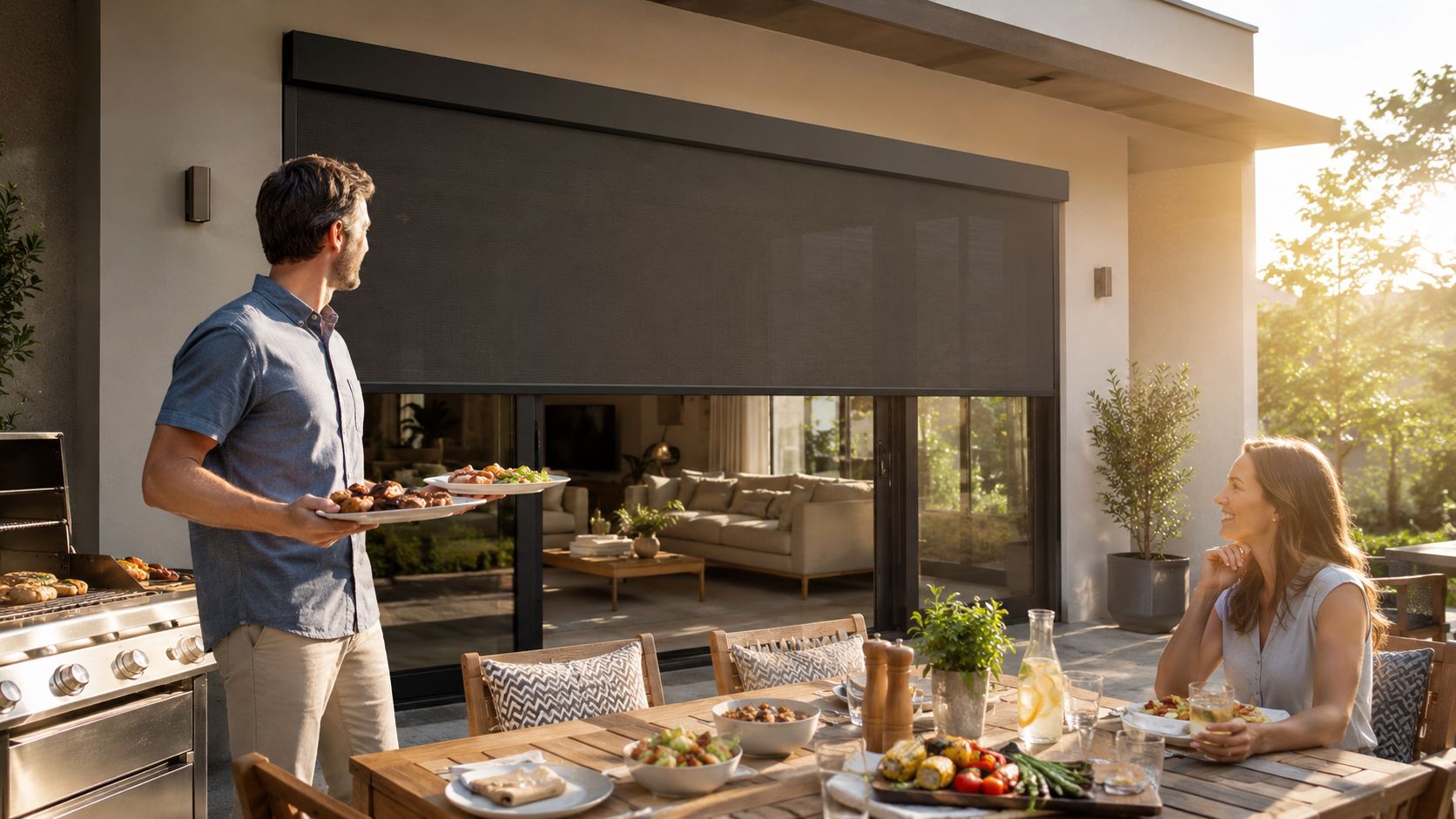
You're carrying plates outside, guests are coming through the patio door, and the late afternoon sun starts blasting straight across the room. That's the moment people stop thinking about window treatments as décor and start thinking about them as infrastructure.
With the right setup, you don't stop what you're doing. You tap a keypad, use a remote, or say a voice command through Josh.ai, and the shades move without anyone wrestling with fabric or slats.
That shift is bigger than it sounds. The broader motorized window-covering market was valued at USD 1.84 billion in 2023 and is projected to reach USD 3.92 billion by 2032, with a projected 8.78% CAGR from 2024 to 2032, driven by convenience, energy efficiency, and smart-home integration, according to this motorized shades market overview.
A sliding door is usually wide, highly visible, and used many times a day. That combination makes manual coverings feel clumsy fast. Homeowners often live with the problem longer than they should because they assume motorization is just a luxury upgrade.
It isn't, at least not as it's often understood. It's a practical fix for a difficult opening.
A lot of homeowners also compare indoor shades with exterior screening options. If you're evaluating both sides of the glass, the Sparkle Tech solar shades guide is a useful companion read because it helps clarify when outdoor solar protection makes sense versus interior shading.
Motorizing the largest glass opening in the room often changes the way the entire room is used.
For homeowners building or upgrading a connected home, this is also where shading stops being a one-off purchase and starts fitting into a broader control plan. Integrated lighting, shading, audio, networking, and voice control all work better when they're designed together, which is the reason many clients start with a broader smart home services plan rather than treating shades as an isolated project.
Convenience is the first thing people notice. It isn't the main reason many of them end up loving the system.
Value shows up every day in comfort, privacy, and how well the room holds up over time. Sliding glass doors admit a lot of light and heat. That's great when you want the view. It's not so great when glare lands directly on the TV, the sofa fabric takes the hit, or the room turns warm by mid-afternoon.
Scheduling matters more than button control. If your shades close during the brightest part of the day and reopen later, the room stays more balanced without constant manual adjustment. That's especially helpful on west-facing patio doors.
There's also a product-level tradeoff worth knowing. Industry guidance notes that vertical blinds remain popular for sliding doors, while vertical cellular shades are identified as the most energy-efficient option, and motorized controls are viewed as the safest and most convenient. That guidance appears in this discussion of sliding-door treatment options and motorized control.
If a homeowner tells me comfort is the top priority, I don't automatically steer them to the same answer I'd give a style-driven client. The right solution depends on whether the room needs thermal performance, view preservation, blackout capability, or the cleanest visual line.
There's another benefit homeowners feel but don't always name right away. The room looks calmer.
A large sliding door can dominate a space. Replacing dated blinds or uneven manual shades with a clean motorized treatment gives the wall a more finished look. It also helps with privacy at the exact times people tend to want it most, like evenings when interior lights are on.
Short version:
If you're also evaluating the door itself, not just the covering, these Superior Home Improvement patio door insights are worth reading because the door's glass, seal quality, and orientation affect how much work the shade system has to do.
A smart shade earns its keep when the room feels better before you even think about adjusting it.
For most motorized shades sliding glass doors projects, roller shades are the cleanest technical fit. They stay in a single plane, don't swing into the traffic path, and can be matched to very different privacy and daylight goals.
That matters because sliding doors punish bad choices. If the treatment interferes with the panel movement or feels bulky every time someone heads outside, it won't matter how nice it looked in the showroom.
Industry guidance identifies motorized roller shades as the most common technical fit for sliding glass doors because they provide single-plane light control without obstructing the door's path, with fabric options from sheer to blackout, as outlined in this roller shade guide for sliding glass doors.
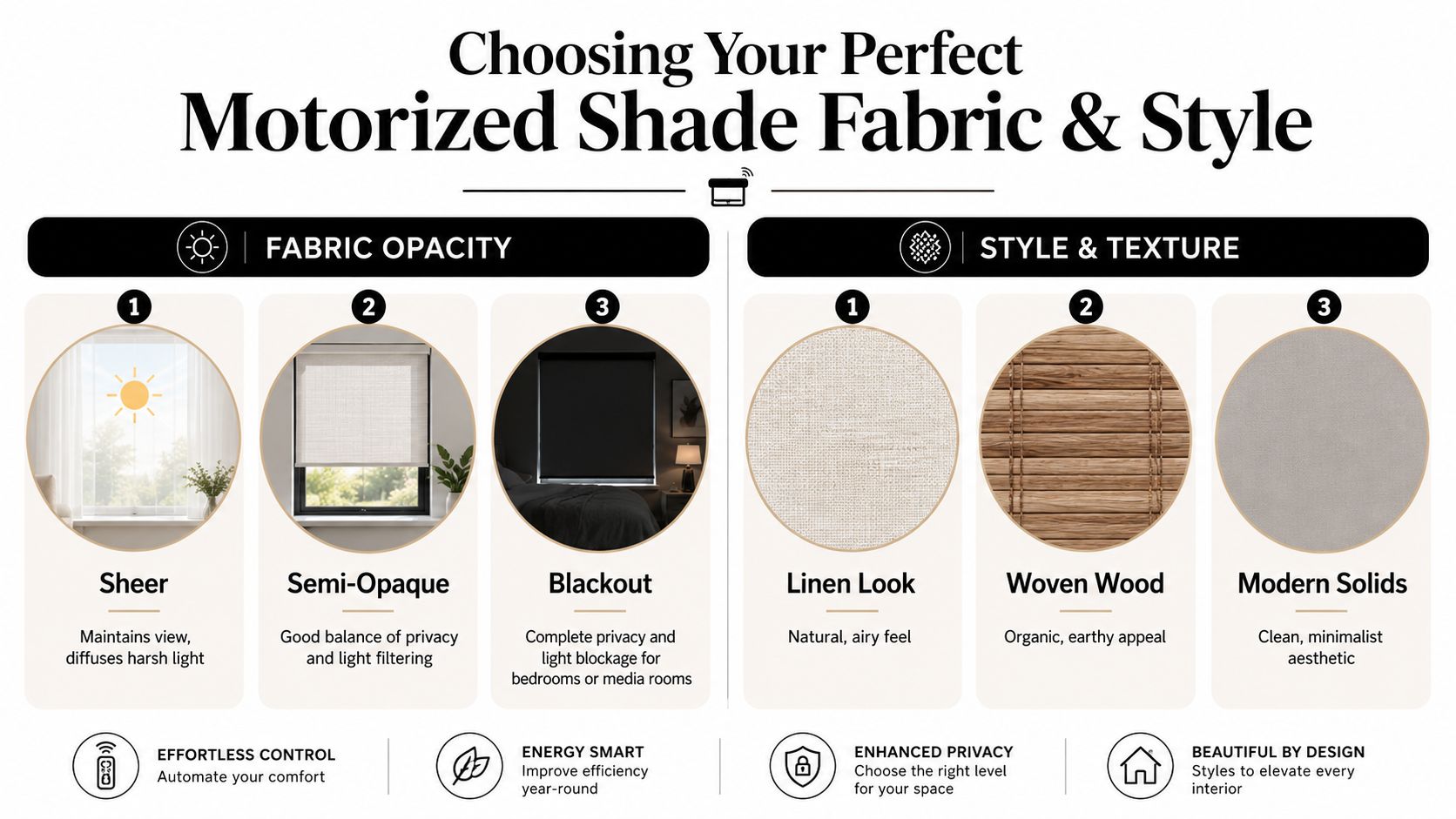
This is the choice that most directly affects how the room feels.
| Fabric type | Works well when you want | Watch for |
|---|---|---|
| Sheer | Daylight, softer glare, preserved outdoor view | Reduced nighttime privacy |
| Light-filtering | A balance of privacy and ambient light | Less view-through than many expect |
| Blackout | Maximum privacy and dark-room performance | Stronger visual presence, especially on large spans |
Sheer fabrics are excellent in living rooms where the view matters. They cut harsh sunlight without closing the room off.
Light-filtering fabrics are often the safest middle ground. They soften the room, improve privacy, and avoid the heavy look some blackout materials create on a large door.
Blackout fabrics make sense in bedrooms, media rooms, and homes where a patio door faces strong evening sun. They're also useful when the sliding door sits near a projector or dedicated viewing area.
Fabric texture changes the room more than many homeowners expect. A linen-look weave feels softer and more architectural. A smooth solid reads cleaner and more contemporary. Darker fabrics can reduce glare aggressively, but they also become a stronger visual element when lowered.
Mounting also matters.
Practical rule: On a high-traffic patio door, choose the fabric after you decide how the shade will stack, where people walk, and how often the door opens.
A lot of homeowners focus on color first. Integrators and shade professionals usually work in the opposite order. First confirm the operating layout. Then choose the fabric family. Then fine-tune color and texture.
For clients comparing engineered shade solutions and design options, Clara motorized blinds and shades are one example of how modern fabrics, clean hardware, and automation can be combined without turning the opening into a bulky mechanical feature.
Horizontal blinds are rarely the right answer for a big sliding door. They tend to feel awkward at wide spans and aren't pleasant in a space where people are constantly moving in and out.
Very decorative treatments can also become frustrating if they take up too much side stack space or require constant manual repositioning. On a patio door, function has to win first. The style should support it, not fight it.
The motor is only half the story. The power plan usually decides whether the finished system feels smooth or compromised.
Homeowners tend to ask about quietness first, and that's a good instinct. In open-concept spaces, bedrooms, and home theaters, motor noise matters. So does consistency. A shade that moves smoothly every time is more important than one with a long feature list.
Each power path has a place.
Battery-powered shades are often the easiest retrofit choice. They avoid wall surgery and work well when the home is already finished. The tradeoff is maintenance. Someone has to recharge or replace batteries, and that task usually lands on the homeowner after the novelty wears off.
Plug-in power works when there's an outlet in the right place and cable routing can stay clean. It can be a solid middle option, but visible wiring can quickly ruin the look if the opening wasn't designed for it.
Low-voltage wired shades are usually the cleanest long-term solution in new construction and major remodels. They require planning before drywall and trim are complete, but they remove the maintenance cycle and give the installer more control over the finished result.
For homeowners in the planning stage, low-voltage wiring basics help explain why prewire decisions matter so much for shades, keypads, lighting control, networking, cameras, and audio.
I usually frame it this way:
There's also a control question underneath the power question. If the shades will tie into Lutron lighting scenes, voice control, theater modes, and occupancy routines, I'd rather see the power strategy chosen with the whole control ecosystem in mind.
A family room slider and a bedroom slider don't always need the same approach. In a theater-adjacent room, for example, clients are more sensitive to motor sound, movement speed, and how abruptly the shade starts and stops.
That's where premium motor platforms earn their cost. Not because they're flashy, but because they feel composed. The opening and closing action becomes part of the room's rhythm instead of an interruption.
A motorized shade by itself is useful. A shade that coordinates with lighting, audio, video, and voice control is where the system starts feeling like a real smart home.
This is why Lutron remains such an important platform in residential integration. Its shade and lighting ecosystem gives you stable control logic, elegant keypads, and reliable scene execution. Then a voice layer like Josh.ai makes the system natural to use instead of app-dependent.
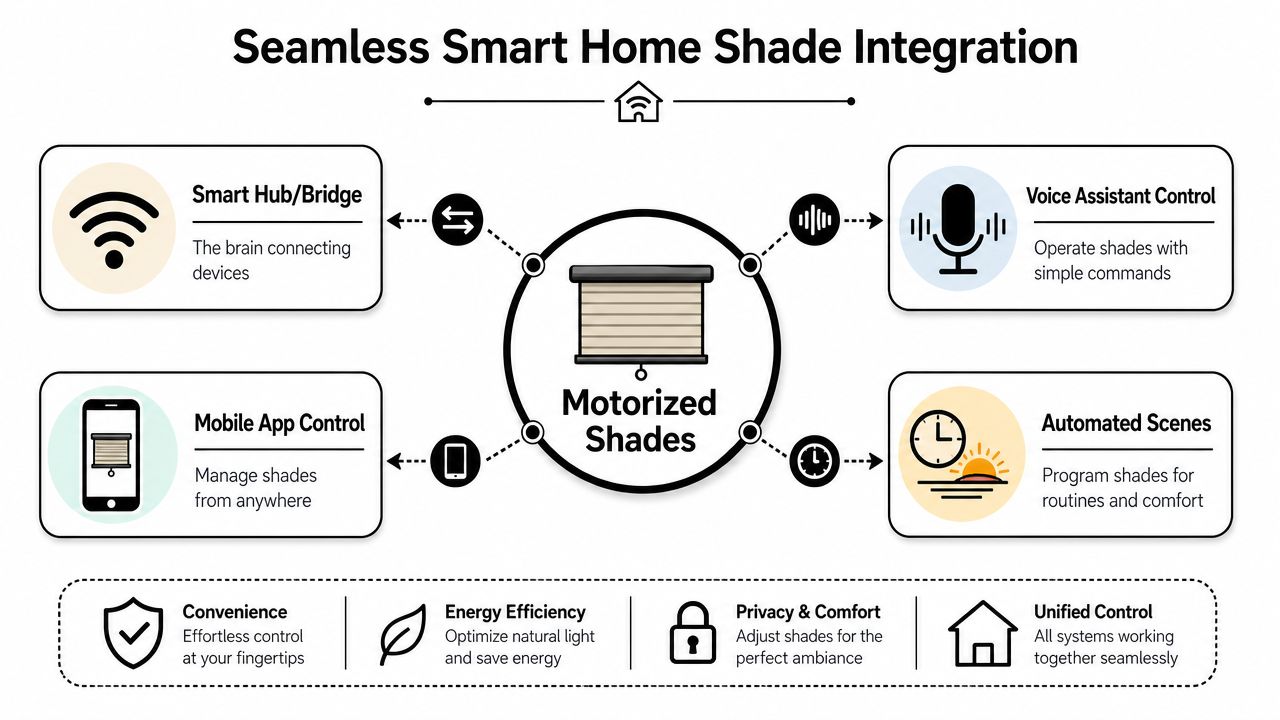
Good integration doesn't mean adding more commands. It means reducing friction.
A few examples:
A homeowner can piece together some of this with separate apps. That's not the same as integration. True integration means the room responds as one environment.
Here's a quick video that shows the idea of connected control in action:
Not every smart device belongs in a serious home system. Some products are fine alone but unreliable when you ask them to coordinate with lighting scenes, occupancy logic, theater presets, and remote access.
That's why many integrators center projects around known control ecosystems. Lutron handles lighting and shades exceptionally well. Josh.ai adds high-quality voice interaction. Strong networking from platforms such as Ubiquiti helps keep control dependable across the property. Audio platforms like Sonos fit naturally when clients want simple whole-home listening without overcomplication.
For homeowners researching connected living more broadly, this smart home setup guide is a decent general primer. Once the goals become more specific, the main task is choosing platforms that cooperate well instead of just checking feature boxes.
One example of a structured control path is Lutron and Control4 integration, where shading, lighting, and broader automation can be organized into a system rather than scattered devices.
The smartest shade isn't the one with the most app features. It's the one that disappears into a routine and works every day.
This is also where broader residential scope matters. The same planning mindset used for automated shades applies to custom home theater, new home builds, whole-home audio, networking, security, restaurant AV, outdoor lighting and sound, and exterior lighting systems. The difference is that at home, comfort and ease of use usually matter more than feature count.
Sliding door shade pricing varies quickly because the opening is large and the details matter. Fabric, width, power method, fascia, integration level, and installation conditions all change the final number.
One published benchmark puts motorized roller blinds at roughly $400 to $1,000 on average per window, with app, remote, or voice control commonly included as part of automated convenience, according to this motorized sliding glass door blinds pricing reference.
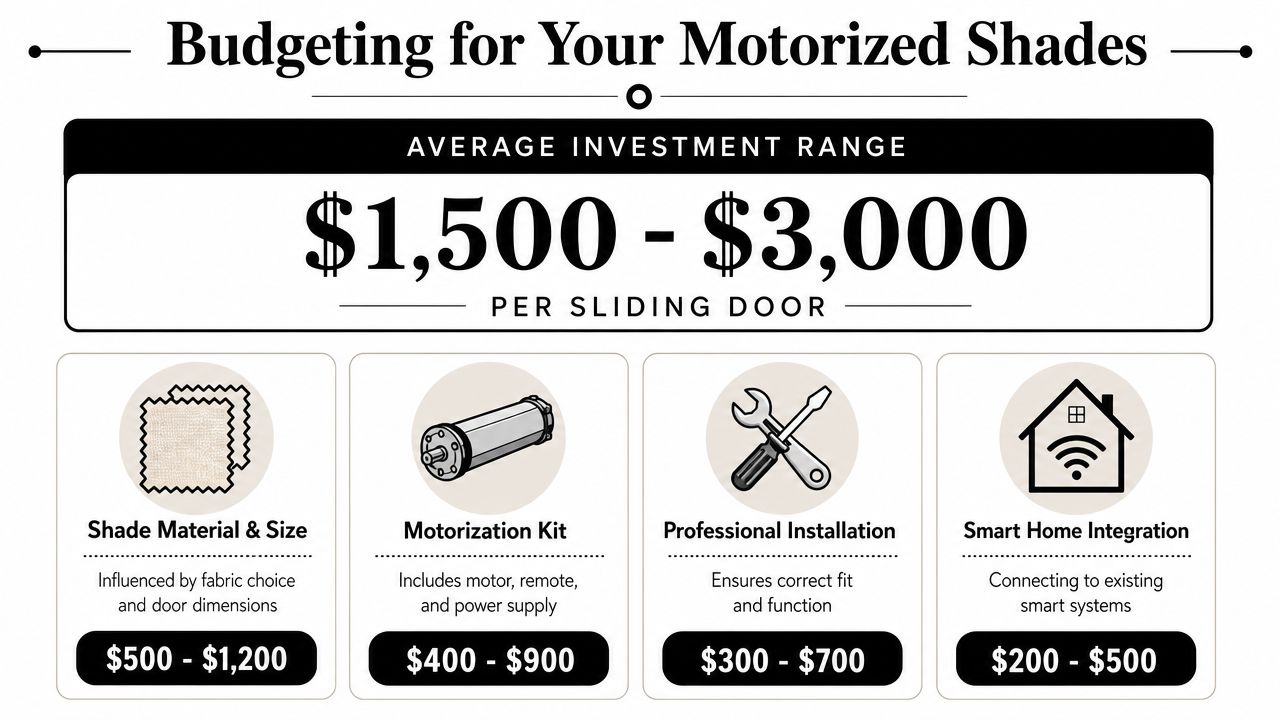
A basic motorized opening and a fully integrated premium installation are not the same project.
The final cost is usually shaped by these factors:
I usually tell homeowners to budget in layers, not one lump sum.
First decide whether you want a single motorized shade that works independently or a shade that participates in the whole house. Then decide whether this is a retrofit or part of a larger build. That distinction often matters as much as the fabric itself.
If the room already includes smart lighting, distributed audio, or theater equipment, it's worth budgeting for proper integration up front. Retrofitting the intelligence later can be done, but it's rarely as clean.
Professional installation addresses details that DIY articles often gloss over. A shade over a sliding glass door has to clear trim cleanly, stack where people are not walking, stop at the right height every time, and move in a way that does not become irritating after a week of use. Patio door guidance often points to those day-to-day usability issues, especially stack size, travel speed, and traffic flow, because those are the problems homeowners notice once the novelty wears off.
In a higher-end system, those details also have to line up with the rest of the room. A Lutron shade tied to lighting scenes or a Josh.ai voice command has to respond predictably, not just technically. If the keypad is in the wrong place, the preset is wrong for afternoon glare, or the shade closes too slowly when the sun hits the glass, the system feels unfinished even if the hardware itself is good.
The mistakes are familiar because the opening is harder than it looks:
I see this most often on retrofit projects where the homeowner bought quality products but never got the last 10 percent right. That last 10 percent is what determines whether the shades feel refined or annoying.
Wired systems raise the stakes. Low-voltage planning, bracket alignment, concealment, final programming, and testing all need to be handled together. If the house already includes Lutron lighting, centralized control, distributed audio, or Josh.ai, the shade install should be commissioned as part of that ecosystem, not treated as a standalone window covering job.
Day-to-day care is simple when the system was installed correctly. Dust the fabric with the manufacturer's recommended method. Keep the roller area and sill clear so the shade can travel without obstruction. Recharge battery-powered shades on a schedule that makes sense for the room, instead of waiting for a low-battery warning to interrupt daily use.
The longer-term piece is serviceability. Motors may need limit adjustments after settlement or trim changes. A scene may need to be updated after new furniture, new lighting, or a different daily routine changes how the room is used. Voice control often benefits from small refinements too, especially in homes where Josh.ai is handling shades, lighting, and media together.
Home AV Pros handles these projects across southern Wisconsin and nearby northern Illinois, including residential automation, automated shades, lighting control, networking, audio, theaters, cameras, and low-voltage work for new construction. That broader scope matters on sliding glass door openings because shade performance is often tied to keypad placement, Wi-Fi stability, lighting scenes, and control logic, not just brackets and fabric.
A well-installed shade system fades into the background. It opens on cue, closes when glare or privacy calls for it, and never turns the patio door into the problem.

Copyright © 2026. Home AV pros. All rights reserved.