
You're probably thinking about low voltage wiring because something in the house already feels off.
Maybe the TV wall looks great until you notice the dangling devices and cable clutter. Maybe the Wi Fi works fine in the kitchen but drops in the back bedroom. Maybe you want music in more than one room, lights that respond the same way every time, and a home theater that feels polished instead of pieced together. Those problems usually don't start with the apps or the gear. They start with the wiring plan behind the walls.
In a modern home, low voltage wiring is the central nervous system. It carries the signals that make networking, audio, video, lighting control, cameras, and automation work together. It's different from the standard electrical wiring that powers outlets and appliances. This layer is built for communication, control, and clean integration.
That matters more now because connected homes aren't a niche project anymore. The global low voltage cable market was valued at $158.9 billion in 2022 and is projected to reach $278.7 billion by 2032, according to Allied Market Research's low voltage cable market release. Homeowners feel that shift every time they expect uninterrupted streaming, strong whole-home Wi Fi, smart lighting scenes, and reliable voice control.
A lot of homeowners first notice low voltage wiring only after they've already bought nice equipment.
They install a Sonos system and realize one room drops out. They add a couple of smart switches and then decide they really want Lutron keypads, automated shades, and lighting scenes that feel consistent. They put a TV over the fireplace and then wonder where the streaming box, soundbar connections, and network feed are supposed to go. The gear is visible. The underlying issue usually isn't.
When someone asks, “What is low voltage wiring?” they're usually asking a more practical question.
They want to know why one home feels effortless while another feels like a stack of gadgets. In the first home, the network has proper access point locations, the media wall has planned cable paths, the speakers have home runs where they belong, and the control system was considered before drywall went up. In the second, every new upgrade turns into another patch.
Low voltage wiring doesn't make a home feel smart by itself. It makes all the smart systems behave like they were meant to live together.
That's why this work sits underneath so many premium experiences. A stable wired backbone helps Ubiquiti access points deliver better coverage. It gives Sonos products a stronger network foundation. It lets Lutron lighting and shade systems communicate cleanly. It gives Josh.ai a dependable path to the devices it controls.
The mistake I see most often is treating low voltage as an add-on. It isn't.
If the wiring plan starts late, you end up compromising on speaker placement, keypad locations, TV walls, camera positions, rack space, and outdoor coverage. If it starts early, the house can support hidden speakers, clean theater wiring, discreet wireless access points, reliable cameras, and exterior systems like outdoor lighting and sound without the usual visual clutter.
For homeowners building or remodeling, that's the principal value. Low voltage wiring gives you the hidden structure that lets the home look simple on the surface.
Most definitions stop too early.
Technically, low voltage wiring is generally treated as wiring below higher line-voltage levels, and many home and AV explainers use a practical threshold of about 50 volts for structured cabling, controls, security, and data systems. Some technical specifications also classify low-voltage conductors and cables at 600 V and below, depending on the application and standard. For a homeowner, though, that voltage number isn't the most useful part.
What matters is that low voltage wiring is an umbrella term for structured cabling, security, AV, networking, and control systems, and success depends more on system design and pathway planning than on the voltage label itself, as explained in Tailwind Voice & Data's overview of low voltage wiring.
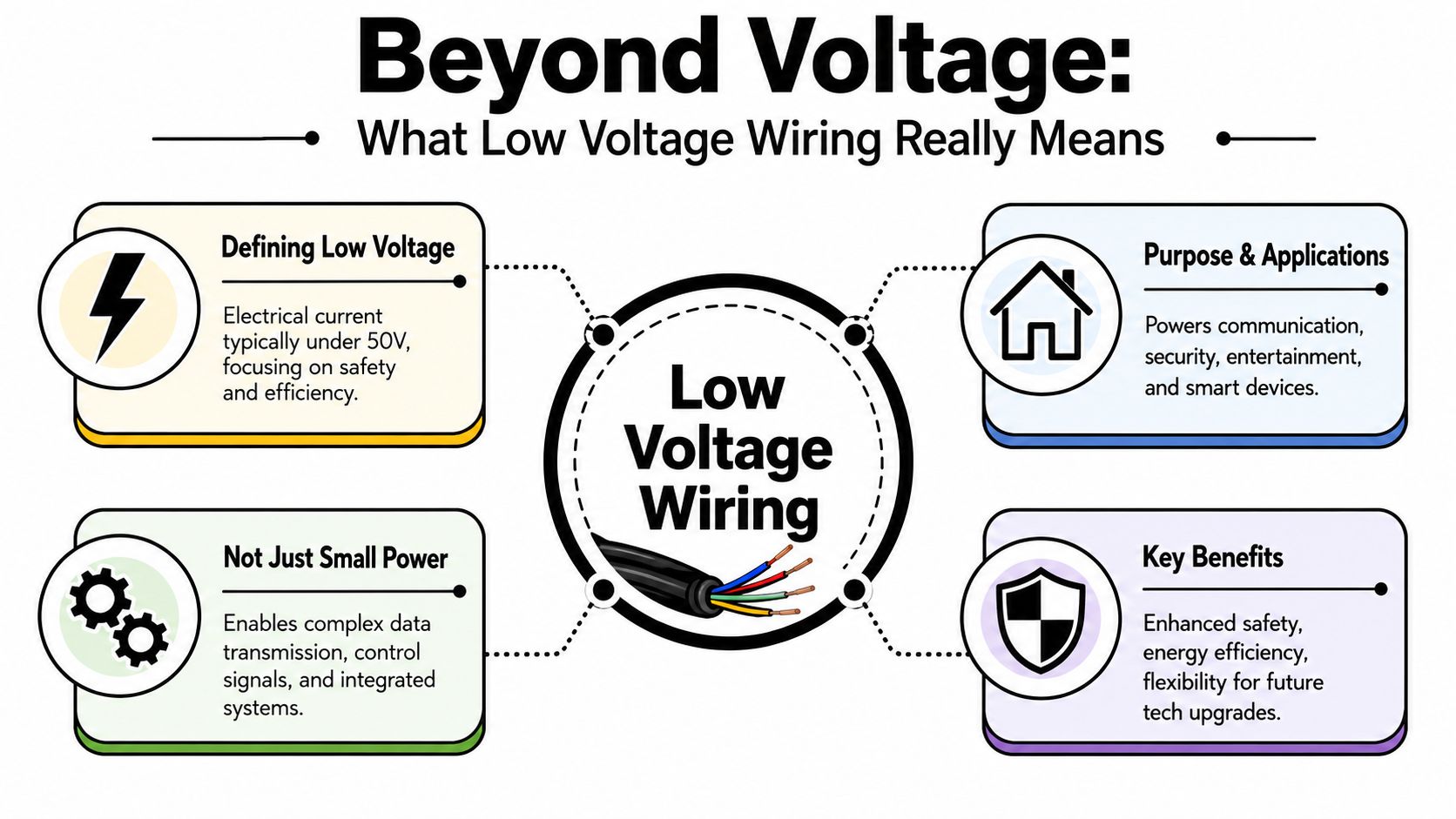
The simplest way to think about it is as a highway system inside your home.
You don't just run cable to wherever a contractor happens to be standing that day. You plan a central location for networking and AV gear, decide where signals need to go, choose the right pathways, and make sure future additions won't require opening finished walls. A house with good low voltage design has routes, endpoints, service loops, labeling, and room to grow.
That's why two homes can both have “smart devices” and perform very differently. One has a structured system. The other has scattered products.
If you're trying to understand what low voltage wiring means in real life, focus on these pieces:
A helpful companion read for the electrical side of the topic is this guide to VDC for automation engineers. It's useful if you want more context on how low-voltage direct current shows up in control and automation environments.
Practical rule: If the system needs to communicate, coordinate, stream, trigger, or report back, low voltage wiring is usually part of the conversation.
And one detail gets missed all the time. Even if the cable itself is correct, poor labeling, weak terminations, and skipped testing can still leave you with an unreliable system.
The reason homeowners care about low voltage wiring isn't the cable itself. It's what the cable enables.
Smart homes have moved from isolated products to integrated environments, and that's one reason market analysts estimate the low voltage wire market at $145.7 billion in 2024 and project it to reach about $302 billion by 2034, according to GM Insights' low voltage wire and cable market analysis. In residential work, that growth shows up as more demand for networked AV, lighting control, cameras, outdoor systems, and voice-driven automation.
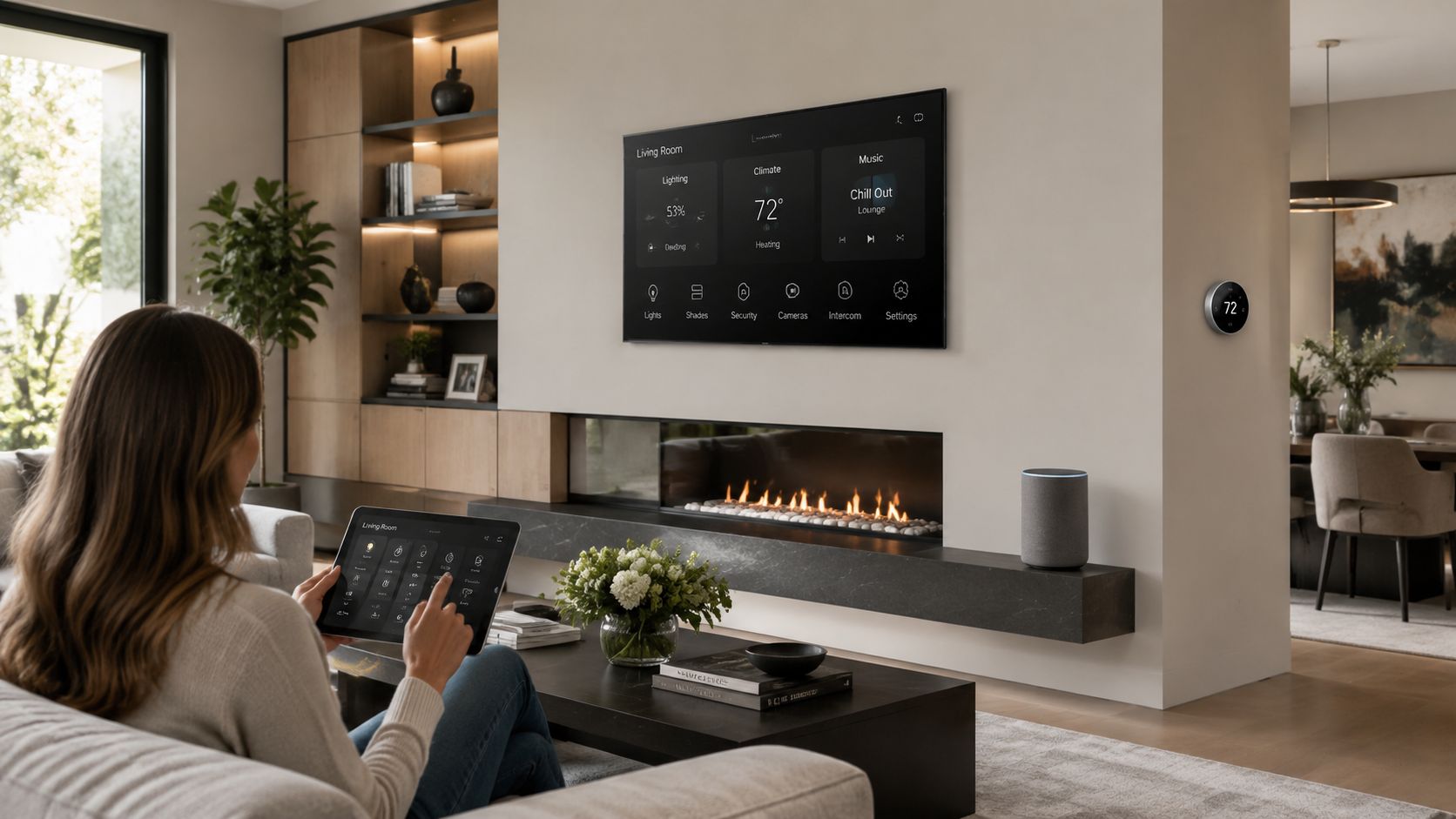
A Ubiquiti Wi Fi system works best when access points are hardwired back to the network instead of depending on weak wireless hops. That gives you stronger coverage, cleaner roaming, and a better experience for streaming, gaming, video calls, and automation traffic.
A Sonos whole-home audio setup gets much easier to design when speaker wire, network drops, and equipment locations are planned early. In-ceiling speakers tied to Sonos Amps don't happen neatly by accident. They happen because the prewire accounted for room layout, speaker placement, and rack space.
Lutron systems depend on thoughtful keypad locations, shade wiring where needed, and a design that respects how people move through the home. The difference between “smart lighting” and a polished lighting system is usually in the planning. One feels like an app. The other feels architectural.
Then there's Josh.ai. Voice control sounds simple to the user, but the experience only feels premium when the rest of the infrastructure is dependable. If the lighting, shades, media devices, and network aren't solid, the assistant gets blamed for problems it didn't create.
A dedicated theater or media room puts even more pressure on the wiring plan. Kaleidescape systems, surround sound, hidden subwoofers, control processors, display connections, and networking all need proper infrastructure if you want the room to perform cleanly and still look finished.
Outdoor spaces are the same story. Oelo lighting, exterior audio zones, weather-aware control, and outdoor speakers all rely on pathway planning and the right cable choices. If you're exploring exterior projects, this overview of low voltage landscape lighting options helps show how the wiring side affects the final result.
Security is another area where homeowners benefit from a wired-first mindset. Many modern cameras use network cabling and are much more reliable when they aren't left to spotty wireless coverage. If you're comparing camera layouts or trying to understand setup basics, this practical guide on how to set up an IP camera gives useful context.
A short visual example helps show how these systems come together in real rooms.
Here's what tends to work well in homes:
What doesn't work is treating every device as a one-off purchase. Homes become harder to manage when music, lighting, cameras, TVs, and automation all get installed as separate islands.
Once you know what low voltage wiring is doing in the house, the next question is what cables make up the system.
Homeowners don't need to memorize every spec sheet, but they should understand that different systems need different cable types. Low voltage isn't one cable. It's a family of cables chosen for data, video, audio, control, and power delivery.
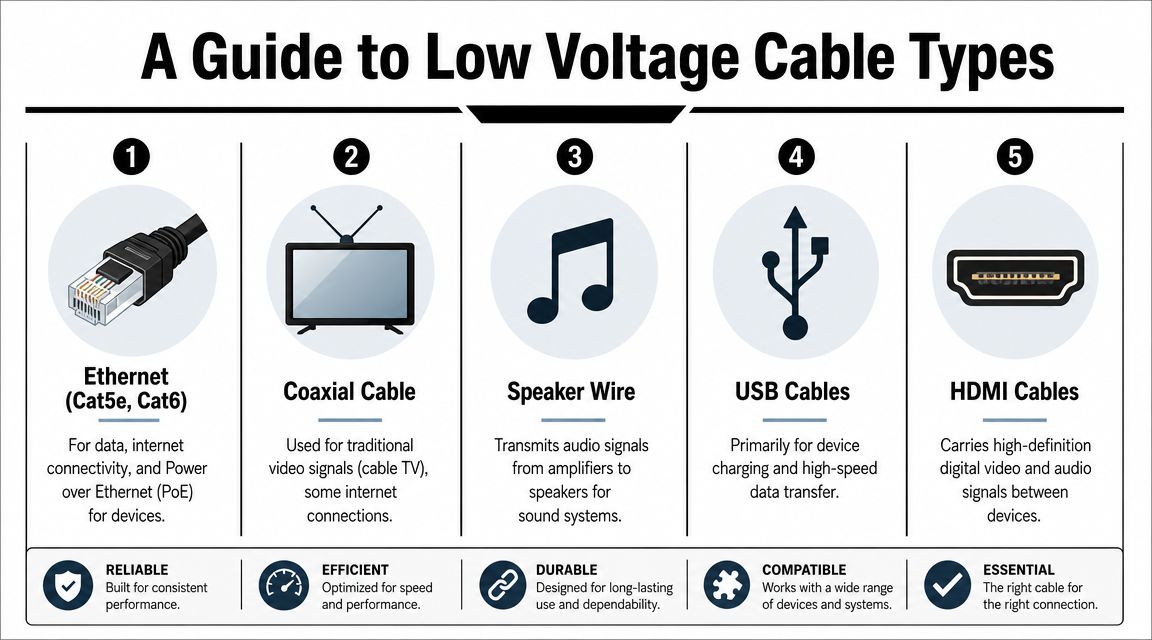
Ethernet cable is the workhorse for networks. It handles internet distribution, wired device connections, many camera systems, and the backbone for wireless access points. In a smart home, this is usually the cable you wish you had more of.
Coaxial cable still matters in some homes. It's often used for cable service feeds, some internet handoffs, and certain video applications. Even if a home streams most content, a coax run in the right place can still be useful.
Speaker wire carries audio from amplifiers to speakers. That matters for in-ceiling speakers, patio audio, theater surrounds, and whole-home music zones. Good placement and the right gauge matter more than fancy marketing language.
HDMI and USB cabling also show up in residential AV, though they're usually part of local device connections rather than full-home backbone wiring. They still need planning at media walls, desks, theater racks, and display locations.
| Cable Type | Primary Use | Key Consideration |
|---|---|---|
| Ethernet | Data, networking, cameras, access points | Reliable bandwidth and device connectivity |
| Coaxial Cable | TV and some service feeds | Service provider compatibility and pathway planning |
| Speaker Wire | Audio from amp to speakers | Run length and speaker location |
| USB Cables | Device charging and local data transfer | Connection distance and device type |
| HDMI Cables | Digital audio and video between devices | Signal path and equipment placement |
For homeowners thinking about cameras, PoE often comes up quickly because it can carry both power and data over one network cable. This explainer on what a PoE security camera is is a useful next step if that's part of your project.
Not all low voltage cable is built for the same environment. In power-distribution applications, low-voltage cable systems commonly use 0.6/1 kV rated cable with PVC or XLPE insulation, and those insulation choices affect resistance to heat, moisture, and physical damage, as outlined in this low-voltage cable specification document.
That principle carries over to residential planning. In-wall cable rating, outdoor suitability, and pathway conditions all matter. So does conductor quality. For reliability, solid copper conductors are the safer bet for structured cabling and long-term performance.
The cable you can't see still determines whether the system feels expensive or frustrating.
A clean low voltage system isn't just about choosing the right cable. Installation quality decides whether that cable performs the way it should.
I've seen homes with good products fail because the prewire was rushed. I've also seen modest systems perform beautifully because the installer respected pathways, bend radius, separation, labeling, and testing. That's the difference between pulling wire and building infrastructure.
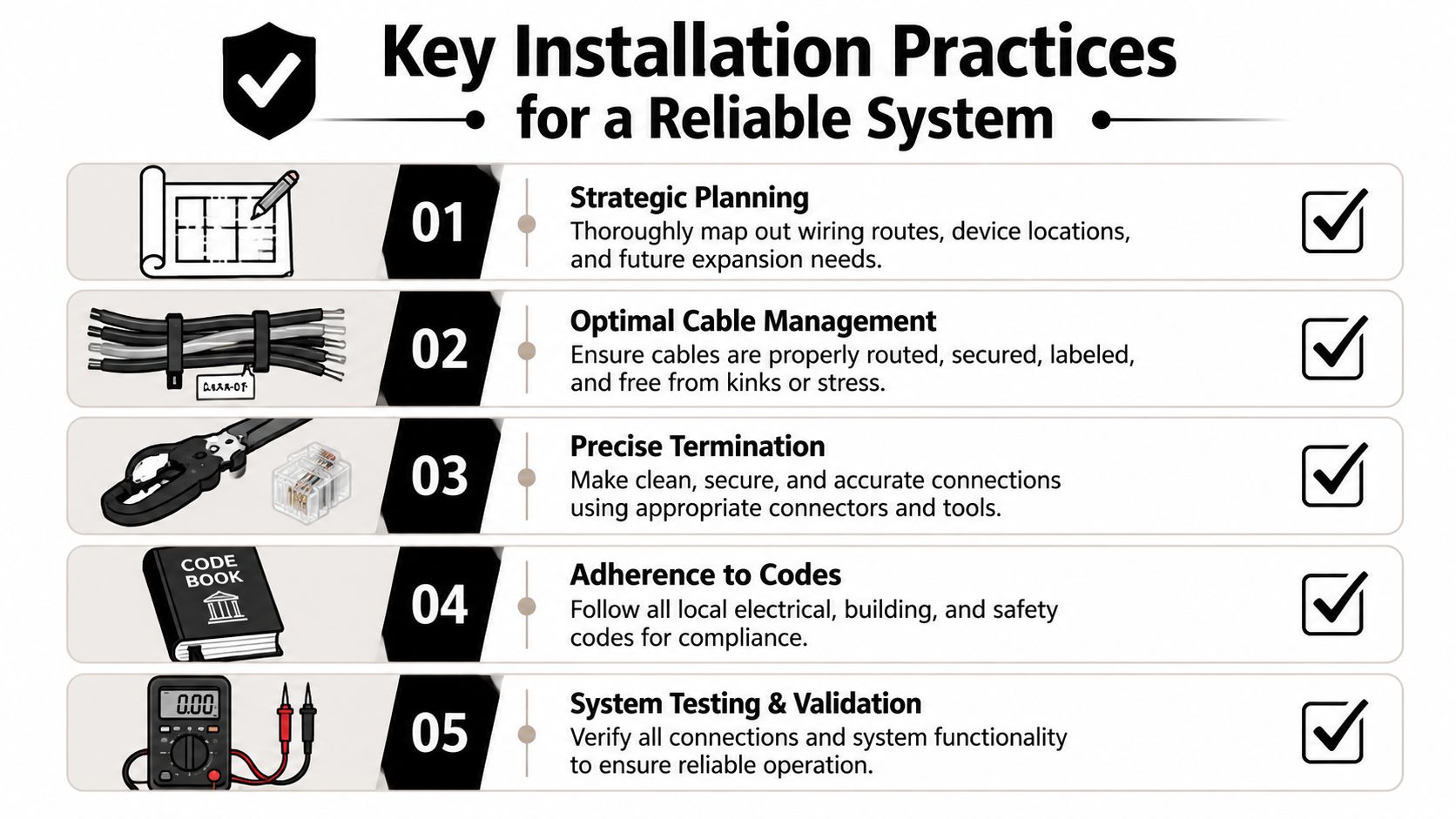
The first sign of a good installation is planning before the pull. Device locations are mapped, pathways are chosen, and future upgrades are considered. That often means extra conduit, spare cable routes, and service access where it will matter later.
The second sign is physical discipline during the install. Cables are supported properly, not crushed behind brackets or stretched through framing. Terminations are neat. The rack or panel layout makes sense. Labels are readable by the person who has to service the house years later.
Good low voltage work should make future service easier, not harder.
The most common problems are rarely dramatic. They're basic mistakes:
Voltage drop is another issue professionals watch closely, especially on longer runs. One building specification notes that low-voltage conductors are often 12 AWG minimum, and for circuits over 100 ft, the wire may need to be upsized to 10 AWG to reduce resistance and avoid issues like dimming or signal loss, according to this low-voltage electrical power conductor specification.
Exterior systems often expose bad planning faster than interior ones. Outdoor lighting, gate devices, cameras, and outdoor speakers deal with moisture, distance, temperature swings, and physical wear.
If you're handling decorative exterior fixtures, this primer on how to set up outdoor post lights is helpful for understanding placement and fixture considerations. For a broader view of cabling and layout around exterior lighting systems, this guide to how to wire low voltage lighting connects the wiring side to the finished result.
A professional install usually includes these habits:
That's what keeps a smart home from becoming a troubleshooting project.
Some low voltage jobs are straightforward enough for a capable DIY homeowner. Running a single speaker wire in an unfinished basement is one thing. Designing the full low voltage backbone for a new build is something else.
When the project includes networking, Wi Fi access points, distributed audio, lighting control, security cameras, TV locations, shade integration, and automation, the challenge isn't the act of pulling cable. It's coordinating all the systems so they work together cleanly, look intentional, and stay serviceable.
A good low voltage professional should be able to show more than a list of products.
Look for:
One option for homeowners comparing firms is this page for low voltage wiring contractors near me. It's relevant if you're trying to understand what a residential low voltage scope can include in new construction, retrofits, and integrated AV work.
Professional help usually makes the biggest difference in projects like these:
Home AV Pros handles those kinds of residential-first projects, including custom home theaters, new home builds, restaurants, home audio solutions, and outdoor lighting and sound. That kind of scope matters because the house works better when one team understands how the entertainment, network, control, and lighting layers fit together.
Sometimes. It depends on where you live and what the system does.
Simple speaker, networking, or media wiring may be treated differently from systems tied to security, fire, or life safety. Local code and inspection practices decide that. If the work touches regulated systems, permit requirements are more likely. A qualified integrator should check those requirements before the job starts.
Yes. It's usually easier in new construction, but retrofit work happens all the time.
Existing homes just require better route planning and more care. Installers may fish walls, use attic and basement access, work around insulation and framing obstacles, and choose device locations that minimize disruption. The goal is to add infrastructure without making the house look like it was opened up for it.
It can improve marketability and future-readiness.
Most buyers may never ask what cable category is in the walls, but they do notice strong Wi Fi, clean TV installations, whole-home audio, integrated lighting control, camera coverage, and a home office that works properly. A structured system supports those outcomes. Even when it isn't the headline feature, it often helps the house feel more current and more usable.
If you're planning a smart home, theater, whole-home audio system, or outdoor lighting project, Home AV Pros can help you build the wiring backbone before the walls close and the compromises start.

Copyright © 2026. Home AV pros. All rights reserved.