
A lot of well-designed homes disappear at night.
The stonework, the mature trees, the layered greenery, the walk to the front entry, the patio where everyone gathers. After sunset, all of that detail can flatten into darkness unless the lighting is planned with the same care as the architecture. That's usually the moment homeowners start looking at outdoor lighting installation differently. It stops being a line item and starts becoming part of how the property feels to live in.
The category itself reflects that shift. The global outdoor lighting market was valued at USD 15.03 billion in 2022 and is projected to reach USD 64.50 billion by 2032, while the U.S. accounted for 26.9% of global revenue in 2024 and is projected to grow from USD 3,550.4 million in 2024 to USD 5,422.0 million by 2030 according to Fact.MR's landscape lighting market analysis. That's not a niche upgrade. It's a major home improvement category, especially for homeowners who already care about outdoor living, security, and presentation.
A familiar pattern shows up on higher-end homes. The owner has already invested in the things people notice in daylight. Clean rooflines, thoughtful plantings, a defined front approach, maybe a pool, outdoor kitchen, or covered porch. Then the sun goes down, and the property loses depth.
Professional outdoor lighting fixes that, but not by blasting everything with brightness. Good design reveals the home selectively. It gives the facade shape, guides guests to the entry, adds quiet visibility around steps and transitions, and makes the yard usable later into the evening. It also changes how the home feels from inside. Looking out through the windows at night should feel composed, not blacked out.
That matters even more when lighting is part of a connected home. A proper system can work with your schedules, voice control, and broader home automation platform so the exterior behaves like the rest of the property. Instead of a timer and a few random fixtures, you get an outdoor layer that belongs with the architecture and technology stack. If you want examples of what that looks like in practice, modern landscape lighting systems show how exterior lighting can be designed as part of a larger residential environment.
A beautiful yard can look expensive in daylight and unfinished at night. Lighting is what closes that gap.
For homeowners in Wisconsin and northern Illinois, that's often the primary goal. Not flashy effects. Not a casino glow. Just a home that still looks like itself after sunset.
Good design starts with the nighttime view you want to create. The fixture choice comes later.
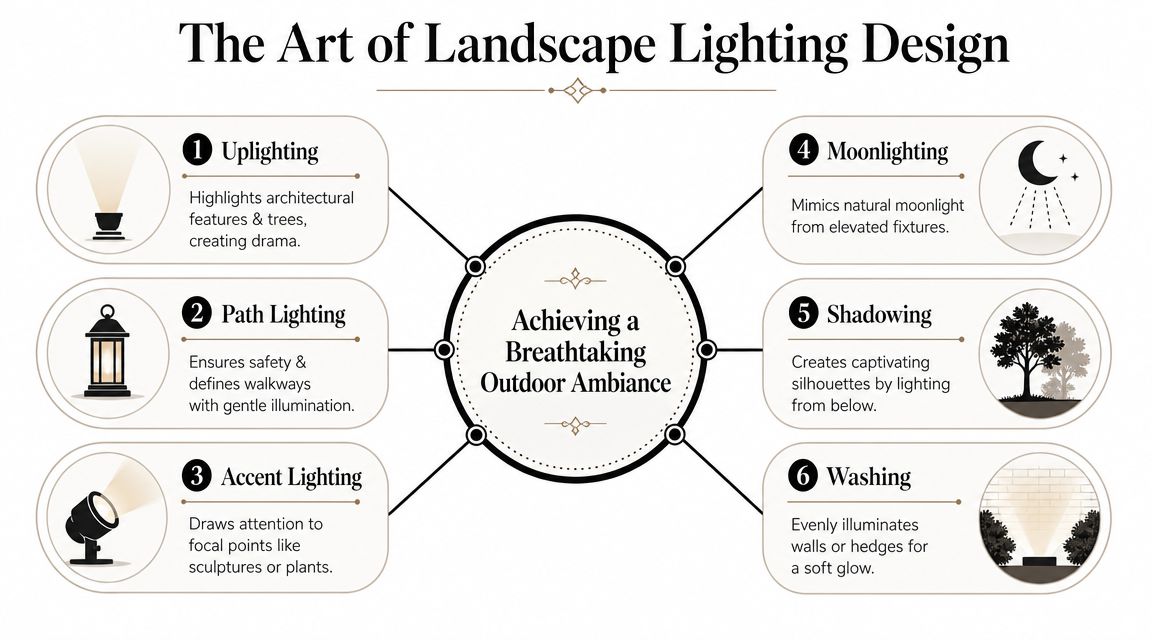
A well-lit exterior reads in layers. The entry should feel easy to approach. Architectural details should stay visible without harsh glare. Trees, planting beds, and gathering areas should have depth, not random bright spots. That kind of result comes from beam spread, setback, mounting location, and aiming angle being chosen for each surface and sightline.
In higher-end homes, design also has to account for how the system will behave inside the automation platform. A front arrival scene, a patio entertaining scene, and a late-night security scene should each feel intentional. That means the lighting plan is doing two jobs at once. It has to look right on the property, and it has to break into controllable zones that make sense in Lutron or Josh.ai.
Path lighting should guide movement without turning a walkway into a row of visible bulbs. Spacing, fixture height, and beam control matter more than fixture count. A professional layout creates overlapping pools of light so steps, edges, and transitions stay readable from the drive, the walk, and the windows.
Accent lighting gives the eye a destination. That might be a specimen tree, a fountain, a piece of stonework, or a sculptural plant form. The trade-off is restraint. Too many accents flatten the composition and make the whole yard feel busy.
Uplighting adds height and structure after dark. It works well on trees, columns, and strong vertical elements, but only when the beam angle matches the subject. A mature oak needs a different approach than a small ornamental near the entry. Placement also affects maintenance. Fixtures buried too close to roots or mulch beds are harder to service and easier to misalign over time.
Facade lighting gives the house presence from the street. The goal is even illumination that reveals texture and depth. Poor placement creates scallops, hot centers, and glare at eye level. Good placement makes the home look composed without calling attention to the source.
| Design choice | What works | What usually fails |
|---|---|---|
| Path layout | Gentle spacing and overlapping pools of light | Fixtures packed too tightly |
| Tree lighting | Beam angle matched to canopy and trunk size | One narrow spot trying to light the whole tree |
| Facade lighting | Aimed to reveal texture and depth | Fixtures too close, causing scallops and glare |
| Feature lighting | One clear focal point per view | Too many competing highlights |
Practical rule: If the source grabs your attention before the effect does, the aiming, placement, or shielding needs work.
Scale changes the whole plan.
Larger homes usually benefit from fewer fixture locations than homeowners expect, but each one has to be selected and aimed with more care. A broad wall may need controlled washing in some areas and tighter accenting in others. Mature plantings create the same issue. What looked balanced when the tree was young can look badly underlit or overly bright a few years later.
This is also why wiring layout should support the design from the start, especially if scenes and future expansion are part of the brief. A cleaner zoning plan makes it easier to separate the front approach from rear entertaining areas, or architectural lighting from late-night pathway lighting. If you want to see how the electrical side supports that design intent, this guide on how to wire low-voltage lighting correctly explains the planning decisions that keep output consistent across the property.
The best question to ask during design is simple. What should the home look like from the street, from the main interior rooms, and from the outdoor seating areas once the lights come on? That answer drives fixture selection, placement, zoning, and how the system will feel in daily use.
A polished nighttime look depends on far more than fixture style. The parts you barely notice in daylight usually determine whether the system still performs properly five years from now.
Most residential exterior lighting uses low-voltage distribution for good reason. It gives more freedom in fixture placement, keeps service work manageable, and supports phased expansion. Those benefits only hold up when the transformer, cable, connections, and circuit layout are designed together, with room for future control zones and smart-home integration.
The transformer sets the foundation. It has to be sized for the actual connected load, not a rough guess, and it should be mounted where a technician can service it without dismantling half the planting bed. Good placement also leaves capacity for added zones later, which matters if the lighting plan will eventually tie into Lutron scenes or voice control through Josh.ai.
The fixtures shape both the visual result and the maintenance schedule. Housing material, lens clarity, gasketing, and mounting hardware all affect how well each unit handles moisture, soil chemistry, freeze-thaw cycles, and routine re-aiming. Lower-grade fixtures often look acceptable at first, then start showing corrosion, water intrusion, or loose aiming points much sooner than expected.
The wire and connectors are where many outdoor systems start to fail. Long runs, overloaded branches, and sloppy splices lead to dim fixtures, uneven output, and repeat service calls. That is why experienced installers plan by load and distance instead of stringing fixtures together wherever it seems convenient.
Consistent light output matters. A path light or accent fixture at the far end of a circuit should not look noticeably weaker than one close to the transformer.
That requires matching wire gauge to both distance and wattage. A 120-watt load over a 75-foot run is generally manageable with 12-gauge cable, according to VOLT Lighting's planning guidance. Longer runs or heavier loads often call for thicker wire, shorter branch lengths, or a different circuit layout to keep output even.
Homeowners usually notice the symptom before they know the cause. One area looks soft, another looks harsh, and the whole property feels less deliberate than the design intended.
If you want a plain-English explanation of the wiring decisions behind that performance, this guide to low-voltage lighting wire planning covers the basics before trenching starts.
Homeowners usually judge the fixture. Installers judge load balance, voltage drop, and service access. The second group protects the first.
Professional work accounts for the second visit, the seasonal adjustment, and the control upgrade that comes later. That is what keeps the system looking intentional instead of improvised.
A lighting system with a timer is functional. A lighting system tied into the rest of the home is something else entirely.
A substantial upgrade occurs when exterior lighting installation becomes part of a broader control experience. Exterior lights can respond to time of day, occupancy patterns, entertaining routines, audio zones, voice commands, and security events. That's where platforms like Lutron and Josh.ai make sense. They don't just turn lights on and off. They organize the property into scenes that fit how the home is used.
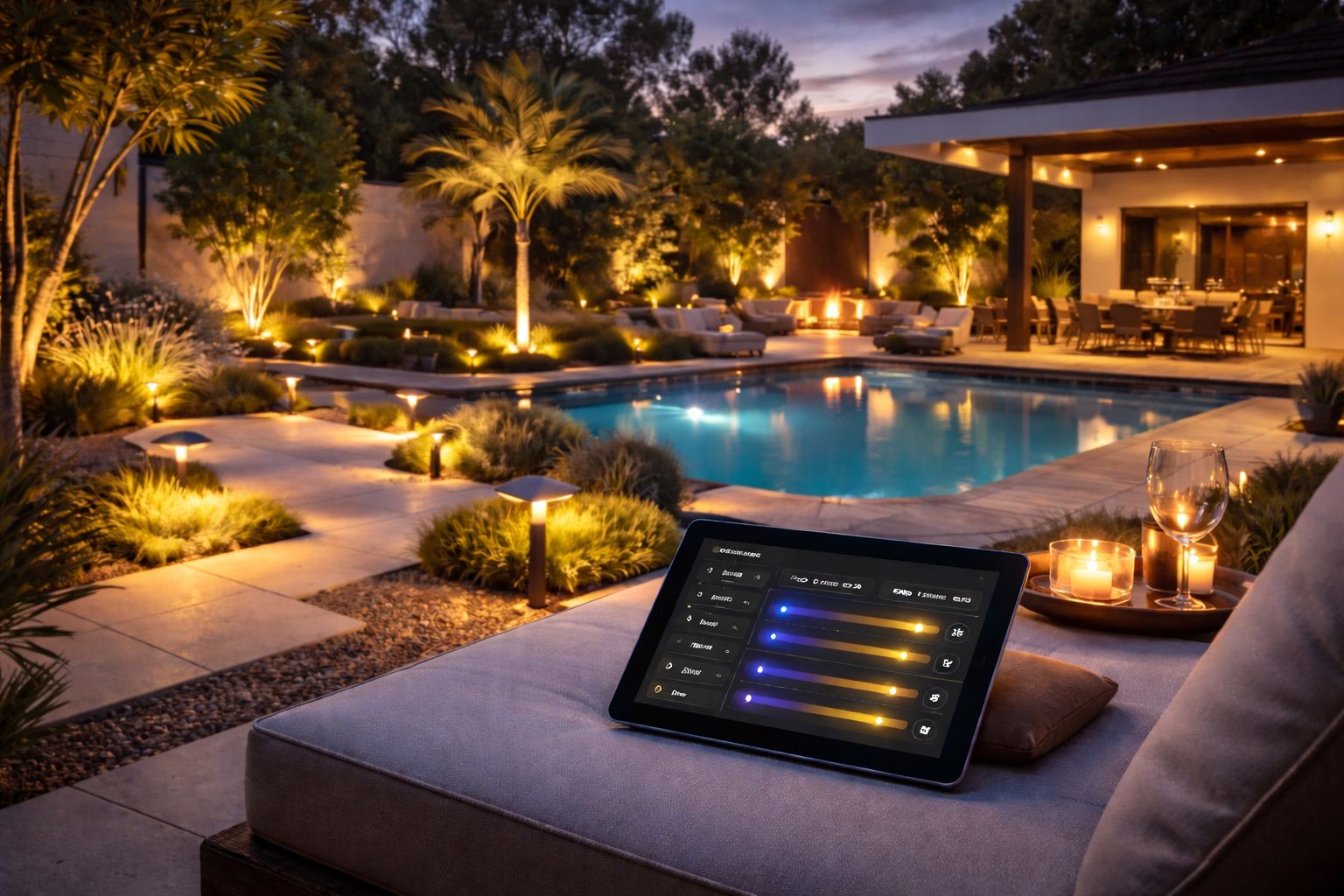
One of the biggest mistakes in outdoor lighting is treating every fixture as if it should behave the same way all night.
That's not how people live. The front approach might need a polished arrival scene at dusk. The backyard might need a softer dinner scene later. A late-night mode may leave only key pathways and architectural lighting active. A security response can temporarily raise selected zones when cameras or doorbells pick up motion.
Here's what that can look like in a connected home:
For homeowners exploring connected control, smart home lighting automation options show how lighting fits into larger whole-home programming.
Outdoor spaces feel fragmented when every system is separate. That's why integrated projects often pair lighting with Sonos for patio and yard audio, Oelo for permanent architectural and holiday lighting, and indoor platforms such as Lutron, Josh.ai, and even media ecosystems that include Kaleidescape inside the house. The point isn't to automate everything for its own sake. It's to remove friction.
A homeowner shouldn't need one app for lights, another for speakers, another for seasonal color, and another for security logic if those spaces are meant to function together.
One practical example is a property where the back terrace, outdoor lighting, and outdoor audio all respond to a single command. Another is a home where exterior lighting scenes match the interior mood once the shades lower and evening routines begin. That's where a residential integrator can tie the pieces together. Home AV Pros handles this kind of work as part of broader home automation, whole-home audio, theater, new build, restaurant, and outdoor system projects, but the strongest applications remain in the home where daily-use scenes matter most.
A quick overview of integrated control helps make the concept concrete:
Good automation doesn't add complexity. It hides complexity behind a scene that feels obvious to use.
You walk the property at dusk, the architecturally interesting areas are obvious, and the weak spots are obvious too. The front entry disappears, the side path feels flat, and the patio has no real evening identity. A professional installation process fixes those problems in a planned order, with enough coordination to make the finished system look intentional and operate cleanly with the rest of the home.
Home AV Pros approaches this work as part design exercise, part infrastructure job, and part control programming. The fixture itself is only one piece. The result depends just as much on cable routing, transformer sizing, nighttime aiming, and whether the system will later tie into Lutron keypads, Josh.ai voice commands, or broader evening scenes across the house.
On-site consultation
The first visit defines use, not just appearance. Entry lighting, entertaining areas, pool visibility, security response, and after-dark curb appeal each call for a different mix of beam control, fixture placement, and automation.
Layout and fixture selection
Beam spread, output, finish, and mounting position get matched to walls, trees, paths, steps, and seating zones. Good design usually uses fewer fixtures than homeowners expect, but each one has a clear job.
Infrastructure planning
Transformer location, voltage drop, branch loading, burial paths, and service access are mapped before installation starts. On established properties, this step matters because mature planting, irrigation, masonry, and existing wiring leave little room for guesswork.
Installation and aiming
Daytime installation sets the hardware. After-dark adjustment shapes the final result. That is where glare gets reduced, facade textures get balanced, and focal points stop fighting each other.
Programming and handoff
Integrated projects finish with scene setup and testing. A single command can trigger exterior lighting, patio audio, and select interior settings together, which is a very different result from a timer-based system that operates in isolation.
Cost follows scope, fixture quality, and control complexity. A front walk and entry package is one kind of job. A full-property system with tree lighting, architectural grazing, patio zones, and smart-home scene integration is another.
A professional U.S. installation costs about USD 3,500 on average, with most homeowners spending USD 2,000 to USD 6,000, according to Angi's outdoor lighting cost guide. The same guide notes smaller systems can start around USD 800, while larger custom designs can reach USD 10,000. It also lists typical fixture costs at USD 100 to USD 500 per fixture and labor commonly at USD 50 to USD 100 per hour.
Those ranges widen quickly once the project moves beyond basic illumination. Brass or copper fixtures cost more up front but usually age better and hold up longer than cheaper housings. More zones, tighter beam control, and cleaner dimming also raise the price, but they usually improve the result more than adding to the fixture count.
The right questions are practical ones. How are cable runs protected? Where is future service access? How much nighttime adjustment is included after first power-up? Those answers usually tell you more about long-term value than fixture count alone.
A lighting system should still look intentional after plant growth, seasonal yard work, and a few years of weather.
That usually comes down to serviceability. Beds change. Irrigation crews trench. Freeze-thaw movement can shift fixture angles by small amounts that become obvious at night. If cable, aiming, and access were treated as afterthoughts during installation, the result slowly drifts away from the original design and from the scenes programmed into the rest of the home.
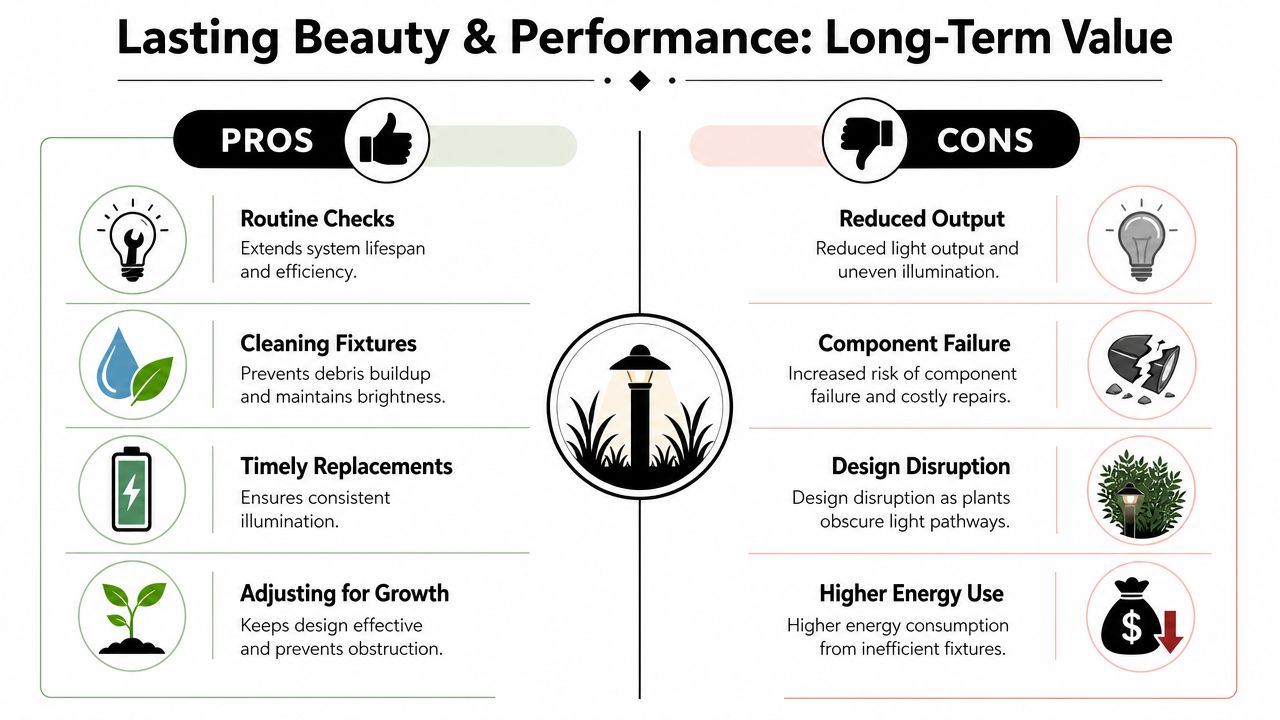
Good upkeep is not complicated, but it does need to be planned. Lenses need cleaning. Fixtures need retargeting as trees and shrubs mature. Some zones benefit from seasonal adjustments based on how the property is used, especially when evening entertaining, arrival paths, and security scenes are tied into Lutron or Josh.ai and expected to behave predictably.
Homeowners often learn after the fact that outdoor systems need post-install tuning. Even DIY-style setups often require night-time retiming, fixture repositioning, and slack at each fixture after installation, as noted in Tru-Scapes' guide to a professional-looking outdoor lighting system. A professional installation accounts for that from the start, which cuts down on rework and keeps automation scenes consistent once the system is in daily use.
Lamp planning matters too. A thoughtful outdoor lighting bulb replacement and maintenance plan helps preserve beam quality, color consistency, and the original nighttime effect instead of letting the system become a patchwork of mismatched fixes.
A durable outdoor system stays easy to tune, repair, and expand.
That matters even more on a high-end home, where exterior lighting is not a standalone accessory. It is part of the broader living experience, and it should keep supporting arrival, dining, entertaining, and security routines without friction as the property evolves.
Homeowners usually ask practical questions right before moving forward. Those questions are worth answering directly.
A careful team routes cable with the property's features in mind and aims to disturb as little as possible. Low-voltage systems are far less invasive than many homeowners fear, but the final impact depends on the property layout, hardscape crossings, planting density, and how much of the yard is being covered. On established homes, the cleanest results come from planning routes before anyone starts digging.
Yes, if the lighting and control strategy are chosen together. That's where platforms like Lutron and Josh.ai become valuable. Exterior scenes can be tied to time-of-day routines, voice commands, and broader home behavior instead of acting like a standalone accessory.
A standard low-voltage outdoor lighting system depends on the home's power, so outage behavior comes down to how the property's electrical and backup systems are configured. If backup power is a priority, that conversation should happen during design so the right loads and expectations are set.
No. Large properties benefit from proper zoning and beam control, but modest lots also gain a lot from thoughtful lighting. The difference is usually scope, not whether the design principles apply.
Look at service access, wire routing, nighttime aiming, future adjustability, and whether the outdoor system will need to integrate with audio, cameras, shades, or voice control later. Those decisions affect your ownership experience more than fixture shape alone.
If you're planning a broader upgrade, it helps to work with a team that understands the whole residential environment. That includes custom home theater, new home builds, home audio, security, networking, outdoor lighting, and the automation layer that ties systems together. Commercial work exists too, including restaurants, but the strongest use case here is still the home, where exterior lighting should feel like a natural extension of how the house already lives.
If you want to see what your property could look like after dark, schedule a consultation with Home AV Pros. They design and install residential technology systems across southern Wisconsin and northern Illinois, including smart home automation, outdoor lighting, whole-home audio, networking, security, custom theaters, and outdoor entertainment.

Copyright © 2026. Home AV pros. All rights reserved.