
You’ve got the box open, the screen is out, and the first reaction is usually the same. The frame tv 55 inch looks slim, expensive, and simple. Then you see the mount, the cable path, the One Connect Box, the outlet location, the glare from the nearest window, and the media console that suddenly feels like it’s in the wrong place.
That’s the moment this TV stops being a product and becomes a project.
A 55-inch Frame works best when nobody notices the installation. They notice the art, the room, the clean wall, and how the TV disappears when it’s off. That result doesn’t come from hanging a panel on drywall and hoping the cord blends in. It comes from planning the wall, the wiring, the viewing height, the lighting, and how the TV will interact with the rest of the home.
Most homeowners buying a Frame aren’t chasing the biggest screen possible. They’re trying to solve a design problem. They want a television in the room, but they don’t want the room to feel built around a television.
Samsung launched The Frame in 2017, and the 55-inch model became one of the lineup’s defining sizes, which helps explain why it shows up so often in living rooms, dens, bedrooms, and open-concept spaces where scale matters as much as picture quality. Historical pricing for the 2021 QN55LS03AAFXZA also shows how the category became more approachable over time, with a list price around $1,597.99 and a 44% average decline over the following four years according to price history for the 55-inch Frame.
That wider accessibility has changed expectations. Homeowners don’t just want a mounted TV anymore. They want something that looks intentional.
A Frame install lives or dies on proportion and placement. If the TV is too high, it reads like a compromise. If the cable is visible, Art Mode loses the illusion. If the bezel fights the trim, millwork, or furniture finishes, the wall never settles visually.
That’s why I tell clients to think about this like built-in lighting or cabinetry. It has to belong in the room.
The best Frame installation doesn’t announce itself. It looks like the room was designed that way from the start.
If you're coordinating finishes, furniture, wall color, and trim details at the same time, it helps to work with an interior designer so the TV doesn’t become an isolated tech decision. That’s especially useful when you’re choosing between a modern white bezel, a wood-look frame, or a minimal black edge that should visually disappear.
A standard TV install solves for support. A strong Frame install solves for five things at once:
That last part matters more than people expect. A Frame can be the visual center of a living space without turning the room into a tech showroom, but only if the rest of the system is equally restrained.
A polished Frame TV install is usually decided before the mount ever touches the wall. On a 55-inch model, small planning mistakes are easy to see. The screen may technically fit, but the room can still feel off every time you sit down.
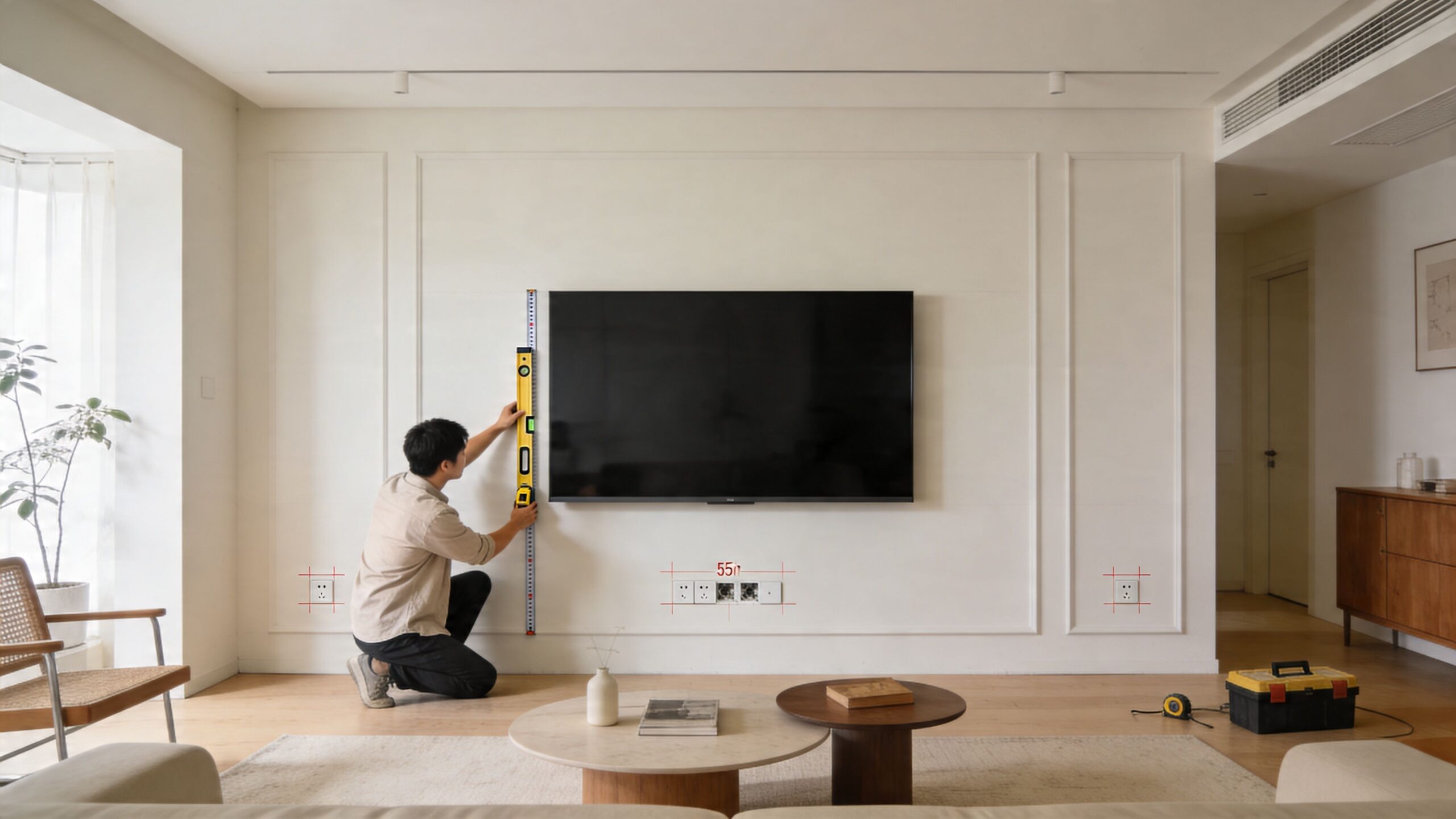
I plan a 55-inch Frame around daily behavior first. Where do people sit on a weeknight. Which seat matters most for sports, movies, and casual TV. How does sunlight move across the wall between breakfast and late afternoon. Those answers usually narrow the wall choices faster than the floor plan does.
A 55-inch screen gives you flexibility, but it still needs the right context. If you are still debating scale, our guide on how to choose the right TV size for your room helps confirm whether 55 inches fits the viewing distance and furniture layout you have in mind.
The right location usually depends on five factors:
Clients often want the TV centered on the wall because it looks balanced on paper. In practice, the room feels better when the screen sits at a comfortable seated viewing height and still holds the framed-art look when Art Mode is on.
For many living rooms, that means resisting the urge to mount too high. Fireplaces are the usual problem. A Frame can work above one, but only if the height is reasonable, heat is controlled, and the seating distance softens the viewing angle. If every movie night turns into looking upward, the install is serving the architecture instead of the people using the room.
Practical rule: If the wall looks great in a photo but feels tiring after an hour of viewing, placement needs to change.
A good installer does not assume the wall is simple because the room is finished. Drywall over standard studs is often straightforward. Plaster, masonry, tile, old patchwork, and hidden blocking change the job quickly.
I like to verify the wall early, before finish choices and automation details get locked in. That means locating studs, checking cavity depth, identifying obstacles, and confirming whether the One Connect path is realistic without compromising the wall surface.
Here is how that usually breaks down:
| Wall type | Usually straightforward | Common complication |
|---|---|---|
| Drywall over studs | Mounting and cable planning | Outlet placement does not line up with the TV location |
| Plaster walls | Possible with careful prep | Cracking during cuts and difficult cable fishing |
| Masonry or brick | Secure mounting | Clean wire concealment is harder |
| Tile or stone feature walls | Strong visual result | Precision drilling with almost no room for error |
This part matters even more in design-led projects. A wall may look perfect for a flush Frame install, but if the structure behind it fights cable routing or box placement, the final result can feel compromised.
The One Connect Box solves one problem and creates another. It clears the wall visually, but it still needs a smart home-friendly home of its own with power, ventilation, service access, and a clean cable route.
These are the placements I review most often:
Inside a media console
Straightforward and serviceable when furniture sits directly below the TV.
Inside adjacent cabinetry
Better for cleaner sightlines and less visible gear.
In millwork or a nearby closet
A strong option during a remodel or new build, especially if the room already includes structured wiring.
At a remote equipment hub
Best for larger AV systems, but it requires tighter planning around cable path, access, and control integration.
This is also where a professional integrator earns their keep. If the room will later tie into Josh.ai, Lutron, Sonos, or a centralized rack, the box location should support that future system now. It is much easier to reserve conduit, power, and network access during the first install than to reopen a finished wall later.
A Frame TV rarely stays a standalone display for long. Clients start with clean wall art and good streaming. Then they want lights to dim from a Josh.ai voice command, Lutron shades to close for daytime glare, music to hand off to architectural speakers, and the TV to behave like part of one coordinated room.
That only works cleanly if the viewing plan accounts for more than the screen. Good placement leaves room for lighting scenes, automation sensors, hidden audio, reliable network access, and future serviceability.
The best 55-inch Frame installs feel easy to live with because the planning was disciplined from the start.
A 55-inch Frame TV only works visually if the wall stays quiet. The screen can be perfectly centered, the bezel can suit the room, and Art Mode can be dialed in. A visible wire still gives away the whole trick.
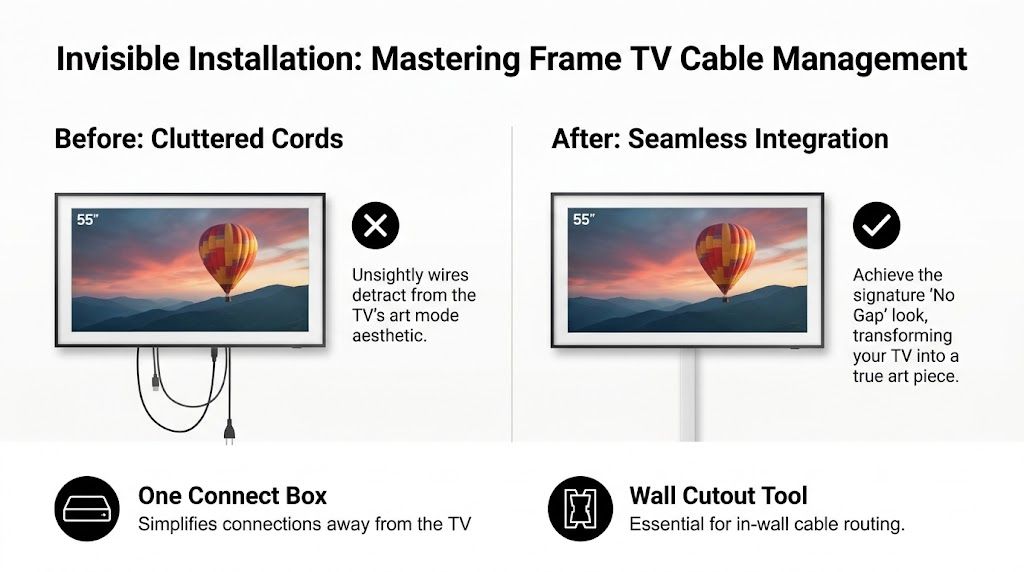
I tell clients to treat cable planning as part of the design, not a cleanup step after the TV is mounted. On a standard living room TV, a small compromise is often acceptable. On a Frame install, small compromises stay visible every day.
The decision usually comes down to a surface-mounted raceway or a concealed in-wall path. Both are valid. They just solve different problems.
| Approach | Best for | What it looks like | Trade-off |
|---|---|---|---|
| Paintable raceway | Finished rooms where wall access is limited | Cleaner than loose cables, but still visible | Faster install, weaker framed-art effect |
| In-wall concealment | Design-focused spaces and remodels | Closest to a true framed-art look | More labor, more planning, code compliance questions |
A raceway is often the right call in a finished room with plaster, masonry, tile, or expensive wallcovering. If it is aligned carefully and painted well, it can disappear enough for everyday use.
In-wall routing gives the best result when the goal is to make the TV read like art first and technology second. It also demands better planning up front, especially if the room will later tie into lighting, voice control, and hidden source equipment.
The One Connect cable creates false confidence because it looks like a single clean solution. The problem is that a clean look and a code-compliant installation are not always the same thing. In many Frame projects, the included cable is not the cable you want buried in a wall cavity, and that changes the entire approach.
That is usually the point where a quick weekend install turns into a proper integration job.
If the cable path needs to disappear, the wall assembly, local code, cable rating, power location, and service access all need to be considered together. A hidden cable only improves the room if the installation is safe, maintainable, and built to be serviced later without opening finished walls again.
The best installations leave the TV visually alone on the wall and place the One Connect Box somewhere that makes sense for the room. In a simple family room, that may be a low cabinet with ventilation and easy access. In a more polished project, it may be hidden in millwork or routed to a nearby closet so the wall stays completely free of gear.
My process is usually straightforward:
If you want a broader look at concealment methods, this guide on how to hide TV wires and cables covers the options and the trade-offs in more detail.
A quick video can help visualize why this stage determines whether most installs succeed or fail.
The One Connect Box is easier to live with when its location is chosen for access and long-term service, not just for hiding it on day one.
A cabinet below the TV is common because it keeps cable runs manageable and gives you easy access for streaming boxes, game consoles, or a network switch. It also tends to work well with future control upgrades, since integrators can tie the TV, sources, and lighting into one control path without adding another visible device in the room.
A closet or remote equipment area creates a cleaner finish, but it raises the standard for planning. Longer cable paths need to be measured correctly. Ventilation matters more. Troubleshooting takes longer. If the room is headed toward Josh.ai control, Lutron scenes, distributed audio, or a centralized rack, remote placement can be the right move, but only if the infrastructure supports it from the start.
Older homes in southern Wisconsin and northern Illinois tend to punish assumptions. Plaster cracks. Framing is inconsistent. Wall cavities are tighter than they look. Existing electrical lines often sit exactly where the ideal cable route should go.
That does not mean the install has to look compromised. It means the method has to fit the house.
In some rooms, the best answer is a carefully planned in-wall route to a nearby cabinet. In others, a well-executed raceway is the better professional choice because it protects the wall, avoids repair work, and still preserves the look of the room. Good integration work is not about chasing the most aggressive concealment method. It is about choosing the cleanest result the structure can support, then making sure it will still work properly once the TV, lighting, network, and control system are all in daily use.
A Frame TV can look great by itself. It becomes far more useful when it behaves like part of the house.
That shift matters because homeowners don’t experience their rooms one device at a time. They experience scenes. Movie night. Morning news. Afternoon art display. Entertaining with music in adjacent spaces. A TV that sits cleanly on the wall but ignores the shades, lighting, audio, and network around it isn’t really integrated.
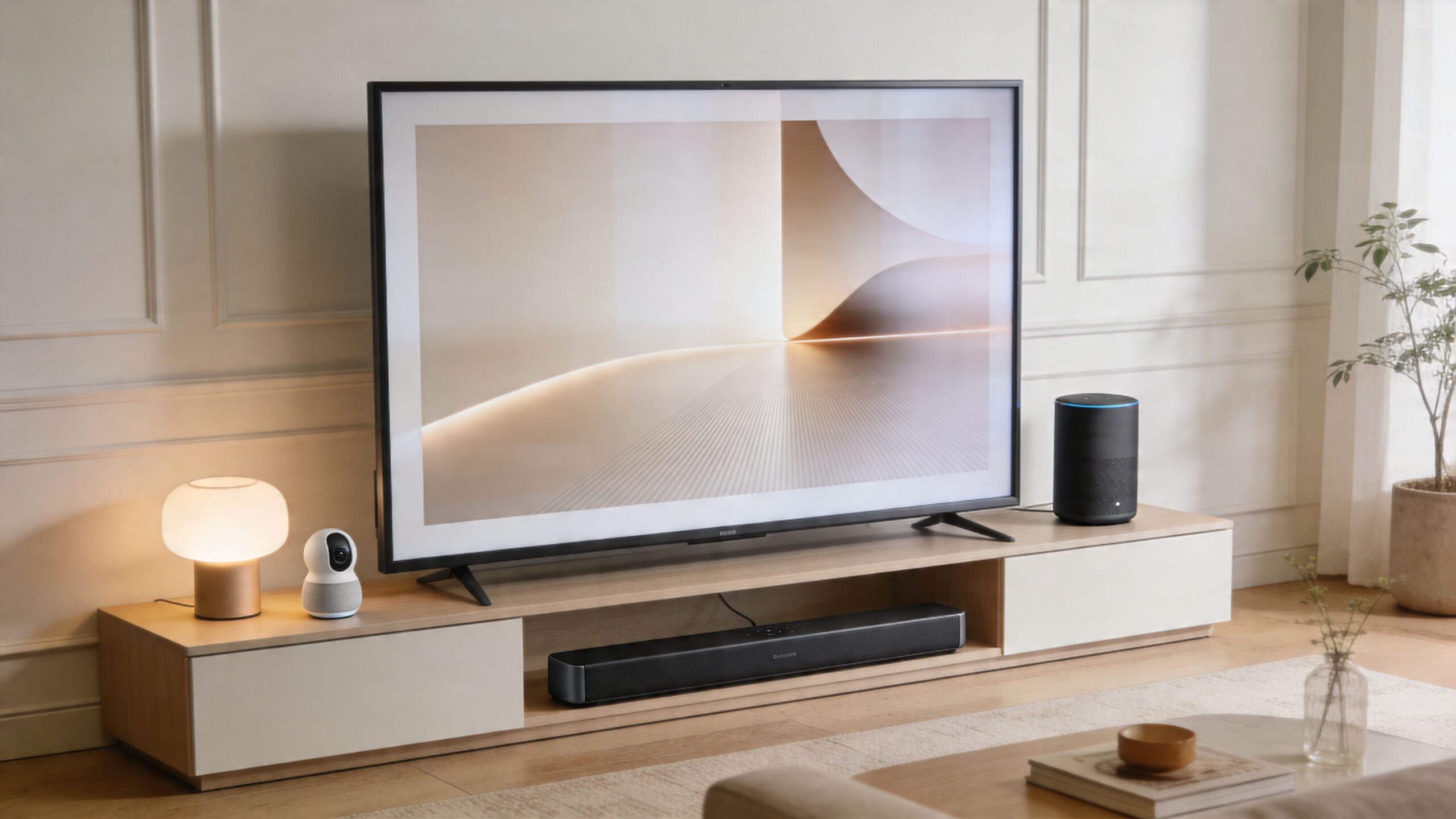
With Josh.ai, the experience changes. Instead of juggling remotes and apps, you can make the room act on a natural language command.
A practical living room scene might work like this:
“Okay Josh, watch Netflix.”
The TV powers on, the correct input loads, shades lower, and the lights shift to a comfortable viewing level.
“Okay Josh, art mode.”
The TV returns to display mode, lighting brightens slightly, and the room becomes a daytime living space again.
“Okay Josh, goodnight.”
The TV turns off, shared spaces power down, and exterior lighting can follow the house routine.
The value isn’t novelty. It’s friction reduction. A room that responds predictably gets used more.
The Frame is especially sensitive to room lighting because its whole appeal depends on realism. If the sun blasts the wall at the wrong time, art can look flat or overly reflective. If the room stays too dark during daytime display, the TV can look like a screen pretending to be art.
That’s why Lutron shades are such a strong pairing. Automated shades can cut harsh glare during key daylight hours without asking you to manually correct the room every day. In a whole-home setting, that same Lutron system can also tie into keypads, occupancy routines, and broader lighting scenes.
A smart room isn’t just automated. It’s coordinated.
When the lights, shades, and display are tuned together, the Frame stops looking like a TV that happens to show art.
The display side gets the attention because it’s mounted on the wall. The compromise usually shows up in sound.
The 55-inch Frame has a slim form factor for a reason. Thin TVs don’t create room-filling audio. If the room is a family room or open living area, adding Sonos usually makes the biggest daily difference per dollar spent. A soundbar keeps the setup visually restrained, and it can also become part of a broader whole-home audio system.
For households that want music to move beyond a single room, a Sonos ecosystem makes it easy to carry the same experience into kitchens, patios, bedrooms, and lower levels without overcomplicating control.
For movie-focused homeowners, Kaleidescape is where the conversation shifts from convenient streaming to premium cinema delivery. In the right home, a Frame in a main living space can coexist with a dedicated theater or media room that leans more heavily into performance. That mix works well for families who want elegance in the great room and a separate space for serious film watching.
None of this feels polished if streaming is unstable. That’s why Ubiquiti networking often sits underneath the visible AV layer. Strong Wi-Fi coverage and well-planned wired connections eliminate the random dropouts and buffering that people often blame on the TV itself.
The ecosystem can also extend beyond the walls. Oelo permanent lighting can be tied into broader home scenes so entertaining, holiday lighting, and exterior ambiance don’t feel disconnected from the interior control experience.
This is also where the broader work of an AV integrator starts to show up. The same planning mindset used for a Frame wall often carries into custom home theater, new home builds, home audio solutions, restaurants, outdoor lighting and sound, and security or networking upgrades. The difference is that in a home, every one of those systems has to feel quieter and more intuitive. Residential work succeeds when the technology recedes and the room feels easier to live in.
A mounted Frame still needs finishing work. This is the stage where it either becomes part of the room or remains a very nice television hung with good intentions.
The bezel should relate to the room, not just the TV catalog. In modern spaces with clean trim and pale walls, a white or light finish can let the panel fade into the architecture. In warmer rooms with wood tones, a wood-look bezel can help the screen read more like framed art.
What doesn’t work is choosing the bezel in isolation.
Use these cues:
If you want examples of style directions, this gallery of The Frame bezel ideas is useful for comparing how different finishes land in real rooms.
A common owner frustration is recurring subscription cost. One pain point for Frame owners is the $5 to $20 per month Art Store subscription, but newer matte QLED models from 2025+ are reported to reduce glare by 30% compared to older versions, which makes free art loaded by USB look more realistic, according to this review discussing Art Mode alternatives.
That makes curation more interesting because you’re not locked into a paid art library to get a convincing result.
Good low-cost or free approaches include:
If you’re trying to make the art feel native to the room, a resource like this living room wall art decor guide can help you think in terms of palette, scale, and subject matter rather than just downloading random images.
Less variety usually looks better. A tightly edited collection feels intentional in a way a giant mixed folder never does.
Often, a TV is adjusted once, and the setup is considered complete. A Frame really serves two roles, and it helps to tune both.
For everyday viewing, focus on comfortable movie and streaming performance. For Art Mode, focus on realism and restraint.
A practical checklist:
This is also where the room’s earlier planning comes full circle. If the bezel suits the décor, the mount is level, the cable is invisible, the shades control glare, and the art is curated with restraint, the TV starts behaving exactly as intended. It becomes useful without dominating the room.
Most Frame installations don’t fail dramatically. They miss by inches, by one visible wire, by a poor cable decision, or by a smart-home setup that looked good in theory and becomes annoying in practice.
That’s why these projects can fool homeowners. The TV goes up. The picture works. Nothing appears broken. But the room never quite looks finished.
Some problems are aesthetic. Some are structural. Some don’t appear until you’ve lived with the setup for a few weeks.
The ones I’d watch for first are these:
The TV is mounted too high
The wall may have looked good empty, but seated viewing feels wrong every day.
The wall looks clean except for one visible cable path
That single detail undermines the art effect more than people expect.
The One Connect Box has no good home
If it ends up stuffed into furniture without a plan for access or ventilation, service gets frustrating fast.
The smart devices don’t cooperate
If the TV, shades, lights, and audio aren’t programmed to behave easily, “smart” becomes one more layer of work.
The install ignored the house itself
Older walls, trim details, plaster, and retrofit constraints all demand different methods.
People often reduce professional installation to bracket safety. That matters, but it isn’t the whole issue.
The bigger risk is cumulative compromise:
| Missed detail | What happens in real life |
|---|---|
| Slightly crooked placement | You see it forever, especially against trim lines and furniture |
| Visible wire strategy | Art Mode stops looking convincing |
| Improper wall cuts | Repair and paint become part of the project |
| Weak system planning | The room gets more remotes, more apps, and more friction |
| No service access | Small updates become annoying equipment problems |
The product itself is well-liked for good reason. The 55-inch Frame has over 10,000 Amazon reviews with a 4.5/5 average, and user tests cited by Smart Home Sounds report that Art Mode can use up to 30% less power than normal viewing mode because the ambient light sensor automatically dims the display in the room, as noted in this overview of Frame TV features and specs. But a well-reviewed product can still be let down by a mediocre installation.
You should seriously consider professional help if any of these apply:
That last one is the deciding factor for many homeowners. A Frame isn’t a “good enough” TV purchase. It’s a design-sensitive purchase. If the installation doesn’t support that, you lose the reason many people choose it in the first place.
For homeowners who want a complete system rather than a one-off mount, working with an audio visual contractor usually makes the most sense when the project touches structure, wiring, automation, networking, and finish quality all at once.
A strong integrator also sees beyond the wall in front of them. They can coordinate a single living room TV, yes, but also pre-wire a new home, build out a dedicated theater, distribute audio across the house, add security and Wi-Fi, and carry the same clean design thinking outside to outdoor lighting and sound. That’s how the house feels cohesive instead of pieced together over time.
If you want your frame tv 55 inch installation to look clean, sound right, and work smoothly with lighting, shades, networking, and whole-home control, Home AV Pros can help design and install a system that fits the way you live. From TV mounting and smart home automation to custom home theater, whole-home audio, new home builds, outdoor lighting and sound, and even select commercial spaces like restaurants, the focus stays on reliable performance and polished residential results.

Copyright © 2026. Home AV pros. All rights reserved.