So, you're ready to dive into the world of home automation. It's an exciting step, but turning a pile of smart gadgets into a truly intuitive, seamless system is where the real challenge lies. That’s where a professional integrator comes in.
At Home AV Pros, we've been designing, installing, and supporting custom audio-video and automation systems for homes and businesses across southern Wisconsin and northern Illinois since 2011. We believe technology should be simple, reliable, and blend beautifully with your home's design. Whether it’s a professional TV mounting job, a complete smart home ecosystem, a dedicated home theater, or whole-home audio, our certified team handles it all—from picking the right gear to programming and long-term support. We work with the best in the business, like Josh.ai, Lutron, and Sony, to ensure every installation is rock-solid.
It’s one thing to set up a smart speaker or a video doorbell. It's a completely different ballgame to create a fully integrated smart home where everything works in perfect harmony. While a DIY approach might seem tempting for smaller tasks, a cohesive system demands expert planning and execution from experienced home automation installation companies.
This guide will walk you through the entire process, helping you define what you really want and find the right partner to make it happen. We’re going to look past the basic DIY mindset and show you why professional design, proper wiring, seamless system integration, and ongoing support are essential for a high-end smart home experience.
A true professional doesn't just plug things in; they design and build a robust, unified ecosystem. They have a deep understanding of how different technologies talk to each other and can solve complex problems that would leave most homeowners scratching their heads. Ultimately, their expertise ensures your investment is reliable, a joy to use, and ready to grow with you in the future.
Think about the distinct advantages of hiring a pro:
The desire for connected homes is far more than a passing fad. The global home automation market is on a steep upward curve, expected to jump from USD 117.61 billion in 2026 to a staggering USD 211.21 billion by 2031. This explosive growth shows just how much people value the convenience, efficiency, and security that smart devices bring to their lives.
A successful smart home isn't about having the most gadgets. It’s about having the right gadgets working together perfectly to simplify your life. That harmony is what a professional installer delivers.
Before you get too far, getting familiar with the basics of installing a home automation system can give you a great foundation. This guide is your playbook for finding a trusted pro in the southern Wisconsin and northern Illinois area who gets both the technology and your vision.
If you’re ready for some personalized advice, you might be interested in our expert https://homeavpros.com/smart-home-consultations/.
Before you even think about calling a professional, the most important work happens right in your own home—and your own head. A clear vision is the absolute bedrock of a successful smart home project. Without one, talks with installers get muddled, quotes come back all over the place, and you might end up with a system that just doesn't feel right.
The goal is to move from a vague idea, like "I want a cool media room," to something concrete and specific. This clarity is what allows an installer to give you an accurate quote and design a system that truly fits your life. It all boils down to figuring out what really matters to you and your family.
The easiest way to get started is by making two simple lists. This isn't just about cool gadgets; it's about the experience you want to create in your home.
First, your "must-have" list. These are the absolute non-negotiables, the core reason you're starting this project in the first place. For instance, your must-haves might look something like this:
Next, make your "nice-to-have" list. These are the extras you'd love to add if the budget allows, but you could live without for now. Maybe that's whole-home audio, smart landscape lighting, or a sophisticated voice control system like Josh.ai. Having these two lists gives you and your installer some wiggle room when designing the system.
A well-prepared homeowner is an installer's best partner. When you can clearly communicate your priorities, from core functionality to future dreams, you empower them to design a system that truly serves your lifestyle.
Thinking ahead is just as critical. Do you see yourself adding automated shades to the bedrooms in a year or two? Or maybe expanding the security system? Mentioning scalability from the get-go ensures your installer puts the right foundation in place—the wiring, the control system—so you can easily add those future features without having to tear open walls later on. A little foresight now can save you a ton of money and headaches down the road.
Once you've got your vision down, it's time to talk numbers. Home automation costs can swing wildly, so it helps to have a general idea of what different levels of investment look like. A simple media room setup is a completely different ballgame than a fully integrated home with lighting, climate, security, and entertainment all working together.
Here’s a rough breakdown of what to expect at different project scopes:
Entry-Level (Single-Room Focus): This is often a top-notch media room or home theater. You’re putting your money into a fantastic display, great speakers, and a universal remote or a simple control system. The goal here is to perfect one specific experience.
Mid-Range (Multi-Room Integration): At this level, you’re looking at automating lights and shades in key areas, maybe adding audio throughout the house, and putting in a more serious security system. It’s about connecting a few different systems to make life more convenient in several rooms.
High-End (Whole-Home Ecosystem): This is the full smart home experience. We’re talking about sophisticated systems like Lutron for all your lighting and shades, advanced climate control, video distribution to every TV, and a powerful control platform that ties every single piece of tech together. This level requires serious design, professional programming, and a deep partnership with a certified integrator.
Knowing these tiers helps set realistic expectations. To get a clearer picture of what's possible, you can check out pre-designed smart home packages, which are a great starting point for budgeting.
Being upfront with an installer about your budget is the best thing you can do. It allows them to design the best system for your money, focusing on your "must-haves" first and then seeing which "nice-to-haves" can fit. That kind of transparency is the key to a great outcome.
Okay, you've got a clear vision and a budget in mind. Now for the crucial part: finding the expert who can bring it all together. Sourcing the best home automation installation companies is more than just a quick Google search. It’s a methodical process of finding a partner with the right technical skills, professional polish, and a communication style that works for you. This is where your homework really pays off.
Start your search locally. If you're in the Madison-Milwaukee corridor, for example, you'll want to find companies with a solid track record right here in your area. Look at their online reviews, sure, but dig deeper for industry credentials. A company’s commitment to quality often shows in their team's certifications.
When you begin reaching out, walking into a consultation prepared with smart questions is a game-changer. You're not just shopping for a price; you're vetting their entire process, their real-world expertise, and how they operate. Any true professional will welcome this—in fact, they expect it.
Here are the non-negotiable questions you should have on your list for every potential installer:
This simple flowchart lays out the planning that should happen before you ever pick up the phone.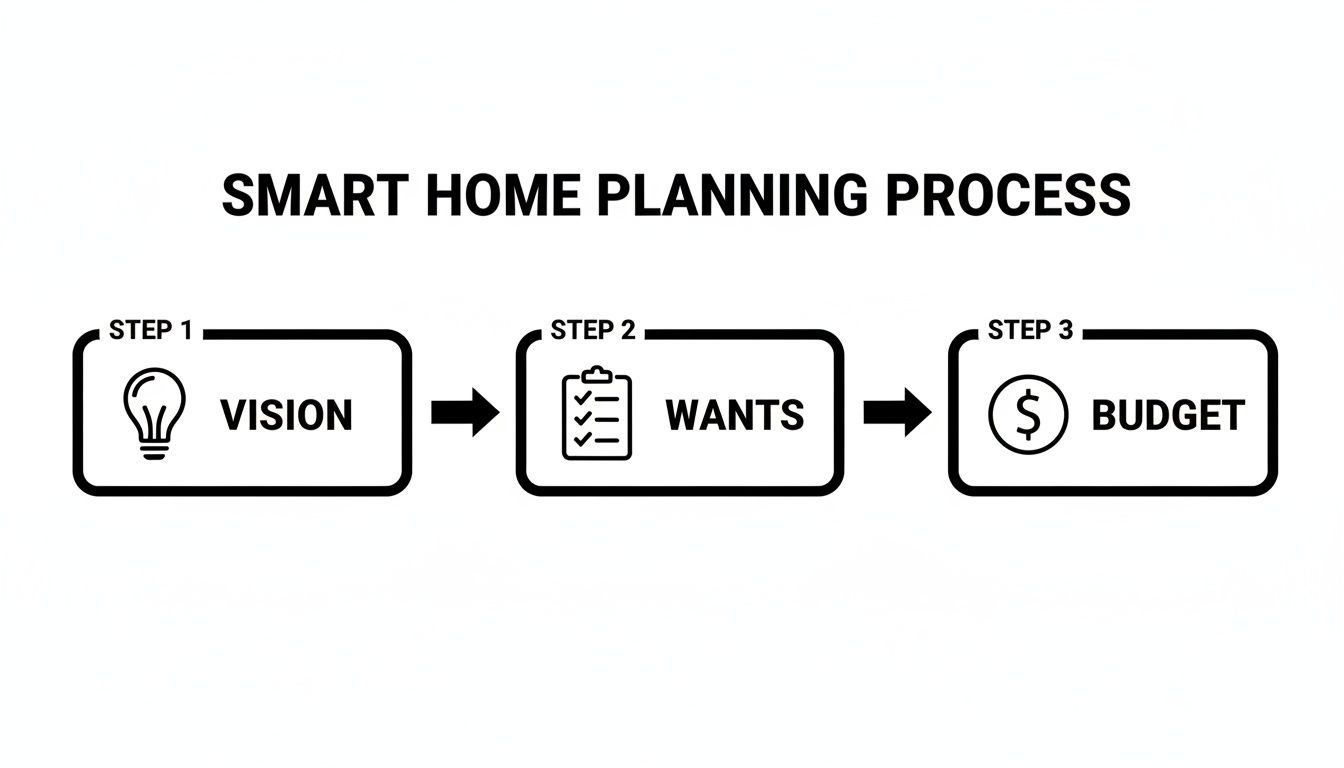
Walking in with your vision, wants, and budget clearly defined makes the whole vetting process smoother and far more effective for everyone involved.
The on-site survey is where you’ll learn the most. It's your opportunity to see how a company operates in the real world. Pay attention to not just what they say, but how they listen and what they notice about your space.
A top-tier installer won't just pull out a tape measure. They’ll ask insightful questions about how you actually live—where does the family gather, what are your daily routines, what frustrates you about your current setup? They should be checking out your home’s construction, looking at existing wiring, and testing your Wi-Fi signal strength in different areas.
It's also a great time to gauge their professionalism. Look for signs of an organized operation. For instance, many of the best integrators use tools like efficient field service scheduling software to manage their appointments and projects, which is a good indicator of a company that values your time.
An installer's attention to detail during that first walkthrough is a direct reflection of the care they'll put into the final installation. A great partner listens more than they talk and focuses on designing a solution for your life, not just selling you the latest gadgets.
The North American market for home automation is incredibly sophisticated. In fact, North America dominates the global market, holding a massive 39.5% revenue share in 2025. This demand is driven by high adoption rates for connected devices and a real focus on energy efficiency. Because the standards are so high, finding certified professionals is absolutely essential for complex projects.
Once the proposals start rolling in, it's time to compare. Remember, the lowest price is rarely the best value. A detailed, transparent proposal is a sign of a professional who has genuinely thought through every aspect of your project.
To keep things straight, I always recommend putting the key details into a simple comparison table. This forces you to look beyond the bottom line and evaluate the entire package each company is offering.
Use this checklist to systematically compare quotes from different home automation installation companies. This helps you look beyond the price and evaluate the complete offering.
| Evaluation Criteria | Company A | Company B | Company C |
|---|---|---|---|
| CEDIA Certified? | Yes | Yes | No |
| Brands Mentioned | Lutron, Josh.ai | Control4, Sonos | Mixed DIY Brands |
| Labor Warranty | 2 Years | 1 Year | 90 Days |
| Support Plan Offered? | Yes (3 Tiers) | Yes (1 Tier) | No |
| Total Quoted Cost | $28,500 | $24,000 | $19,000 |
| On-Site Survey Notes | Very detailed | Seemed rushed | Focused on price |
Laying it out like this makes the choice much clearer. While Company C is the cheapest, they lack the certifications, a solid warranty, and the long-term support that gives you peace of mind.
For contractors and builders, understanding these differences is even more critical when looking for reliable partners. Our guide on working with low-voltage contractors offers more specific advice on building these vital relationships.
Okay, you’ve got a few proposals in hand. Now comes the most critical part: figuring out what they really say. This isn't about jumping on the lowest number. It's about digging into the details to see who truly understands your vision and has the experience to bring it to life. A well-crafted proposal is a direct reflection of the installer’s professionalism and attention to detail.
Think of a good proposal as a blueprint, not a grocery list. You should see a clear, itemized breakdown of costs—every piece of equipment, the labor involved, and any specific fees for programming or project management. If you get a quote that just gives you a single, lump-sum price, be wary. That’s a major red flag because it hides where your money is actually going.
When you’re comparing proposals from different home automation installation companies, you need to make sure you’re comparing apples to apples. Knowing what to look for in each section will help you spot discrepancies and potential problems before you sign anything.
A solid proposal will always spell out:
Beyond the numbers, look for a detailed scope of work. It should explain in plain English what your system will do when it's finished. For example, instead of a vague line like "Install smart lighting," it should read more like this: "Install and program Lutron RadioRA 3 system for kitchen and living room, including five dimmers, two keypads, and three custom scenes ('Entertain,' 'Movie Night,' 'Away')." Specificity is key.
As you comb through the paperwork, keep your antenna up for warning signs. Catching these early can save you a mountain of headaches down the road.
One of the most common traps is a suspiciously low bid. It’s always tempting, but a price that’s way out of line with the others usually means something’s been cut. They might be using cheaper, less reliable equipment, underestimating the labor required, or planning to hit you with surprise charges later.
Another red flag is an installer who seems locked into one specific brand for everything. A great integrator has a diverse toolbox. They recommend products because they are the right fit for your project, not because they offer the best profit margin. They should be able to clearly explain why they chose a particular brand for your situation.
A truly professional proposal is an educational tool. It should leave you feeling informed and confident about your investment, not confused by jargon or vague promises. If you have to ask for clarification on multiple items, it may signal poor communication down the line.
The home automation market is exploding. Projections show the industry could top USD 715.6 billion globally by 2032, fueled by a blistering 22.8% compound annual growth rate. This boom means a lot of new installers are jumping in, which makes it absolutely critical to meticulously vet proposals and stick with established companies. You can read a full analysis about the booming home automation market here.
Finally, trust your gut. If a salesperson is pushy, dismisses your concerns, or seems disorganized, that's likely a preview of what you’ll deal with during the project. The right partner will be patient, knowledgeable, and focused on earning your trust from day one. Choosing the right installer is the single most important decision you'll make in this entire process.

Alright, you’ve done the hard work. You’ve defined your vision, vetted a few installers, and now you have proposals sitting in front of you. It’s decision time. Remember, you’re not just buying equipment or comparing bottom-line numbers; you're choosing a long-term technology partner for your home.
The right company should have made itself clear by now. They've answered your questions patiently, shown you similar projects they’ve completed, and given you a transparent, detailed proposal. More than anything, you should feel that they’re committed to supporting you long after the last wire is connected.
This final check is about making sure you feel 100% comfortable before you move forward. It’s about starting the project with a trusted professional, not just a contractor.
Before you sign anything, take a moment to run through this mental checklist. This is what separates the good home automation installation companies from the truly great ones I've seen over the years.
The company you choose is becoming a part of your home's story. Your final decision should be based not just on what they will install, but on the trust and confidence they’ve built with you throughout this entire process.
It really helps to picture what "done right" looks like. In our experience working across southern Wisconsin, a successful project is one where the technology just melts into the background of a client's daily life.
Take a recent home theater project in Madison, for example. The client wanted a genuine cinema feel but dreaded the thought of juggling five different remotes. The final result was a perfectly calibrated 4K projector, discreet in-wall speakers, and a single, elegant interface that dimmed the Lutron lights, lowered the screen, and started the movie with one tap. The win wasn't just the high-end gear; it was making it all effortless.
In another Milwaukee home, we designed a whole-home audio system around the family’s routine. Music fades in gently in the master bedroom to wake them up, their favorite playlist kicks on in the kitchen during breakfast, and it's simple to switch to some quiet background music on the patio for the evening. That’s the kind of seamless integration that the best home automation installation companies deliver.
Feel free to browse our gallery to see more real-world smart home and AV projects.
Once you've made the call and given them the green light, a few final logistical things will happen before the work begins. Don't hesitate to ask for more details on these last items.
1. Reviewing the Contract
Read the final contract carefully. It should perfectly match the proposal you agreed to—no surprises. Double-check the project timeline, the payment schedule, and the process for handling "change orders" (any additions or modifications you might want to make once the project is underway).
2. Clarifying the Payment Schedule
Most projects follow a standard payment structure. It usually looks something like this:
Make sure these terms are laid out clearly and you’re comfortable with them.
3. Preparing Your Home for Installation Day
This is a simple one, but it makes a big difference. Ask your installer what, if anything, you need to do to prepare. They may need clear access to specific rooms, attics, or the spot where the main equipment rack will live. Clearing pathways and protecting nearby furniture ahead of time helps the team work safely and efficiently.
By moving through these final steps with care, you’re not just hiring an installer. You’re starting a partnership built on clarity, trust, and a shared goal. Now you can move forward with confidence, knowing you’ve picked the right team to bring your vision to life.
Jumping into a smart home project can feel like learning a new language, and it's natural to have a lot of questions. Getting straight answers is the first step to making a smart investment. Here are some of the most common things people ask us before they hire a home automation installation company.
This is probably the number one question we get, and the honest-to-goodness answer is: it really depends. The timeline is completely tied to the size and complexity of your project.
For example, setting up a dedicated home theater in one room might only take a few days to a week. But if we're talking about a full-blown, whole-home system for a new build—with integrated lighting, automated shades, security, and multi-room audio—that’s a project that unfolds over several months, right alongside the construction crew. For projects in existing homes, a good installer will break the work into phases to keep the disruption to your daily life at a minimum.
The real secret here is solid project management. Always ask for a detailed timeline with clear milestones. A true pro will map out every phase, from running the first wires to installing the gear, and all the way through to final programming and showing you how to use it all.
It all boils down to two things: integration and reliability. DIY gadgets, like a smart thermostat or a handful of smart plugs, are great on their own. The problem is they don't always play nicely together. You often find yourself juggling a dozen different apps on your phone just to control everything, which gets old fast.
Professional-grade systems from brands like Lutron, on the other hand, are engineered from the ground up to be a single, cohesive ecosystem. Your installer programs everything to communicate flawlessly, giving you one simple, intuitive interface to control your entire home. It’s the difference between having a drawer full of random gadgets and living in a truly intelligent, responsive environment.
Absolutely! This is where a little bit of foresight makes a huge difference. One of the biggest advantages of working with experienced home automation installation companies is that they design for scalability.
A smart integrator will ask about your long-term vision during the initial planning. They'll make sure the right backbone is in place—like pulling the correct wiring or installing a control processor with enough horsepower—so that adding new features down the road is straightforward and doesn't require tearing open your walls.
We often see clients phase their projects like this:
This is a fantastic and crucial question. A professionally designed system is built to handle this exact scenario. While you’ll lose cloud-dependent features like checking your cameras from your phone or using voice commands, the core functions of your home should not skip a beat.
Your ability to turn on lights from a wall keypad, adjust the thermostat, or play music from a local server will keep working just fine. That's because the system’s "brain" is a physical processor located right there in your house, not floating somewhere in the cloud. This local control gives you a much more robust and reliable system for everyday life.
Ready to stop juggling apps and start living in a home that just works? The team at Home AV Pros has been designing and installing custom smart home systems since 2011. Let's talk about bringing your vision to life.
Written with the Outrank tool

Copyright © 2026. Home AV pros. All rights reserved.