
The LG OLED wallpaper TV is in a class of its own. It's designed to look less like a television and more like a floating piece of art, blending right into your wall. With an impossibly thin screen that sits nearly flush and a separate "Zero Connect Box" to handle all the inputs, it’s the key to achieving a truly minimalist, cable-free look. This isn’t just about buying a new TV; it’s a design choice for a high-end, modern home.
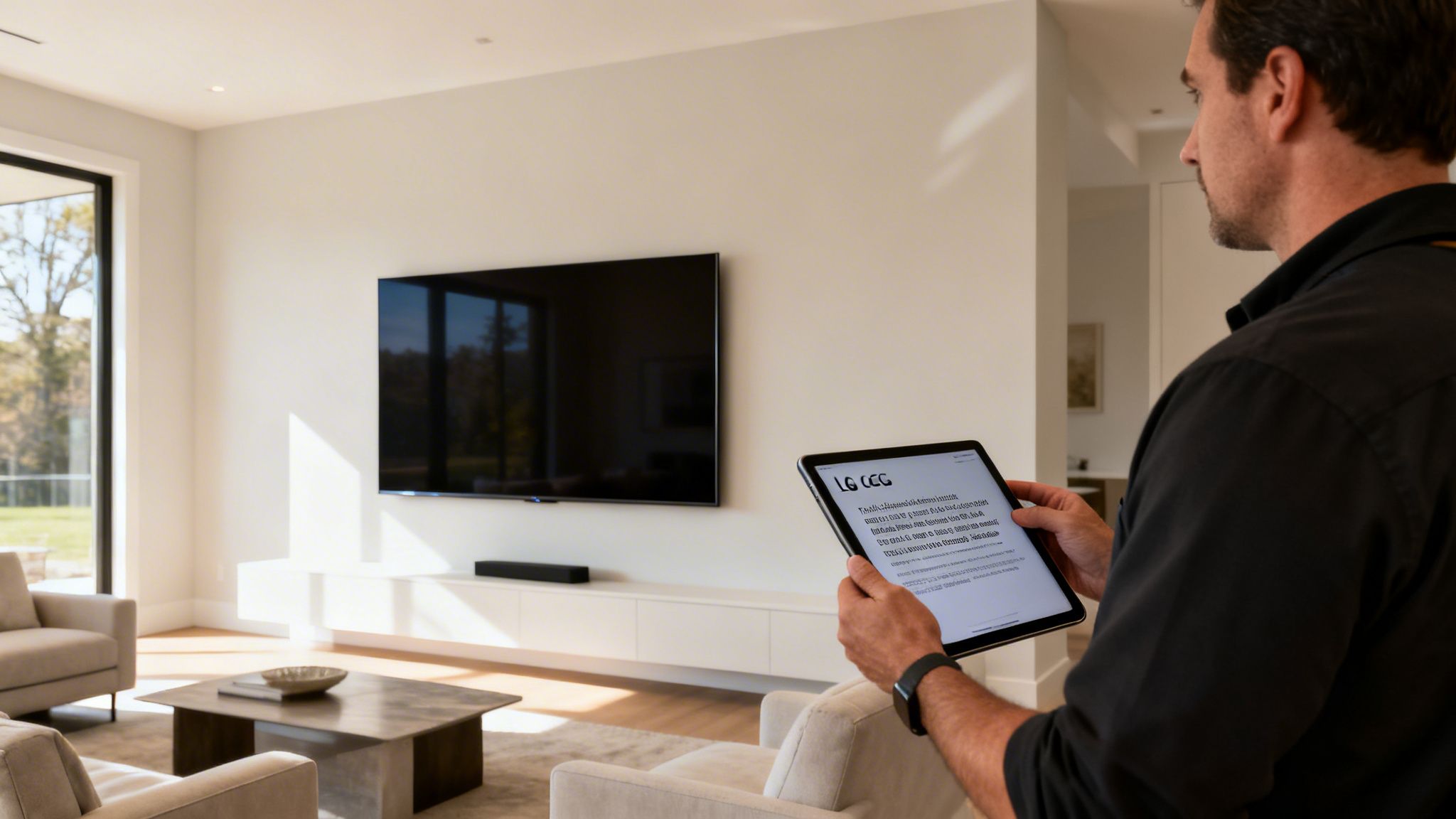
Make no mistake, the LG OLED Wallpaper TV is an architectural element. For homeowners, especially those in the middle of a new home build or a major renovation, it’s the perfect marriage of technology and interior design. The entire point is to make the tech disappear, leaving behind nothing but a gorgeous picture.
This is where planning becomes everything. You can't just unbox this TV and hang it like a normal screen. The Wallpaper TV demands a professional game plan from the very beginning. A site survey is the first thing we do to guarantee that "invisible" finish. We're looking at everything—the structure inside the wall, potential heat sources, and even how ambient light will hit the screen throughout the day. Getting this right from the start is what separates a good result from a flawless one.
Before you even think about cutting into a wall, a thorough pre-installation check is essential. We've put together a quick checklist that covers the key points we assess during our initial site visit. This helps ensure there are no surprises and that the final installation looks exactly as you imagined.
| Consideration | Why It Matters for a Seamless Look | Our Professional Approach |
|---|---|---|
| Wall Structure & Material | The wall must be perfectly flat and strong enough to hold the magnetic mounts. Drywall, brick, or stone all require different techniques. | We inspect the wall's integrity and flatness, identify stud locations, and determine the best mounting method for a perfectly flush finish. |
| Power & Cabling Path | You need a plan to get power and the single Zero Connect cable to the TV's location without any visible wires. | We map out the most discreet route, often using in-wall rated power kits and fishing the thin signal cable through the wall to the connect box. |
| Zero Connect Box Location | This box houses all your inputs (HDMI, power, etc.) and needs a home where it is both accessible and hidden, with proper ventilation. | We help you choose a strategic location, like a media cabinet, an adjacent closet, or a dedicated media rack, ensuring it has airflow to prevent overheating. |
| Viewing Angle & Height | Optimal placement ensures the best viewing experience from your primary seating area and avoids neck strain. | We measure your seating height and distance to calculate the ideal center point for the screen, typically with the center at eye level. |
| Ambient Light | Direct sunlight or bright reflections can wash out even the best OLED screen. | We analyze the room's lighting conditions at different times of day to position the TV away from direct glare, ensuring perfect contrast and color. |
Thinking through these details beforehand is what makes the difference between a TV on a wall and a true wallpaper installation.
To get that truly clean, high-end feel, the TV can't just be an isolated device. It should be the visual heart of your smart home. We often design systems where the LG Wallpaper TV works hand-in-hand with a powerful and intuitive voice control platform like Josh.ai.
This is where the initial planning really pays off. We map out how all your devices will talk to each other. For example, we'll plan how a Lutron lighting system can automatically dim the lights for movie night with a single command. We’ll also figure out the best way to integrate your audio, whether it’s a whole-home Sonos system or a dedicated home theater, so it complements the TV’s discreet look. For serious film buffs, we can build in a Kaleidescape movie server for an unmatched cinematic experience, making sure it’s properly placed and connected from day one.
The glue that holds all this together is a rock-solid network, which is why we exclusively use Ubiquiti systems to ensure everything runs smoothly.
A great LG OLED Wallpaper TV installation is about more than just hanging a screen. It's about orchestrating your home's lighting, audio, and automation to work together as one seamless system. The TV might be the centerpiece, but the real magic is in the experience.
LG has been chasing the dream of a paper-thin display for years. The Wallpaper OLED is the result of that effort, a stunning piece of engineering that has consistently set the bar for slim design. When the concept first debuted back in 2017, the original model was an astonishing 2.57 millimeters thick. The 2026 revival, the W6 model, builds on nearly a decade of OLED refinement, maintaining its signature thinness while adding True Wireless connectivity via the Zero Connect Box.
Now, that wireless connection is what makes the clean aesthetic possible, but "wireless" doesn't mean zero wires. The Zero Connect Box still needs power and has to connect to all your sources. Getting that box and its associated cables hidden is where the real work of a professional installer comes in. For a deeper dive into this, learning about mastering cable management for your wall-mounted TV is a great place to start.
Our work often goes beyond the living room. We apply the same principles of clean installation and reliable automation to create entertainment environments that flow from inside to out, integrating systems like Oelo landscape lighting and outdoor sound. Whether it's for a custom home theater, a new home build, or even a restaurant, the core goals are always the same: make it clean, make it reliable, and make it easy to use.
The real magic of the LG OLED wallpaper TV isn't just its paper-thin design; it’s the way it can literally disappear into a wall. But getting that seamless look is more than just hanging a screen. It's a small construction project that demands a level of precision you won't find in a standard TV installation. This is where the line between a DIY job and a professional one becomes crystal clear.
To get the TV to sit perfectly flat against the drywall, we have to build a recessed cavity in the wall. The TV’s magnetic mount doesn’t sit on the wall—it sits in the wall. This allows the screen to align perfectly with the surrounding surface, creating that truly invisible, built-in aesthetic.
On a new construction project, this is straightforward. We work with the builders to frame out a recessed box to the exact dimensions needed, ensuring it's square and properly reinforced from the get-go.
For an existing home, it’s a bit more surgical. We carefully cut into the drywall, then modify the studs to build out the recessed pocket for the mount.
This recess does double duty. It's not just holding the mount; it's also where we completely hide the wiring. We're dealing with two different kinds of wiring inside this space:
The most common—and dangerous—mistake we see from DIYers or inexperienced installers is running the TV's own power cord inside the wall. This is a serious fire hazard and a direct violation of electrical code. A pro will always use a rated in-wall power kit to ensure the installation is safe and compliant.
Once the framing and power are set, all you see is a clean recess with an outlet and a small pass-through for the signal cable. If you want to dive deeper into the basics of mounting, our guide on how to mount a TV on the wall covers a lot of the foundational principles.
The secret weapon behind the LG Wallpaper TV's minimalist look is the Zero Connect Box. Think of it as the brains of the operation. All the inputs, processing chips, and connections live in this separate box, which then beams the signal wirelessly to the screen. You can place it up to 32 feet away.
This is what frees you from the usual rat's nest of cables. All your sources—Apple TV, Kaleidescape, gaming consoles—plug into the Zero Connect Box, not the display. This makes choosing a location for the box a key part of the design process. We often place it in:
At Home AV Pros, we specialize in making this technology disappear. Whether we're designing a media closet from scratch in a new home build or integrating the box into custom joinery, the goal is to make it invisible and functional. We ensure the box has proper ventilation and is hard-wired into a robust Ubiquiti network for a rock-solid wireless connection to the screen.
This is how a TV becomes the centerpiece of a sophisticated smart home, working in concert with Lutron lighting, Sonos audio, and Josh.ai voice control for a seamless experience. It's the same level of detail we bring to our restaurant clients, because a clean, reliable installation is non-negotiable in any setting.
An LG OLED Wallpaper TV is a showstopper, but it shouldn't be a standalone piece of tech. The real goal is to make it disappear into the fabric of your home, becoming the visual heart of a living space that responds to you. This is where professional design makes all the difference—it's what separates a home with a bunch of smart gadgets from a genuinely smart home.
At Home AV Pros, we specialize in weaving all these threads together. We design systems where your TV isn't just for watching movies; it's a central hub, elegantly controlled by platforms that are as powerful as they are simple to use. Truly getting the most out of an LG Wallpaper TV means leveraging smart home technology to build an environment that feels completely intuitive.
The best smart home is the one you don't have to think about. That's why we're big fans of voice control platforms like Josh.ai. Unlike other systems that require you to memorize stiff, robotic phrases, Josh.ai is built to understand natural language.
Imagine walking into your media room and simply saying, "Okay Josh, it's movie time." A single phrase can kick off a whole sequence we've programmed just for you:
We call this a "scene," and it's the core of a seamless smart home experience. We work with clients to design custom scenes for everything imaginable—from intense gaming sessions and morning news to displaying digital art when you're hosting a dinner party.
The goal is to move beyond juggling multiple remotes and apps. A single voice command or a tap on a screen should transform your environment instantly, making advanced technology feel simple and intuitive.
Of course, before any of this digital magic can happen, the physical foundation has to be perfect.
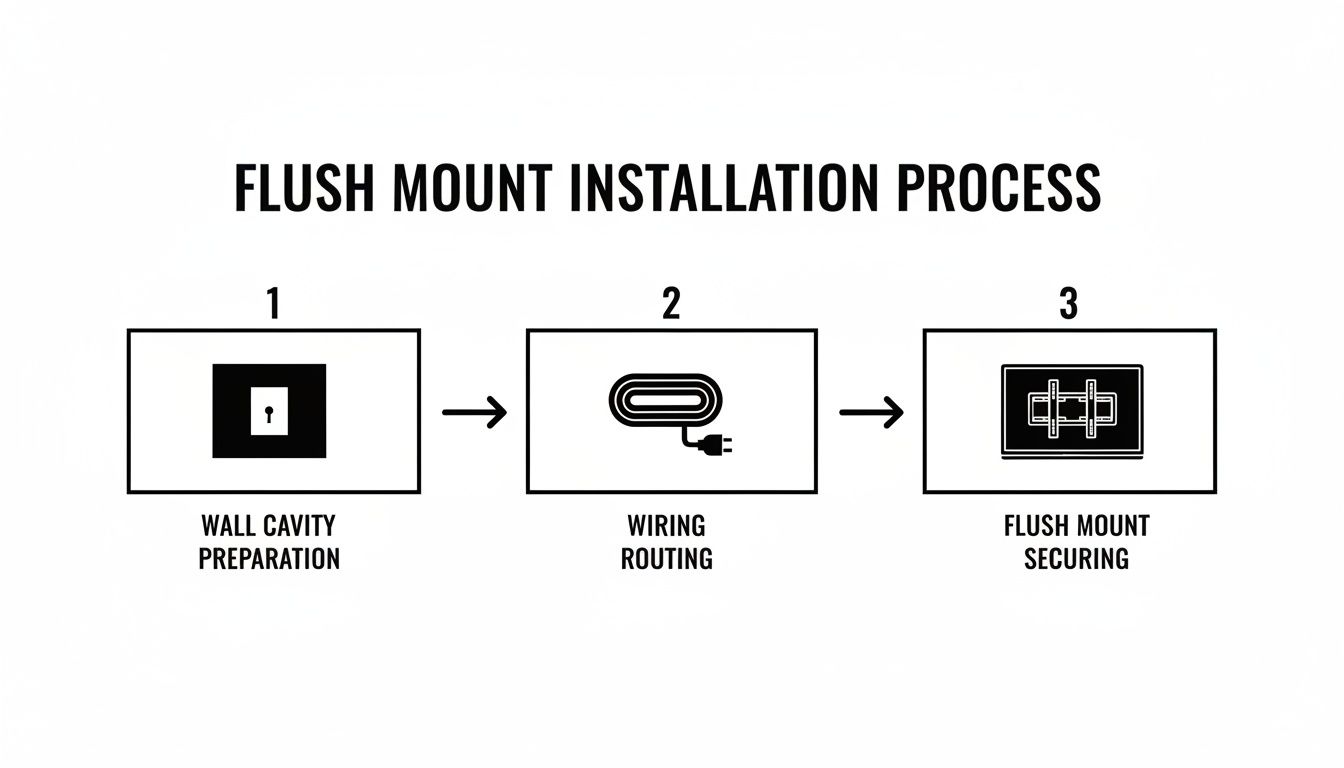
This diagram shows the critical groundwork—creating the wall recess, running all the necessary wiring, and getting that perfectly flush finish. This is the bedrock upon which a sophisticated smart home is built.
Here's a truth we've seen time and time again: none of this works without a rock-solid, enterprise-grade network. A weak or spotty Wi-Fi connection is the number one source of frustration in a smart home, leading to buffering video, lights that don't respond, and voice commands that go nowhere.
That’s why, for every home project we do—whether it’s a full new home build or a simple living room upgrade—we build the digital backbone on a robust Ubiquiti network. Unlike the mesh systems you can buy at a big-box store, Ubiquiti gear is designed to handle the massive bandwidth demands of dozens of connected devices all running at once.
A powerful network ensures your LG OLED wallpaper TV stays perfectly synced with its Zero Connect Box, your Sonos speakers stream hi-res audio without a hiccup, and your Josh.ai commands are executed instantly. It's the invisible infrastructure that makes the entire experience feel effortless.
And with today's technology, that performance is non-negotiable. The latest 2026 OLED evo models, including the Wallpaper TV, are pushing 4K resolution at a blazing 165Hz refresh rate. With NVIDIA G-SYNC and AMD FreeSync Premium certification, they are a gamer's dream, delivering buttery-smooth, tear-free gameplay. All that power, managed by the new Alpha 11 AI Processor Gen 3, needs a network that can keep up.
Our expertise doesn't stop at the living room wall. We believe in creating a single, cohesive system that extends across your entire property. The same intuitive control system for your home theater can also manage your outdoor spaces. We often tie in systems for:
This unified approach is what turns a collection of devices into a truly intelligent home. If you're ready to explore this level of integration for your own space, take a look at our complete guide to home entertainment and automation.
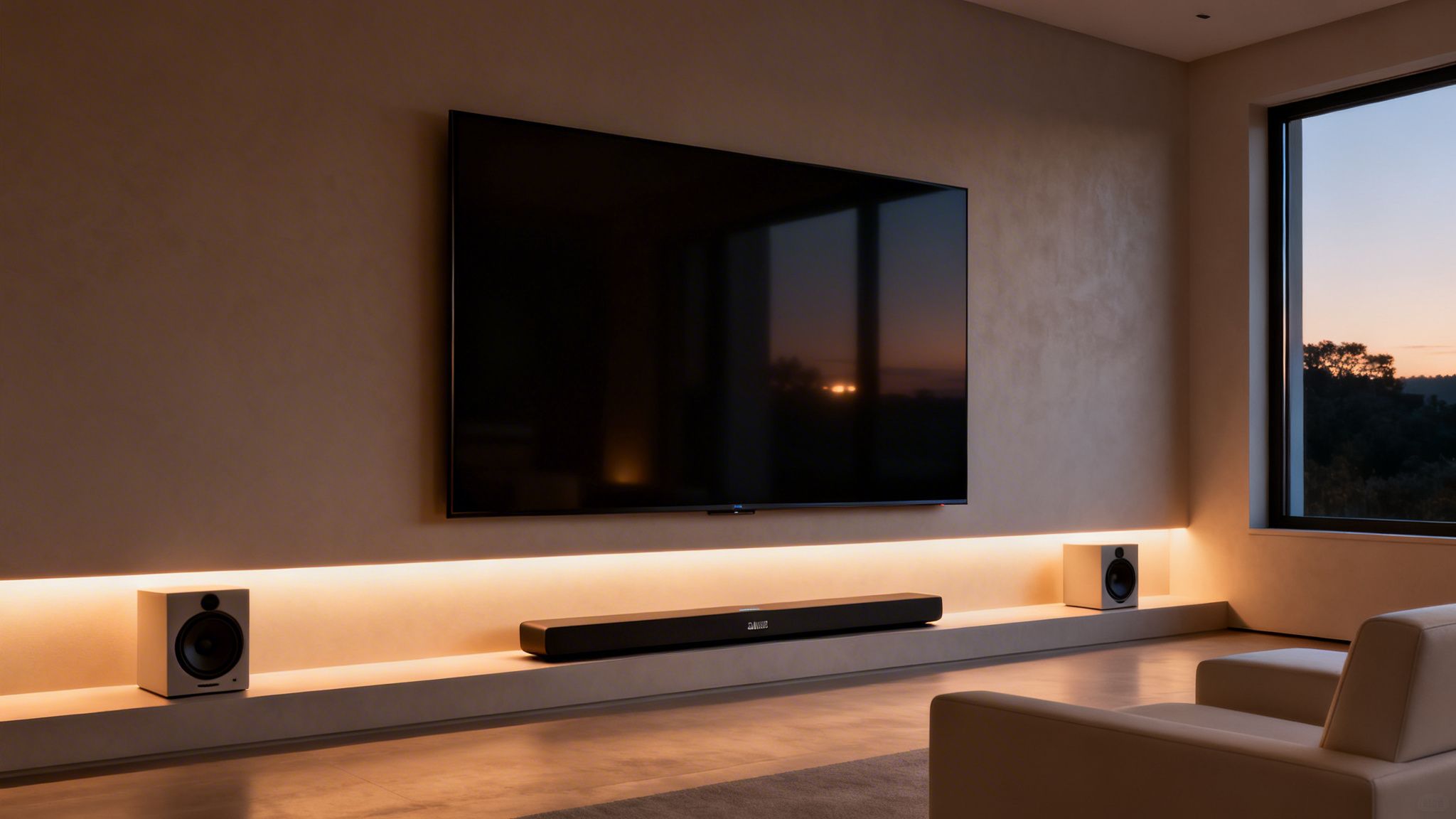
A screen as stunning as the LG OLED wallpaper TV demands an audio and lighting setup to match. Its perfect blacks and incredible color are just the beginning. The real immersion kicks in when the sound and lighting work in concert with the picture, creating a complete atmosphere that draws you right into the story.
At Home AV Pros, this is a cornerstone of our philosophy for every custom home theater we design. The Wallpaper TV’s ultra-clean, flush-mount look sets a high standard, and the audio system has to meet that same level of performance and subtlety.
For anyone aiming for a truly invisible setup, in-wall and in-ceiling speakers are the way to go. We install architectural speakers that sit perfectly flush with the drywall; they can even be painted to match the wall color. The result is powerful, immersive surround sound with no visible boxes or wires, preserving the clean lines of your room.
A fantastic and increasingly popular alternative is a high-performance Sonos soundbar, usually paired with a wireless sub and rear speakers. This gives you a surprisingly robust home audio experience with a very small physical footprint. It also integrates beautifully into a whole-home audio system, so you can stream music throughout the house when the TV is off.
The best audio for a Wallpaper TV is the audio you hear, not see. Whether it's through perfectly integrated in-wall speakers or a sleek Sonos system, the goal is to create immersive sound that doesn't compete with the room's design.
Deciding between these two paths often comes down to the room itself and what you're trying to achieve. In a new home build, we can plan for a complete architectural speaker system from the ground up. For an existing living room, a Sonos system offers a much simpler upgrade path without sacrificing quality. Our guide on how to set up surround sound speakers will give you a better sense of what a full system involves.
A great entertainment space doesn't have to stop at the sliding glass door. We believe in creating a seamless flow from your living room to your patio, deck, and yard. The same smart home system controlling your home theater can just as easily manage your entire outdoor atmosphere.
We often tie in landscape lighting and sound to extend the vibe outside. Imagine hosting a party where the music from your indoor Sonos system is playing in perfect sync on discreet landscape speakers hidden in your garden beds.
A great example is our work with Oelo, a company that makes permanent, color-changing exterior lights. We can install these along your roofline, and you can control them using the same Lutron app or voice commands you use inside. Set them to a warm, ambient white for a quiet evening, or program custom color scenes for holidays and parties—all from one place.
After your LG OLED wallpaper TV is mounted and the audio is dialed in, there's one last step that truly makes a difference: professional video calibration. This is something most people skip, but it's critical. Right out of the box, a TV is tuned to look good in a bright retail showroom, not your home. The factory settings almost always have whites that are too blue, exaggerated colors, and crushed black levels.
Professional calibration involves using specialized light sensors and software to fine-tune the TV's dozens of picture settings. We measure the light in your specific room and adjust the display to meet the exact industry standards for color, brightness, and contrast.
This process ensures you’re seeing the picture precisely as the director and colorist intended. The result is a far more natural, accurate, and cinematic image that’s perfectly matched to your room’s unique lighting. It's the final polish that unlocks the full potential of your investment, turning a great TV into an exceptional one.
While we live and breathe high-end home installations, the truth is, the same principles of rock-solid reliability and a flawless finish apply everywhere. The obsessive attention to detail that goes into a perfect LG OLED wallpaper TV installation is exactly what a commercial space needs to stand out. Our expertise isn't just for living rooms; we bring that same level of polish and performance to local businesses like restaurants.
Think about it: the powerful Ubiquiti network we design for a sprawling smart home is built on the same foundation needed for a restaurant or office. A stable, high-speed network is the non-negotiable backbone for any modern business, keeping everything from your point-of-sale terminals to your guest Wi-Fi running without a hitch.
That invisible, flush-mounted TV in a living room? We use the exact same techniques to create sophisticated, wire-free presentation screens in boardrooms and lobbies. It’s all about creating a professional look that keeps the focus where it should be—on your business, not on a tangle of cables.
We work with restaurants, new commercial builds, and other local businesses to give them systems that are not only powerful but also incredibly simple to use. Staff shouldn't need an engineering degree to change the music.
Some of our most common commercial projects include:
Whether we’re designing a state-of-the-art home theater with a Kaleidescape movie server or a multi-zone audio system for a bustling restaurant, the goal is always the same: technology that just works, simply and reliably.
The stunning quality of the LG displays we install today didn't happen overnight. It's built on a long history of pushing the envelope. LG Display’s journey started with a tiny 15-inch OLED TV panel back in 2009. By 2013, they were the first to mass-produce 55-inch OLED TV panels, which really kicked off the whole OLED TV era.
Here in 2026, LG is celebrating 13 consecutive years of OLED leadership. That commitment is something we see firsthand in the quality of every LG OLED wallpaper TV we install. You can actually trace this impressive history and discover the full heritage of OLED technology on LG Display's news site.
From a new construction home getting a fully integrated system with Josh.ai and Lutron, to a commercial space needing a robust and reliable AV setup, our team at Home AV Pros brings the same expert execution to every job. We pour our passion for custom home theaters, new home builds, and high-performance home audio solutions into every project, ensuring you get an exceptional result.
So, you're looking at getting an LG OLED Wallpaper TV. That's fantastic. But after the initial "wow factor," the practical questions usually start rolling in. It’s a completely different animal than a standard TV, and the installation is where a lot of people get hung up. We get these questions all the time, so let's walk through the big ones.
While the TV itself is incredibly light, the real goal is to make it look like it's part of the wall. For that, you need a perfectly flat surface, and drywall is almost always the easiest to work with. A truly seamless look requires a recessed backbox, which is where the TV's magnetic mount lives.
Now, what about trickier surfaces like brick, stone, or a fireplace surround? That’s where things get interesting. It’s absolutely possible, but it demands specialized tools and a solid plan. A professional site survey from a team like Home AV Pros becomes non-negotiable here. We have to figure out the wall's structure, plot a course for hiding cables, and design a mounting strategy that looks invisible without messing with your home's integrity.
The secret sauce here is the LG Zero Connect Box. It’s a game-changer. This box is the brain of the operation—it handles all your HDMI inputs, power, and everything else—and it connects to the screen wirelessly. No more ugly cable bundles running down your wall.
Our job is to find the perfect hiding spot for that box. Usually, it's tucked away in a media cabinet, a custom credenza, or even a nearby closet. All your sources, whether it's a Kaleidescape movie server or your kids' gaming console, plug directly into the box. The result? Your wall stays completely clean, with nothing but the stunning LG OLED wallpaper TV on display.
The biggest mistake we see is people treating the Zero Connect Box as an afterthought. Its location dictates the entire flow of your setup. That's why we lock down its placement with you right at the start of the design phase, making sure it’s both practical and invisible.
Honestly, this isn't your weekend DIY project. A flawless Wallpaper TV install is a blend of different trades, and getting it wrong can be a costly headache. It really comes down to three key skills:
A DIY attempt often leaves you with a TV that sticks out, wires you can still see, or a system that just doesn't work together. We make sure the look is flawless and everything just works. It's what we do every day, whether it’s for a high-end custom home theater, a new home build, or a sleek restaurant that needs a polished look.
By itself, it’s just an incredible screen. But when we integrate it into a control system like Josh.ai, it becomes the heart of your entire smart home. Imagine using a simple voice command like, "Hey Josh, it's movie night." Instantly, the lights dim, the shades close, and the film starts playing.
The TV's status can even trigger other events. For example, turning the TV on could automatically switch the lights to your preferred viewing scene. It stops being a passive device and starts being an active part of your home’s ecosystem, all running on a rock-solid Ubiquiti network we’ve designed to handle the load. That’s the real difference between just owning smart gadgets and living in a truly smart home.
We know that a project like this can feel a bit daunting, so we've put together a few more common questions we get from clients.
| Question | Answer |
|---|---|
| How long does the installation take? | A standard installation on drywall typically takes 4-6 hours. Installations on complex surfaces like stone or brick can take a full day or more, depending on the scope. |
| What is the estimated cost of a professional installation? | While the cost can vary based on your specific needs, a standard installation usually starts around $800 – $1,200. This includes framing, mounting, wiring, and basic setup. |
| Can I paint the wall after the TV is installed? | No. All wall preparation, including painting, must be completed before the TV is mounted to achieve a clean, seamless finish and avoid damaging the screen. |
| Is the Zero Connect Box included with the TV? | Yes, the LG OLED M Series Wallpaper TVs come with the Zero Connect Box. It is an essential part of the system. |
| How far can the Zero Connect Box be from the TV? | LG specifies a range of up to 30 feet with a clear line of sight for optimal wireless 4K 120Hz transmission. Walls and furniture can reduce this range. |
Hopefully, this gives you a clearer picture of what's involved. When you’re ready to transform your space with the ultimate in design and technology, the team at Home AV Pros has the expertise to make your vision a reality. We handle it all, from initial design to final calibration for new home builds, custom home theaters, home audio solutions, and even landscape lighting and sound. Contact us today for a free consultation and let's create something amazing together.

Copyright © 2026. Home AV pros. All rights reserved.