
You’re probably at one of two points right now. You’re building or remodeling a home and trying to make the right low-voltage decisions before the walls close, or you already know you want music beyond a single soundbar and don’t want to regret a pieced-together system later.
That’s where whole home audio system design either pays off for years or becomes a series of small annoyances. Bad zoning, weak amplification, visible gear, unreliable Wi-Fi, and awkward control all show up after move-in, when changes cost more and feel harder. Good design does the opposite. It lets music follow the way you live, keeps hardware out of sight, and folds audio into lighting, shades, theater, and voice control so the house feels coherent instead of tech-heavy.
For homeowners and builders, the biggest shift is this: whole-home audio isn’t a speaker purchase. It’s a design discipline. The right plan accounts for architecture, family routines, smart home priorities, and the finish level you want to preserve.
A strong system starts with questions, not equipment. The first conversation should be about routines. Where do you start the morning, where do you host, where do you want quiet, and where should sound move with you without needing constant app control?
That’s how audio zones should be defined. Not by a floor plan alone, but by behavior. A kitchen, breakfast nook, and patio might operate as one entertainment area on weekends but need separate control during the week. A primary bath might only need gentle background audio, while a gym or theater lounge needs more output and more deliberate speaker placement.
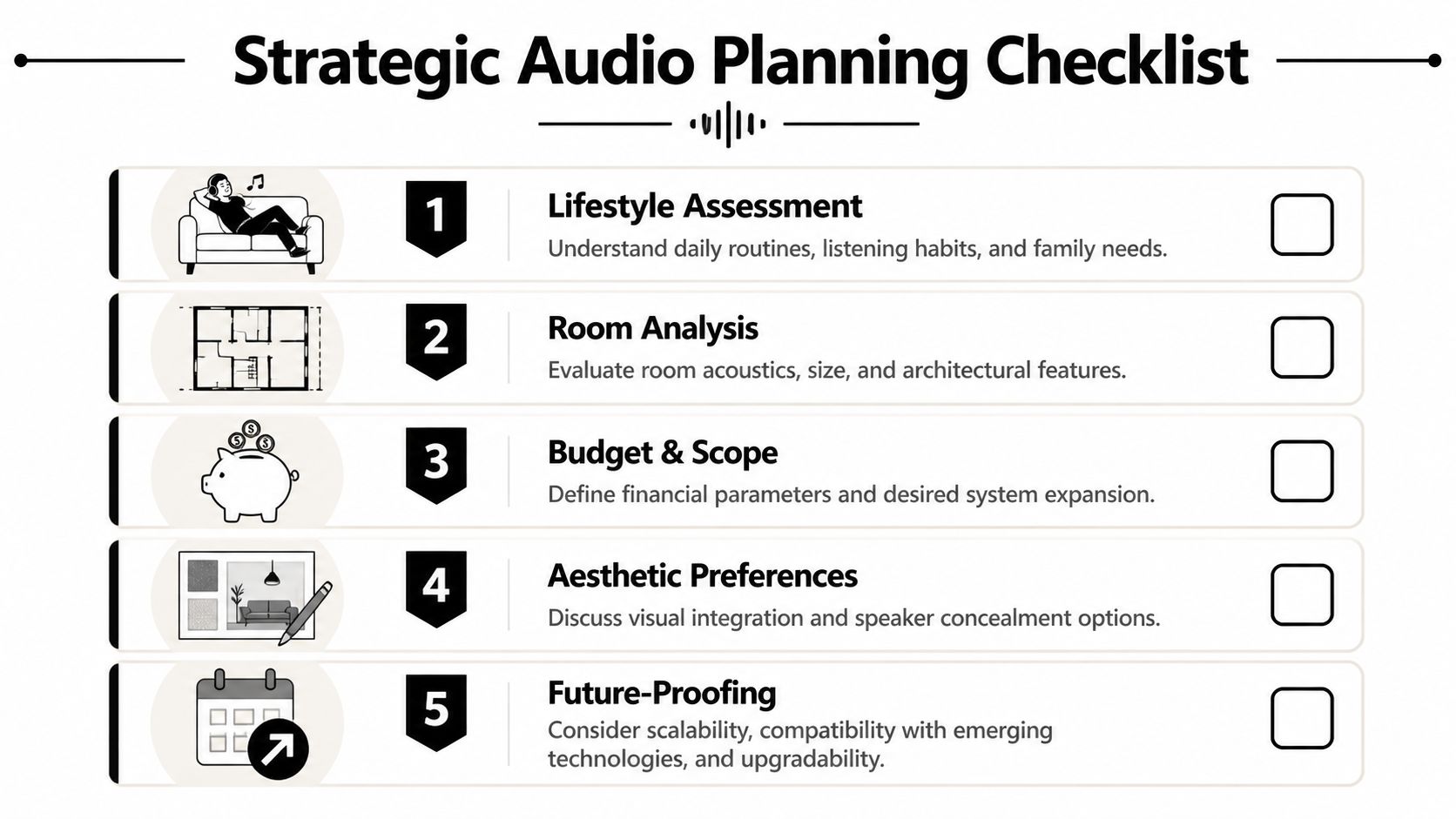
A useful planning session usually answers a few practical things:
Daily-use rooms
Identify the spaces that need music most often. Kitchens, primary suites, patios, offices, and gyms usually matter more than hallways.
Shared versus private listening
Some rooms should group together easily. Others should stay independent so one person’s playlist doesn’t spill into someone else’s quiet space.
Entertainment priorities
Decide early whether the home is optimized for background music, focused listening, movie nights, or all three.
Control habits
Some clients want app-only simplicity. Others want wall keypads, voice commands, or scenes tied to lighting and shades.
Practical rule: If you can’t describe how each zone will be used on a normal Tuesday and a busy Saturday, the zoning plan isn’t finished.
This part can’t be treated casually in new construction. Whole-home audio system sizing and zoning has to be decided during pre-construction because the wired infrastructure can’t be easily changed after drywall installation. A typical home between 3,000 and 5,000 square feet often needs four to eight dedicated audio zones, with each zone returning on its own speaker wire to a central equipment location in a home-run topology, according to this whole-house audio planning reference.
That same planning stage also determines cable routing, central rack location, and whether you’re installing the backbone for future upgrades. The infrastructure usually includes speaker wire, Cat6, and conduit during rough-in. That’s why audio planning belongs alongside lighting, electrical, HVAC, and millwork decisions, not after them.
For remodeling projects, it helps to review what’s realistic before finishes are selected. A smart home renovation plan often works best when audio, lighting control, networking, and concealment details are coordinated as one package rather than added room by room.
A good plan leaves headroom. It supports today’s listening habits without locking the home into one app, one source, or one room layout forever.
What doesn’t work is guessing. “We’ll add speakers later” usually means visible compromises, fewer zone options, and less reliable performance.
The cleanest audio systems usually disappear into the architecture. You notice the coverage, not the hardware. That only happens when placement is designed around both acoustics and sightlines.
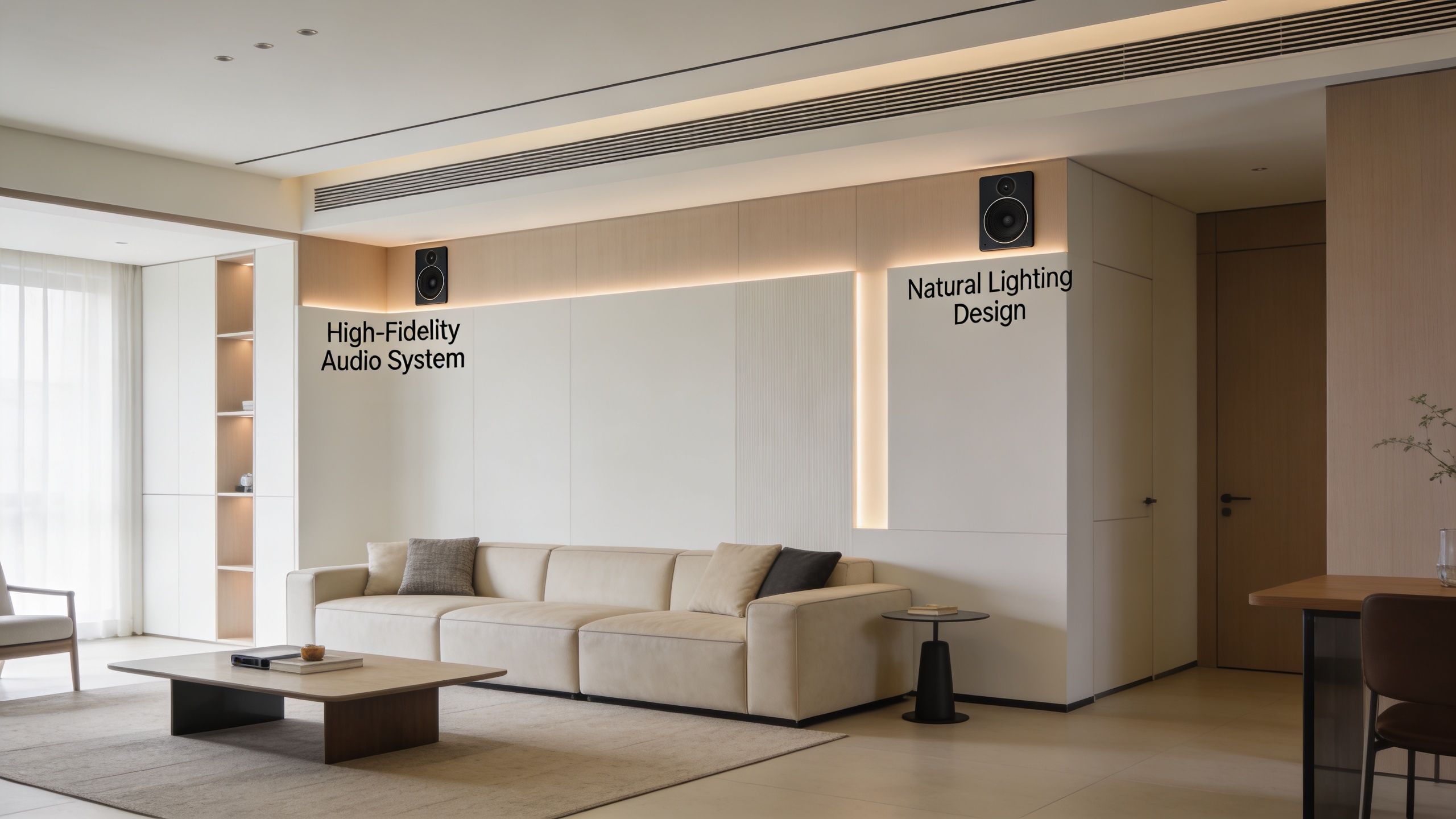
Not every room needs the same speaker approach.
| Room priority | Usually works best | Why |
|---|---|---|
| Background music | In-ceiling speakers | Clean look, even fill, minimal visual impact |
| Focused listening or TV adjacency | In-wall speakers | Better directional performance and stronger front-stage orientation |
| Design-first interiors | Invisible speakers | Preserves architecture where grilles would interrupt finishes |
| Outdoor living | Weather-rated landscape or patio speakers | Better durability and more controlled coverage outdoors |
In-ceiling speakers are often the right answer for kitchens, hallways, baths, and casual living areas. They keep the room visually quiet and distribute sound evenly when placed correctly. In-wall speakers make more sense where listening direction matters, especially in media rooms, lounges, or spaces that blend music and TV use.
Invisible speakers can be the right move in highly detailed interiors, but only if expectations are clear. They solve a design problem first. In the right application, that’s valuable. In the wrong room, they can be the wrong compromise.
Open plans and irregular rooms are where generic advice starts to fail. Existing content often skips practical strategies for L-shaped rooms, alcoves, and sloped ceilings, even though those details change how sound behaves.
According to this guide on speaker coverage and room geometry, 40% of U.S. homes have non-rectangular living areas. It also notes that sloped ceilings can direct first reflections away from the listener, improving clarity, and L-shaped corners can augment bass without boominess when speakers are placed strategically at leg junctions.
That matters in real homes. Vaulted great rooms, kitchen-family room combinations, and long transitional spaces rarely behave like a rectangular demo room.
A speaker layout that looks symmetrical on paper can still sound uneven once ceiling height, glass, millwork, and furniture placement enter the picture.
For homeowners comparing options, a surround speaker placement guide is useful background, but whole-home design adds another layer. You’re not only chasing imaging. You’re balancing coverage, aesthetics, and room-to-room consistency.
Good placement respects lighting trims, beams, vents, and cabinetry. It also respects what the room is trying to feel like. If the ceiling ends up cluttered with mismatched grilles, access panels, and downlights, the system feels inserted, not integrated.
The best designs coordinate with the architect, builder, and interior designer early. That’s how speakers land where they sound right and look intentional.
Most homeowners start by asking a brand question. The better question is architectural: should the system be wired, wireless, or a combination of both?
The answer changes reliability, sound quality, flexibility, and how visible the system becomes over time.
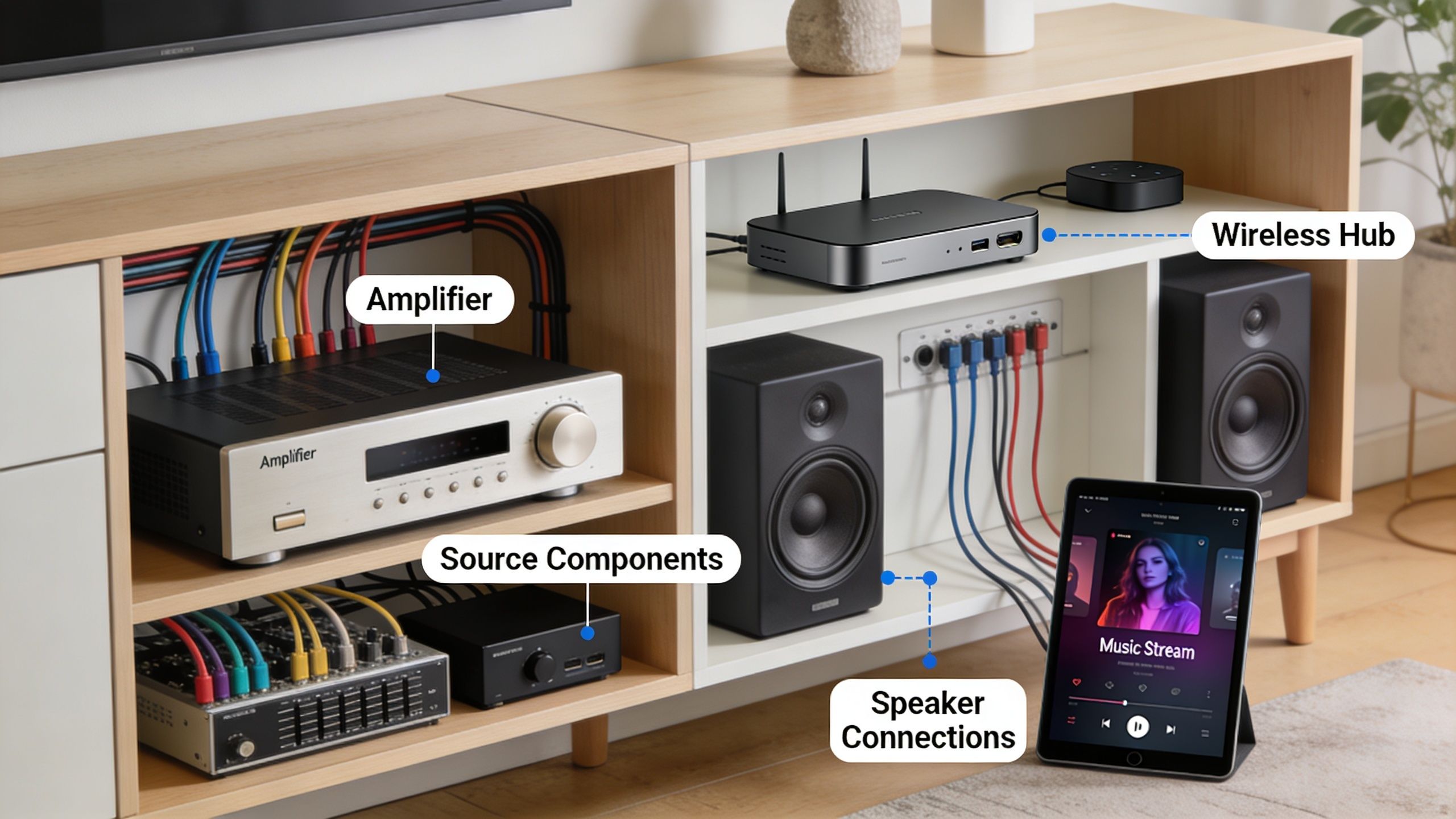
Fully wired systems are ideal when the house is being built or heavily renovated. Speakers connect back to a central equipment location, and control is layered on top. This approach keeps hardware hidden and delivers the most consistent performance.
Fully wireless systems are attractive in finished homes because they avoid opening walls. Sonos made this path familiar for a reason. It’s approachable and easy to expand. But wireless-only design can become limiting in larger homes, in outdoor areas, or wherever the network is uneven.
Hybrid systems combine both. They use wired speaker infrastructure where performance and permanence matter most, then add wireless control or flexible expansion where that makes sense.
The majority of residential installations use a hybrid architecture that combines wired speaker infrastructure with wireless control systems like Sonos, according to this whole-home audio system guide. That approach balances the fidelity and reliability of hard-wired systems with the convenience of wireless multi-room control.
In practice, that often means this:
Even a mostly wired audio system depends on a solid network when streaming, control, voice, and app-based automation are involved. That’s why network design should be treated as part of the audio system, not as a separate afterthought.
A Ubiquiti-based network is often a strong fit when the goal is stable device management, better coverage, and cleaner scaling across larger homes. If the house has dead spots, overloaded access points, or an undersized router, wireless control suffers first and homeowners usually blame the audio system.
A practical starting point is to review how to improve Wi-Fi signal strength before deciding that “wireless audio is unreliable.” In many homes, the issue isn’t the speaker platform. It’s the network under it.
Once the architecture is set, component selection gets much easier. People often overspend in the wrong places at this stage. They chase flashy source devices and ignore the amplifier, or they pick speakers based on a showroom demo without considering room size, ceiling height, or intended use.
The right system is a chain. Each part has to fit the others.
In distributed audio, the amplifier does the heavy lifting. It determines whether in-ceiling and in-wall speakers sound composed and effortless, or thin and strained when more than one zone is active.
According to this overview of whole-home audio amplification, multi-zone systems typically require 8 to 16 channel amplifiers delivering 40 to 120W RMS per channel into 8 ohms. The same reference notes that insufficient wattage can keep speakers from reaching 85 dB SPL at a 10-foot distance in a 400 square foot room, while a properly matched amplifier can achieve over 100 dB cleanly, meeting THX performance benchmarks and reducing distortion.
That’s why “good enough” receivers often disappoint in whole-home audio. They may work in one room. They don’t always scale gracefully across multiple zones.
If the speakers are built into the house, power quality matters more, not less. You can’t move an in-ceiling speaker three feet closer because the amp came up short.
Different listening habits call for different source strategies.
That last category matters because many homes don’t have one audio system. They have several listening experiences under one control umbrella. The kitchen and patio may run streaming audio all day, while a dedicated theater needs a different signal path entirely.
If you’re comparing rack-based options, a surround sound receiver buying guide helps clarify where an AVR belongs and where a dedicated multi-channel amp is the better tool.
A strong equipment plan usually includes:
That mix tends to age well because it’s designed around use, not hype.
The most satisfying audio systems don’t ask anyone to think like an integrator. They give you obvious ways to start music, adjust the mood, and move through the house without dealing with a stack of apps.
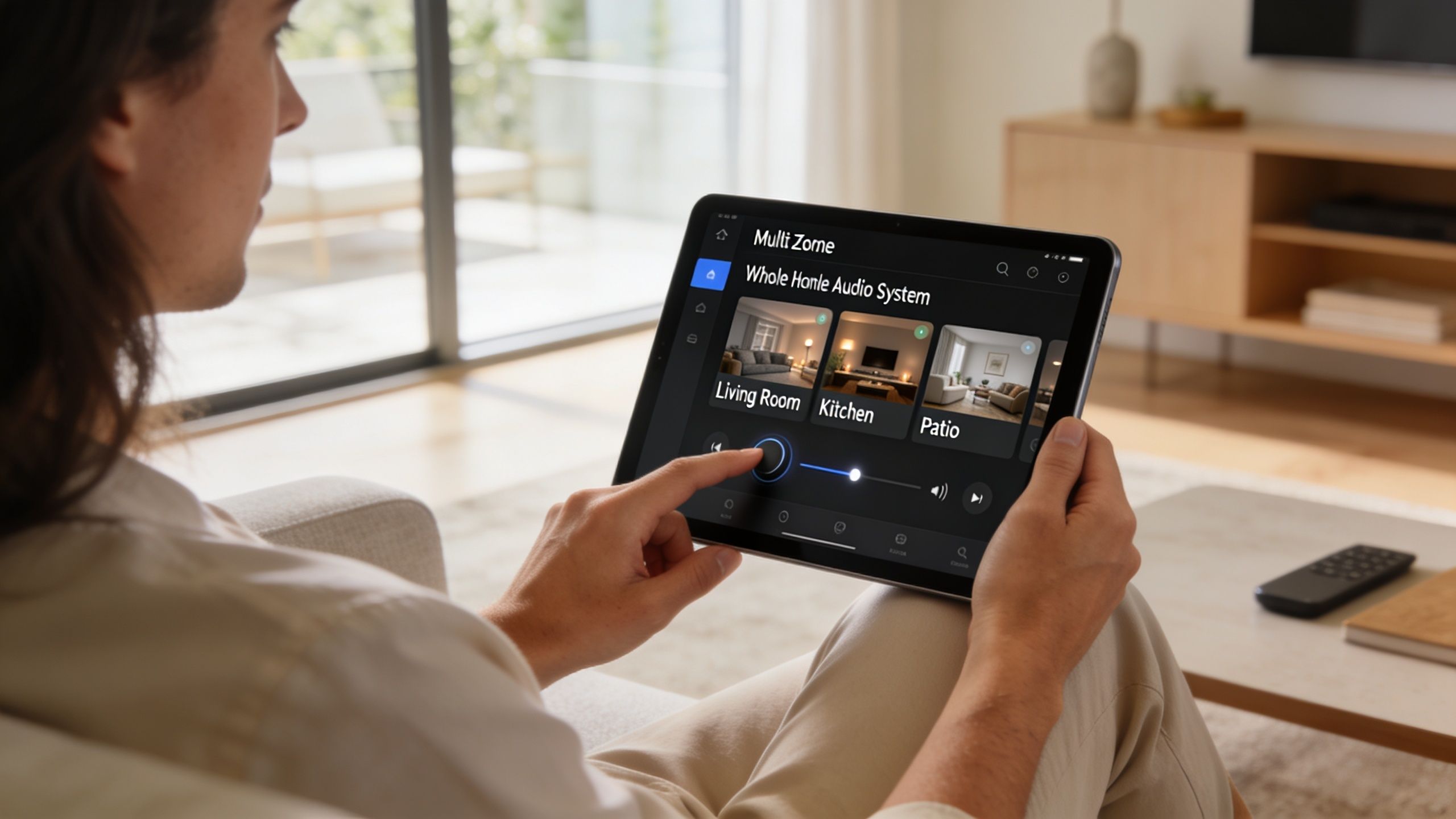
A well-integrated morning might look simple from the homeowner side. You walk into the kitchen, tap a Lutron keypad engraved for a “Morning” scene, and the under-cabinet lighting comes up softly while audio starts at a modest level. Later, a voice request through Josh.ai can move a playlist to the patio while interior zones stay unchanged. In the evening, Sonos provides familiar access to streaming services, but the experience feels unified because the lighting, shades, and audio all respond as part of one environment.
Different rooms benefit from different interfaces.
In a kitchen, a wall keypad is faster than opening a phone. In a theater lounge, a handheld remote or touch panel makes more sense. In a primary suite, voice can be the least intrusive option. The point isn’t to use every control method. It’s to choose the right one for the space and the people using it.
A few combinations work especially well:
Control is only part of consistent listening. The handoff between zones matters too. If audio sounds noticeably different from room to room, the system feels fragmented even if the app is polished.
A recent trend is the integration of AI-driven room correction with multi-room zoning, including updates tied to Josh.ai and Sonos partners, as described in this article on room acoustics and correction. That source says advanced AI such as Dirac Live can improve sound uniformity by as much as 18dB and help avoid the 30% degradation in quality that can occur at transition points between zones.
That’s especially relevant in homes with vaulted ceilings, open stair connections, and mixed flooring materials. Those conditions make one-touch control easy to appreciate, but they also expose acoustic inconsistencies quickly.
Here’s a useful demonstration of integrated smart home control in action:
Good control isn’t about adding buttons. It’s about reducing decisions.
When audio, shades, lighting, and theater sources are coordinated well, the home feels calmer to use. The technology doesn’t disappear because it’s hidden. It disappears because it behaves predictably.
The DIY approach usually looks economical at the start. Then the workarounds begin. A speaker drops off the network, one room is always too loud, the patio lags, the theater remote doesn’t talk to the rest of the house, and no one wants to explain the system to guests.
Some mistakes show up again and again.
Planning zones by room names instead of real use
“Living room,” “dining room,” and “patio” may look tidy on paper, but they don’t reflect how people entertain. The result is constant regrouping and awkward control.
Treating Wi-Fi as somebody else’s problem
Wireless audio control depends on network quality. If the home has poor coverage, overloaded gear, or weak outdoor signal, users blame the music system first.
Underpowering architectural speakers
In-wall and in-ceiling speakers need proper amplification. Cheap consumer gear often sounds acceptable at low volume, then hardens up or loses balance when several zones play at once.
Ignoring acoustics because the speakers are hidden
Hidden hardware doesn’t erase reflective glass, vaulted ceilings, stone surfaces, or room geometry. It just makes troubleshooting less obvious.
A whole-home system has dependencies. Audio touches framing, finish materials, power, rack space, network design, control programming, and sometimes lighting and shade integration. Consumer kits rarely account for all of those at once.
That’s why mixed systems become frustrating. One app controls a few rooms. Another app handles the theater. Voice works in some spaces but not others. Outdoor zones need separate steps. The house ends up with technology everywhere and convenience nowhere.
Professional planning doesn’t just install nicer hardware. It prevents conflict between systems and sets expectations room by room. That includes deciding where wireless is fine, where wiring is worth it, which rooms need stronger output, and which ones should stay subtle.
In practical terms, Home AV Pros handles that coordination across custom home theater, new home builds, restaurants, home audio solutions, and outdoor lighting and sound, with a primary focus on residential integration. That matters because a home audio system often sits inside a larger ecosystem that includes lighting control, networking, video distribution, and outdoor living spaces.
The biggest DIY mistake is assuming each piece can be chosen independently. In a finished home, every independent decision tends to create a connected problem.
The value in this process isn’t just sound quality. It’s alignment. The zones match your routines, the speakers respect the architecture, the rack is sized for growth, and control feels natural enough that everyone in the house will use it.
That’s why whole home audio system design works best when it’s approached as part of the broader home experience. A kitchen audio zone may need to coordinate with Lutron lighting scenes. A patio may need both music and outdoor lighting. A media room may overlap with a custom home theater plan built around Kaleidescape. A new build may need conduit, Cat6, and speaker wiring planned alongside automation, Wi-Fi, and finish selections.
For homeowners, builders, and remodelers, timing matters as much as product choice. Early coordination protects aesthetics and reduces expensive compromises later. If you’re still in the builder-selection stage, this comprehensive guide for Brisbane homeowners is a good reminder that construction decisions and technology outcomes are tied together more closely than most people expect.
In southern Wisconsin and nearby northern Illinois, that integrated approach often means one team handling more than audio alone. The same project may include smart home control with Josh.ai, lighting and shade integration through Lutron, Sonos-based music distribution, a dedicated theater, Ubiquiti networking, outdoor sound, Oelo permanent lighting, or low-visibility AV for design-driven interiors.
For homeowners around Madison, Milwaukee, Rockford, and surrounding communities, the practical goal is simple: build a house that sounds right, looks right, and stays easy to live with long after move-in.
If you’re planning a new build, renovating, or trying to bring order to an existing mix of speakers, networking, and smart home gear, Home AV Pros can help you map the system before small decisions become expensive ones. Start with the rooms you use most, the control experience you want, and the level of finish your home deserves.

Copyright © 2026. Home AV pros. All rights reserved.