
By day, a well-designed home does a lot of quiet work. The stone on the front elevation catches light the right way. The steps to the patio feel intentional. The planting beds soften hard edges. The backyard becomes the place where dinner lingers and guests stay later than planned.
Then the sun goes down, and a lot of that disappears.
That's usually the point where homeowners start looking seriously at outdoor lighting design services. Not because they want brighter yards, but because they want the home to feel complete after dark. Good exterior lighting brings architecture back into view, gives pathways shape, makes outdoor living usable at night, and ties the property into the rest of a smart home instead of leaving the exterior as an afterthought.
A common situation looks like this. The patio is finished. The grill station is in. The audio sounds great outside. Maybe there's even a pool, pergola, or outdoor TV. But once evening arrives, the only real light comes from a porch fixture, a few windows, and whatever spills out from the kitchen. The property doesn't feel unsafe exactly. It just feels unfinished.
Professional exterior lighting changes that.
Done well, it doesn't flood the yard. It layers light where people need it and where the home deserves attention. Walkways become readable. Trees regain depth. Stone columns, façade lines, and garden edges stay visible. A backyard starts working like another room of the house.
Homeowners are putting more value on that experience. The residential outdoor lighting installation and design market was valued at approximately USD 0.22 billion in 2024 and is projected to reach USD 0.55 billion by 2033, growing at a CAGR of 10.5%, driven by investment in outdoor living, security, and property value according to Business Research Insights on the residential landscape lighting market.
The shift isn't just visual. It's behavioral.
People use the backyard more often when it feels finished at night. They host more. They move between indoor and outdoor spaces without the jarring transition from bright interior light to darkness outside. If the property already includes music zones, outdoor seating, or a fire feature, lighting is what makes those elements feel connected.
For homeowners comparing styles and regional approaches, this guide to all-year outdoor lighting installation in austin tx is useful because it shows how year-round exterior lighting can be planned as part of the exterior design, not added as decoration later.
A lot of outdoor projects also stall because sound and lighting are designed separately. That usually creates mismatched controls, cluttered hardware choices, and dead spots in the entertaining areas. For a more cohesive backyard system, it helps to think about lighting and audio at the same time, especially in spaces built around dining, conversation, and media. Homeowners exploring that side of the project can also look at backyard audio system ideas.
Good exterior lighting doesn't try to make night look like day. It gives the eye enough structure to understand the property and enjoy being outside.
A well-designed exterior lighting system does more than make the property visible. It shapes how the home feels after sunset, how people move through it, and how easily those scenes tie into the rest of the smart home. Good results come from balancing appearance, wayfinding, security, and control. Fixture count by itself does not solve that.
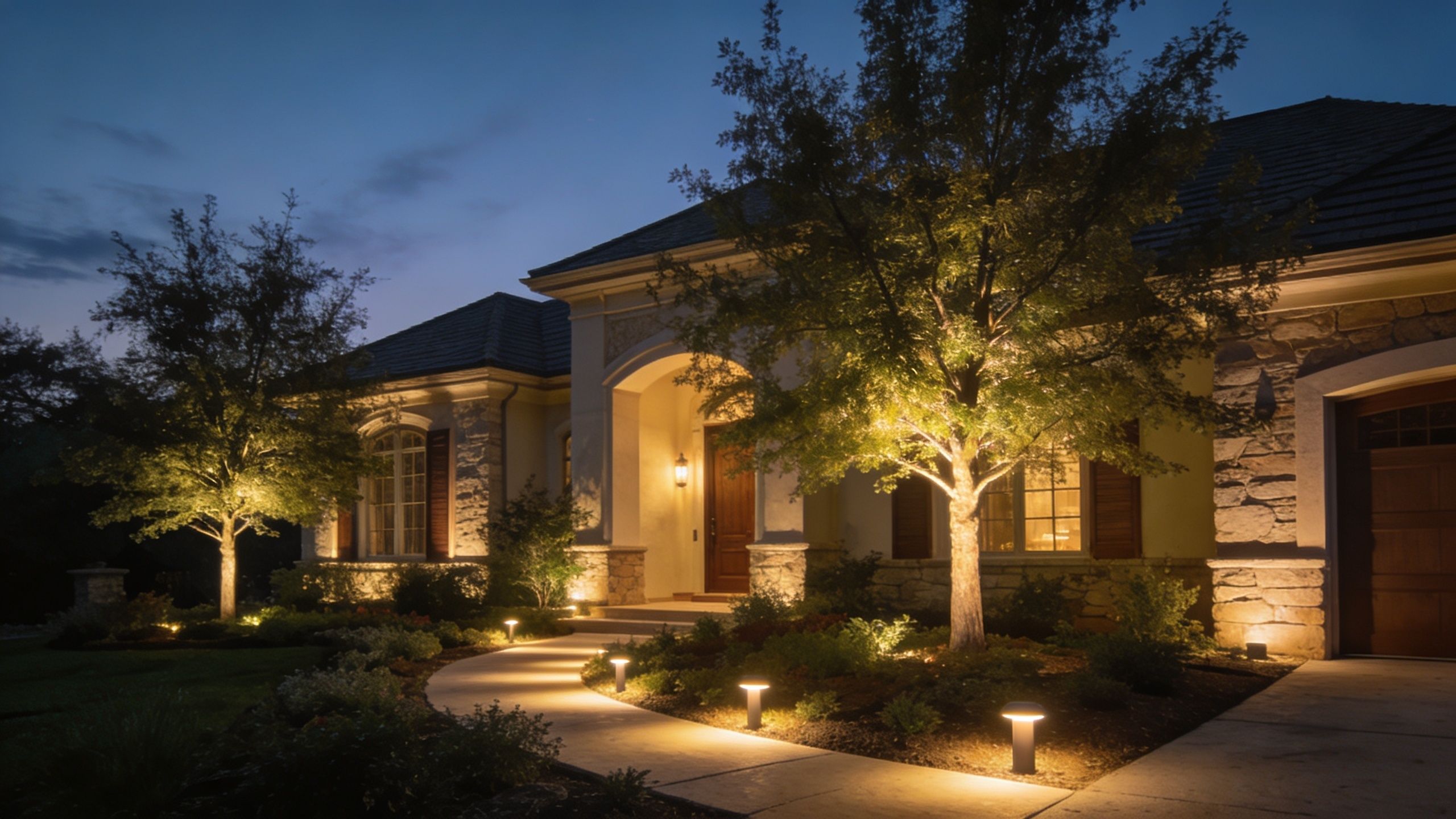
The house should read as a complete composition, not a collection of bright spots.
That takes more than adding path lights and a few uplights near trees. Beam spread, mounting position, output, shielding, and color temperature all affect what the eye notices first. A professional plan builds hierarchy so the entry feels welcoming, the architecture has depth, and planting areas support the scene instead of competing with it.
Uniform fixture selection is another common mistake. Different areas need different jobs done well. Paths need comfortable guidance. Facades need controlled grazing or washing. Seating areas often need softer, lower glare light than the front approach. When every fixture does the same thing, the property looks flatter and less intentional.
Good nighttime visibility comes from placement.
Steps, grade changes, gate paths, and transitions between hardscape and planting need enough light to read clearly without creating glare in the line of sight. That is especially important in homes where clients move from a bright kitchen, bar, or media room to the patio. If the eye has to fight extreme contrast, the space feels less usable.
Security also benefits from restraint. Side yards, secondary entries, and perimeter transitions should be visible, but flooding every corner with high-output fixtures usually creates harder shadows and a harsher look. The better approach is targeted coverage with controlled beam angles and the ability to call up brighter scenes when needed.
That is where integration matters. With systems such as Lutron and Josh.ai, lighting scenes can respond to arrival, bedtime, entertaining, or a late-night dog walk without adding wall clutter or another app. For a high-end home, exterior lighting should work like the rest of the house. Easy to call up, easy to adjust, and coordinated with audio, gates, cameras, and other outdoor technology.
Current LED fixtures support a level of control older systems rarely delivered in residential projects. Better dimming behavior, tighter optical control, longer service life, and lower power draw make layered lighting easier to justify and easier to maintain over time.
Technavio's market analysis reports that LED products hold a large share of this category and can use far less electricity than traditional options in the right applications. That efficiency matters because it allows more refined designs without the old penalty of frequent lamp changes and excessive energy use. See Technavio's outdoor lighting market analysis.
People notice when a home feels finished at night.
Buyers may not know fixture families or beam angles, but they recognize depth, comfort, and control. Professional work supports that impression because it looks integrated with the architecture and the way the home is used. It also leaves room for future additions. Outdoor audio zones, motorized shades, surveillance, and voice control all work better when the lighting system was planned as part of the larger technology stack.
A strong design usually follows three rules:
A lighting system can look impressive on install day and still disappoint six months later. The difference usually comes down to process. Good planning protects the visual result, the wiring, and the way the system fits into the rest of the home.
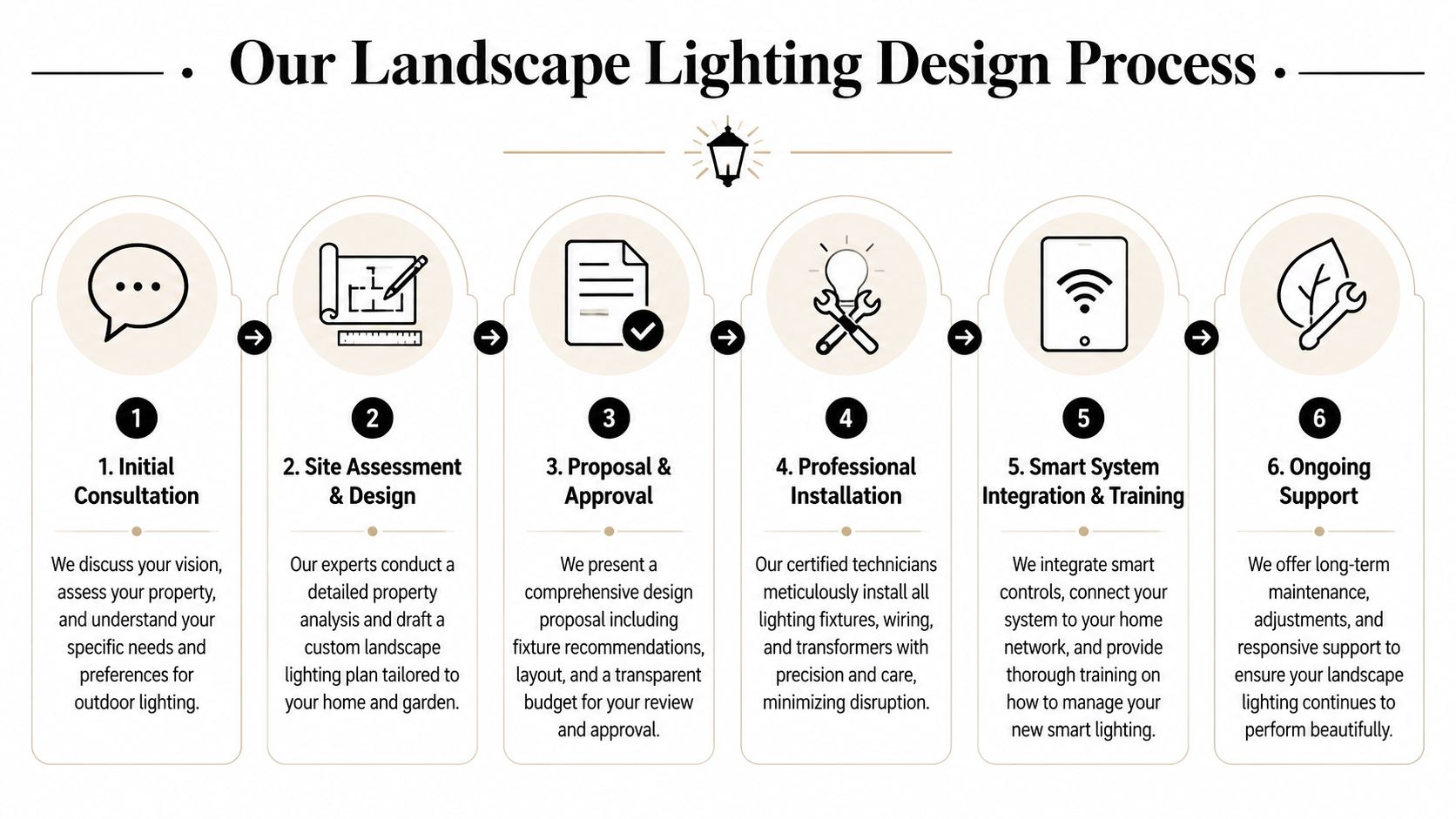
The first meeting should sound more like a lifestyle interview than a fixture discussion.
We ask how the home works after dark. Is the priority a cleaner front arrival, a pool deck that stays comfortable late into the evening, or a backyard that supports dining, audio zones, and casual entertaining? On higher-end projects, the answer often includes more than lighting. Keypads at the patio door, voice control through Josh.ai, scheduled scenes in Lutron, camera visibility, gate access, and outdoor music all affect how the plan should be built.
That early conversation prevents a common mistake. Treating exterior lighting as a separate add-on instead of part of the smart home.
Taste matters, but field conditions usually decide whether a plan performs well. Sightlines from inside the house, existing hardscape, mature trees, service access, drainage, fixture concealment, and transformer placement all need to be resolved before installation starts.
A practical design review usually includes:
Clients often collect visual references before this stage. A broad source of inspiration is landscape design ideas for your backyard, but the final plan still has to match the architecture, the control system, and how the family uses the space.
Practical rule: If a system cannot be adjusted cleanly after installation, the design was not finished.
The problems that hurt outdoor systems are rarely dramatic at first. A poorly placed transformer may be easy to ignore until service is needed. A weak connection may work through summer and fail after a wet Wisconsin freeze-thaw cycle. Fixtures set without enough thought to growth and maintenance often end up buried, tilted, or blocked within a season.
Low-voltage and automation expertise start overlapping at this stage. If the property also includes whole-home audio, outdoor Wi-Fi, surveillance, motorized shading, or lighting control from Lutron, the exterior lighting should be coordinated with those systems from day one. We treat conduit paths, rack locations, network coverage, and control programming as related decisions, because they are.
Programming is not a finishing touch. It is part of the product the homeowner lives with every day.
A well-programmed system feels easy because the scenes match real habits. “Arrive Home,” “Patio Dinner,” “Pool Evening,” and “All Off” make sense immediately. Voice control through Josh.ai should use natural phrasing. Lutron keypads should place the right scene at the right door. Outdoor audio and lighting should respond together when that makes the space easier to use, not more complicated.
That coordination is what separates a nice-looking install from a property that feels fully integrated after dark.
Fixture selection shapes what the property feels like after dark. A refined plan uses different fixture types for different visual jobs, then ties them back to how the homeowner uses the space. On higher-end projects, that also means choosing hardware and beam spreads that will respond well to scene control through Lutron and voice routines through Josh.ai, instead of treating the exterior as a separate system.
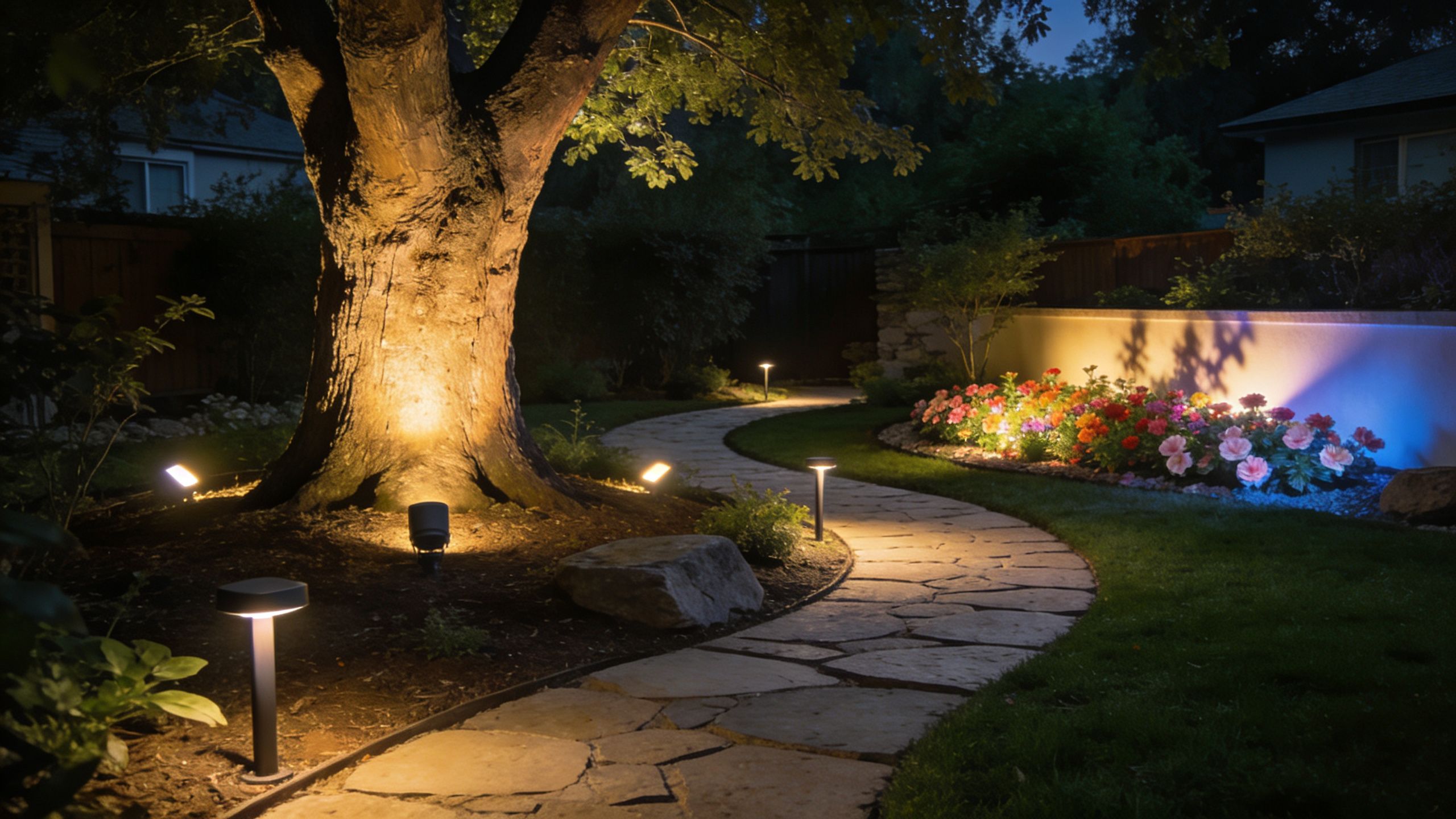
Each fixture category has a specific role, and the best results usually come from restraint.
A quick way to clarify visual priorities before the lighting plan is finalized is to review broader landscape design ideas for your backyard. That usually helps homeowners decide whether the emphasis should be architectural lines, mature trees, gathering zones, or a balanced mix.
The fixture catalog matters less than placement, shielding, and intensity.
Grazing brings out texture in stone, brick, and timber by placing the beam close to the surface. Shadowing projects branch and leaf patterns onto a wall or fence. Silhouetting sets a sculpture or specimen planting against an illuminated backdrop so the form reads cleanly. Wall washing creates an even, quieter spread across broad vertical surfaces.
These choices affect mood more than fixture count does. The same backyard can read as intimate, formal, relaxed, or dramatic based on aiming and output alone. In integrated homes, those looks also need to hold up across scenes. A dining scene should feel different from a late-night poolside scene, but both should still look intentional on the same property.
For homeowners thinking through the low-voltage side of the build, this guide on how to wire low voltage lighting explains why transformer sizing, cable routing, and fixture spacing have such a visible effect on the finished result.
A fixture list does not create atmosphere. Placement, beam control, and restraint do.
Permanent lighting has grown well beyond a seasonal add-on. Specified carefully, it can support everyday architectural accenting and still shift into holiday, event, or team-color scenes when needed.
The Q1 2026 permanent lighting trend reference shows growing interest in programmable exterior systems because they reduce seasonal setup, avoid temporary clips and extension cords, and make color changes easy from a control interface. That is why products like Oelo are showing up more often in higher-end residential plans.
Used carefully, they should support the main lighting design rather than overpower it. The best projects keep the daytime appearance clean, keep the nighttime look disciplined, and make the specialty scenes easy to call up from the same control system the homeowner already uses indoors.
Most outdoor lighting articles stop at fixtures and placement. That's only half the job. On a modern property, outdoor lighting should work with the rest of the house.
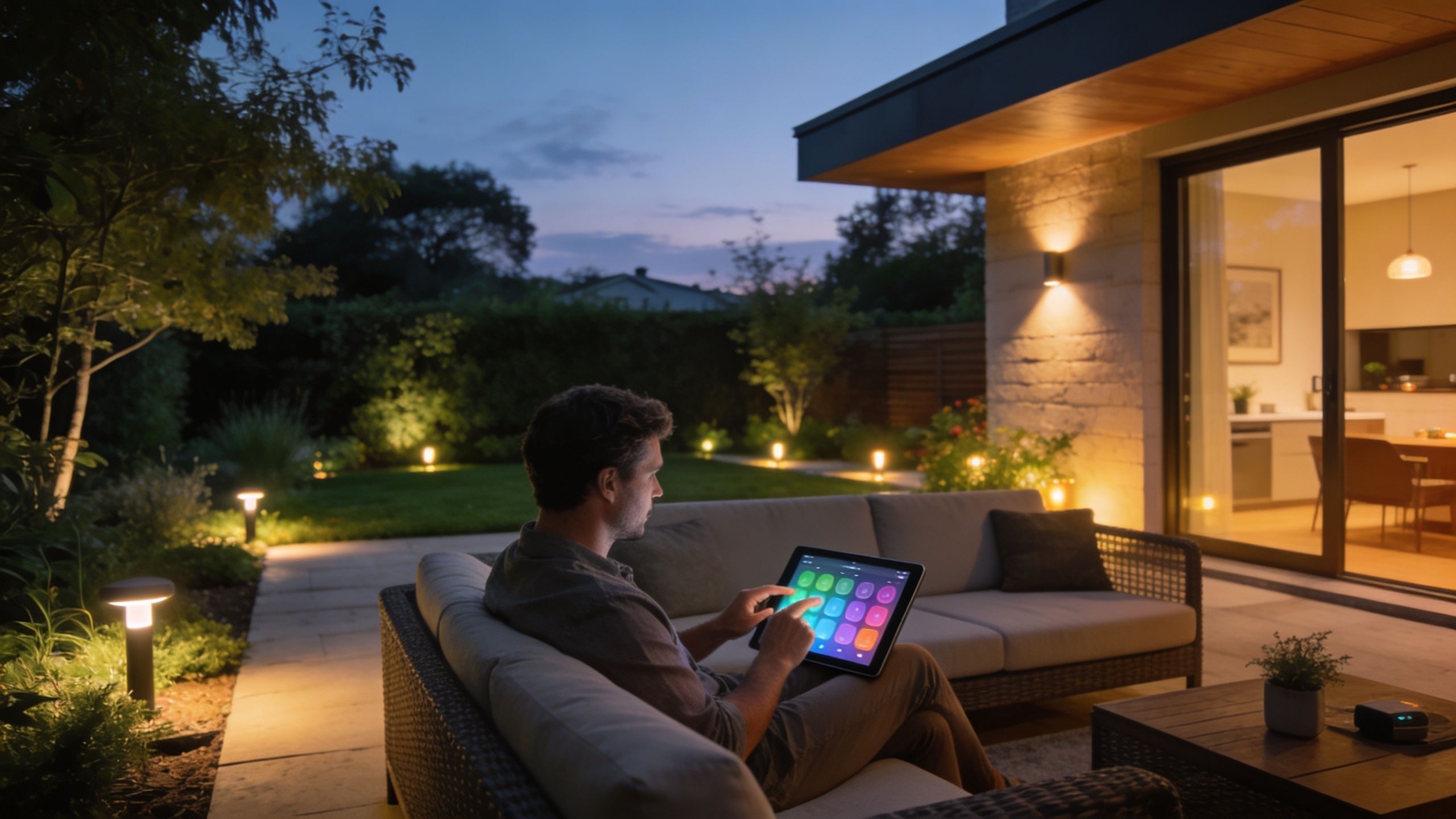
The smart-home gap is real. Data shows 68% of smart home owners prioritize multi-system integration for reliability, according to this smart home integration reference from Outdoor Lights. That aligns with what integrators see in the field. Homeowners don't want five apps and a collection of isolated outdoor devices. They want one predictable system.
That changes the design conversation.
A backyard lighting system tied into Lutron can follow dependable schedules, trigger scenes from keypads, and coordinate with shades or interior lighting logic. Add Josh.ai, and the homeowner can use natural voice commands that make sense in daily life. “Set the patio for dinner” is a better experience than opening an app and adjusting several zones manually.
The best integrations are simple enough to become habit.
Homeowners comparing integrated options can review smart home services for lighting, control, audio, and security to understand how these systems are usually grouped in a full residential design.
Here's a quick example of the kind of control environment many homeowners are aiming for:
A connected backyard depends on infrastructure. If the outdoor Wi-Fi is weak, app response is inconsistent. If cameras and control devices are scattered across consumer-grade gear, reliability drops. This is why many integrated projects include Ubiquiti networking or managed Wi-Fi planning along with lighting and AV.
The smartest outdoor lighting system isn't the one with the most features. It's the one that responds the same way every evening without anyone thinking about it.
A common sequence goes like this. The patio is finished, the speakers are in, the planting is done, and the control system is already making the house feel polished. Then night falls and the exterior still reads flat, dark, or uneven. Fixing that later is possible, but it usually costs more and limits fixture placement, wiring paths, and control options.
In Wisconsin, pricing depends less on square footage and more on decisions behind the scenes. Layout complexity, fixture selection, beam spread, transformer capacity, trenching conditions, and integration with platforms like Lutron and Josh.ai all affect the budget. Retrofit work also costs differently than prewire during construction. Frozen ground cycles, moisture, and seasonal debris push good projects toward better fixture bodies, sealed connections, and cleaner low-voltage routing from the start.
If the property is already being upgraded with audio, control, cameras, or motorized shading, this is also the right time to involve an experienced low-voltage wiring contractor for outdoor system planning. That coordination prevents the usual problem of isolated systems that work fine on their own but never work well together.
These are planning ranges for homes in the Madison and Milwaukee area. Exact numbers depend on site conditions, fixture counts, and how tightly the exterior lighting ties into the rest of the smart home.
| Project Scope | Typical Fixture Count | Estimated Cost Range |
|---|---|---|
| Small patio or entry lighting | 6 to 10 fixtures | Custom quote based on layout and controls |
| Foundation and pathway package | 10 to 20 fixtures | Custom quote based on layout and controls |
| Full property illumination | 20+ fixtures | Custom quote based on layout, controls, and integration |
A useful proposal should spell out the fixture package, transformer sizing, wiring scope, aiming and adjustment, programming, and any integration with Lutron, Josh.ai, Sonos, Oelo, or security devices. If those items are vague, the quote is not finished.
The return is partly financial and partly practical. Low-voltage LED systems use less power than older halogen setups, last longer, and reduce routine bulb replacement. That lowers operating costs over time, but energy savings alone are usually not the main reason clients move forward.
The stronger return shows up in how the property works every night. Arrival paths stay usable. Architectural details remain visible from inside. Outdoor dining and entertainment areas feel intentional instead of improvised. And when lighting is tied into the home's control platform, it becomes part of the same daily routine as whole-home audio, shades, and security scenes, instead of another app or timer someone has to remember.
That integration matters in higher-end homes. A well-designed exterior system can be part of a “Goodnight” command, a vacation schedule, or an arrival scene triggered through Lutron or Josh.ai. That is a different category of value than stand-alone decorative lighting.
A few choices carry more weight here than they do in milder climates:
Budget decisions get clearer when the property is divided by function. Start with the areas that need to work every night, such as entries, walking paths, steps, dining zones, and key views from inside the house. Accent lighting can follow in a second phase. That approach usually produces a better result than spreading the budget too thin across the whole yard.
At 10 p.m., the house should settle into its night routine with one command. Entry lights come on at the right level. Path lighting stays soft. The dining terrace holds its mood. Music, shades, security, and exterior lighting all respond together through the same control system. That only happens when the design partner understands more than fixture placement.
The right installer should be able to design the outdoor system as part of the home's larger technology plan. In higher-end projects, that means coordinating load types, control strategy, wiring paths, programming, service access, and how the property is used after dark. A contractor who only installs lights can make the yard brighter. A true integration partner makes the exterior feel like a natural extension of the smart home.
Restraint matters.
The best design partners can explain what to leave dark, how to avoid drawing attention to the wrong surfaces, and where automation adds convenience without making the system harder to use. That judgment is hard to fake. It usually shows up in the first conversation.
In southern Wisconsin and nearby northern Illinois, local experience changes the outcome. New construction requires coordination with builders, electricians, and programmers early enough to protect fixture locations and conduit paths. Retrofit work is different. It calls for careful wire routing, cleaner serviceability, and control upgrades that do not feel bolted on.
Regional property types also shape the design. A lake home has different exposure, reflection, and viewing priorities than a suburban backyard built around a patio and sports court. Some firms can install exterior fixtures. Fewer can also coordinate the audio zones, networking, cameras, automation scenes, and user interface that make the space easy to live with every night.
Choose the company that can discuss beam spread, corrosion resistance, dimming behavior, and programming logic in the same meeting. That combination usually leads to a better result and fewer compromises later.
Home AV Pros handles projects from a whole-home systems perspective. For clients who already expect polished control indoors, the exterior should work the same way, smooth to use, visually disciplined, and ready to support the way the home operates after dark.

Copyright © 2026. Home AV pros. All rights reserved.