
A lot of homeowners start in the same place. They buy a smart speaker, connect a few bulbs, maybe add a thermostat, and for a while it feels impressive. Then real life shows up. The kitchen light responds, but the patio speakers don't. The Wi Fi drops and voice control stops working. Someone says the room name slightly differently and the system guesses wrong.
That's the gap between smart gadgets and a smart home.
Good voice control home automation isn't about shouting at a plastic speaker across the room. It's about building a house that responds naturally, consistently, and privately. In a well-designed system, one phrase can trigger lighting, shades, music, climate, and video without making the homeowner think about apps, remotes, or which brand controls what.
For families investing in a serious home, especially in new builds, remodels, media rooms, and whole-home audio projects, voice should feel like one control layer among many. It should work when you need it, stay quiet when you don't, and fit into the design of the house instead of taking it over.
You come in through the garage with groceries in both hands. Instead of fumbling for switches or opening three different apps, you say, “Hey Josh, I'm home.” The entry lights come up softly. The kitchen pendants fade on. The thermostat shifts to your evening setting. Sonos starts the playlist you usually use at dinnertime.
That's the version of voice control that actually matters.
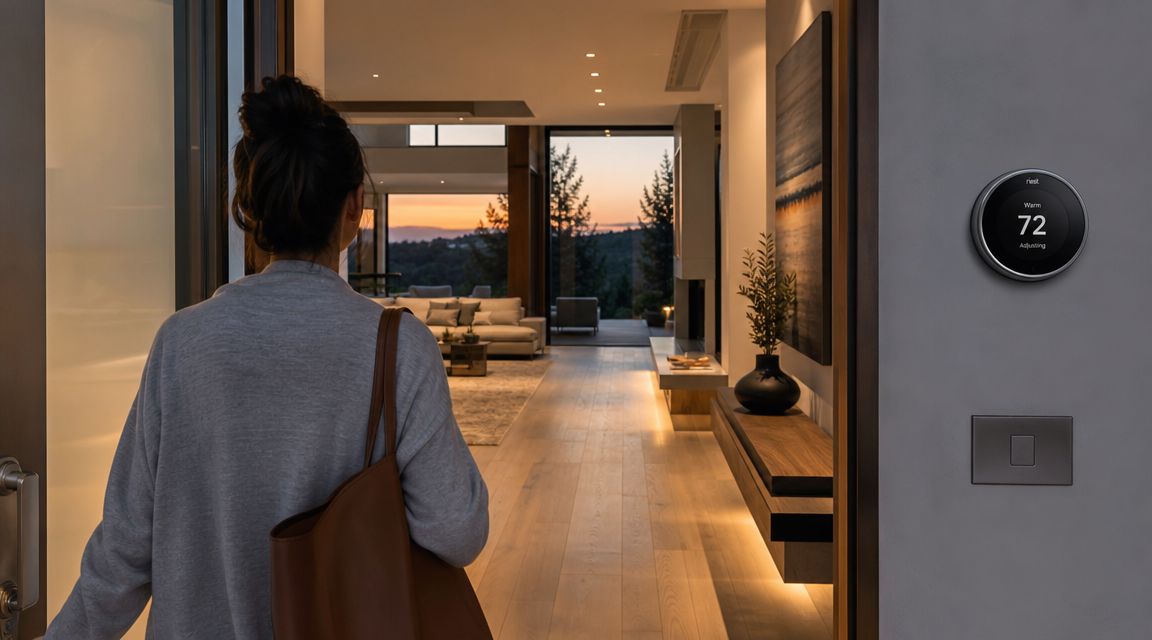
The novelty phase is over. Voice has moved beyond asking for the weather or setting a kitchen timer. One market projection puts the global voice control smart home market at USD 168.27 billion in 2026 and projects it to reach USD 1.58 trillion by 2035, with North America leading adoption, according to Research Nester's voice control smart home market forecast. That projection matters because it reflects a broader shift. Homeowners now expect voice to be part of lighting, climate, entertainment, and security planning.
The strongest use cases usually aren't isolated commands. They're scenes.
Practical rule: Voice should simplify the room. If it adds steps, confusion, or guesswork, the system wasn't designed well.
In the homes that work best, voice isn't the only interface. Keypads, touch panels, occupancy logic, scheduled routines, and well-programmed defaults still matter. Voice becomes the most natural on-demand layer. You ask for what you want in plain language, and the house handles the rest.
That's also why premium systems feel so different from a DIY pile of devices. They aren't built around one gadget. They're built around the homeowner's daily patterns.
A voice command sounds simple, but the system is doing several jobs very quickly. It has to hear you clearly, understand what you meant, decide which system should respond, and then confirm the action without delay.
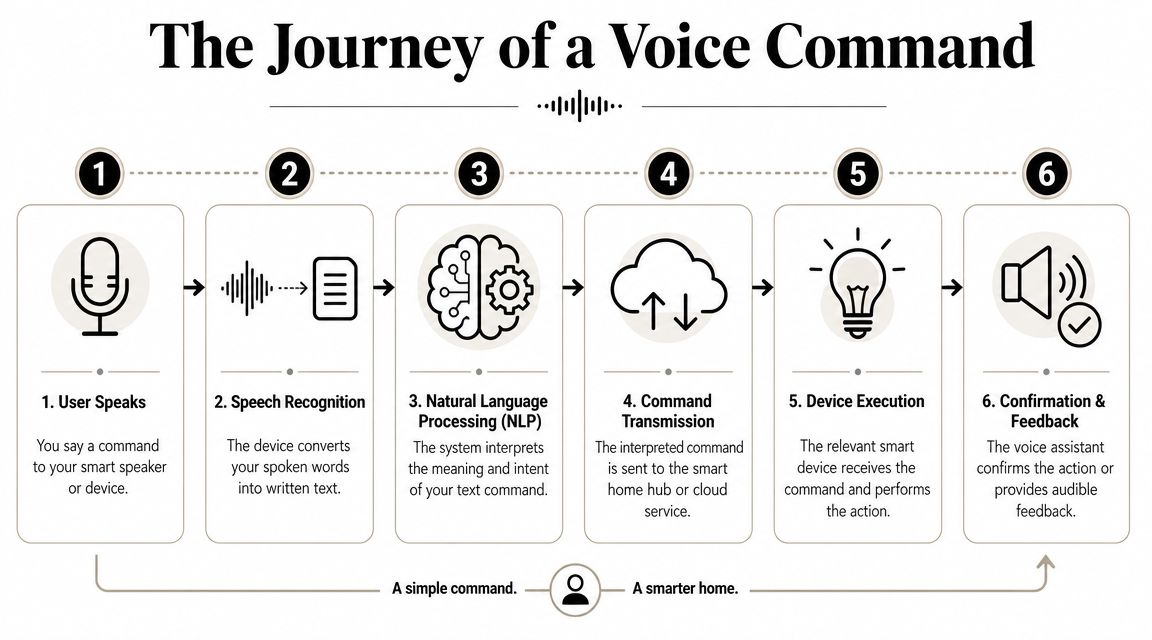
A typical voice control home automation workflow looks like this:
Wake word detection
The microphone waits for a trigger phrase. Until then, it's listening for that cue, not acting on every sentence in the room.
Speech recognition
The system converts your spoken words into text.
Intent mapping
It figures out what you mean. “Turn on movie night” is different from “turn on the den lights.”
Device routing
The platform decides where the command belongs. That may be a Lutron lighting processor, Sonos zone, Kaleidescape player, shade controller, or another subsystem.
Execution
The device or automation controller runs the action.
Feedback
Some systems answer verbally. Others confirm with device response, such as lights fading or music starting.
That basic event-to-action model shows up in everything from consumer assistants to embedded projects using speech recognition, Bluetooth transport, microcontrollers, and relay control, as outlined in this technical voice control home automation project reference.
The biggest design decision is where the intelligence lives.
Cloud-based voice systems send the speech data out for processing and then wait for a return command. Offline or edge-based systems keep more of that recognition on the device or inside the home. According to Dusun's overview of cloud and offline voice control architectures, cloud systems depend on internet quality and can introduce latency, while local processing improves response speed and privacy. For critical functions like lighting and security, local processing keeps essential control available even when the internet drops.
That's why I treat local or hybrid control as the right path for important rooms and essential functions.
If the house can't turn on lights during an outage because a cloud service didn't respond, that isn't home automation. It's dependency.
The voice platform only works as well as the structure behind it. Bad room names create bad outcomes. If you have “family room lamp,” “great room light,” and “living room sconces” all referring to the same open area, you're asking for inconsistent behavior.
A clean design usually includes:
If you're planning a larger system, this is also where the broader control strategy matters. A dedicated smart home hub often acts as the traffic manager between devices, scenes, and interfaces.
There's another side to this topic that often gets missed in smart home articles. If you're also trying to optimize for voice search in your business or online content, it helps to understand how people naturally phrase requests out loud. Home voice control works the same way. People don't speak in button labels. They speak in intent.
Most homeowners think they're choosing a speaker. They're really choosing a philosophy.
Mass-market assistants are built for scale. They're made to fit millions of households, answer general questions, and connect with a huge range of consumer products. That's useful. But a premium home has different priorities. It needs stronger privacy, deeper subsystem integration, cleaner hardware, and a more refined experience in the room.
Josh.ai sits in that second category. It's designed for the custom-integrated home, not the impulse-buy smart speaker aisle.
A consumer assistant can usually handle basic commands. Turn on lights. Play music. Set a timer. For many homes, that's enough.
A professionally designed voice platform is different. It's built to control scenes across multiple systems with more predictable results. That matters when one command needs to coordinate Lutron lighting, shades, Sonos zones, Kaleidescape playback, and other automation layers without confusion.
A review of voice-controlled home automation literature also highlights why this matters from a usability standpoint. It cites assistant recognition accuracy figures of 90% for Google, 87% for Alexa, 80% for Cortana, and 62% for Siri, while also tracing the parallel rise of security concerns including voice squatting attacks identified in 2016, ultrasonic attacks in 2018, and intensified privacy concerns in 2019, according to this review on voice-controlled home automation systems. Recognition quality helped make voice practical, but it didn't remove the need for better system design and stronger privacy decisions.
| Feature | Josh.ai (Professional) | Alexa / Google Assistant (Consumer) |
|---|---|---|
| Primary design goal | Integrated home control | General consumer convenience |
| Privacy approach | Oriented around privacy-first home control | Broad consumer ecosystem with cloud-heavy behavior |
| Integration depth | Built for custom AV and automation environments | Often strong at basics, but uneven with advanced multi-system logic |
| Natural language in the home | Geared toward room-aware, scene-based control | Strong for common commands, but can get messy in complex homes |
| Hardware aesthetic | Purpose-built for designed interiors | Consumer device styling |
| Best fit | New builds, luxury homes, media rooms, whole-home systems | Apartments, starter smart homes, single-room setups |
Josh.ai makes sense when the house already includes serious infrastructure. If the project has Lutron lighting, distributed audio, dedicated theaters, automated shades, and layered control scenes, a consumer assistant often becomes the weak link.
That doesn't mean every home needs Josh.ai. It means the platform should match the ambition of the project.
For homeowners weighing budget against experience, it helps to understand how system choices affect planning and scope. This overview of home automation system cost is a useful starting point because voice is only one layer of the larger design.
The most expensive mistake isn't buying too much system. It's buying the wrong class of system and then trying to force it to behave like a custom one.
The phrase “turn on the light” undersells what voice can do in a real home. The interesting part starts when one request triggers a coordinated response across lighting, audio, video, shades, and outdoor spaces.
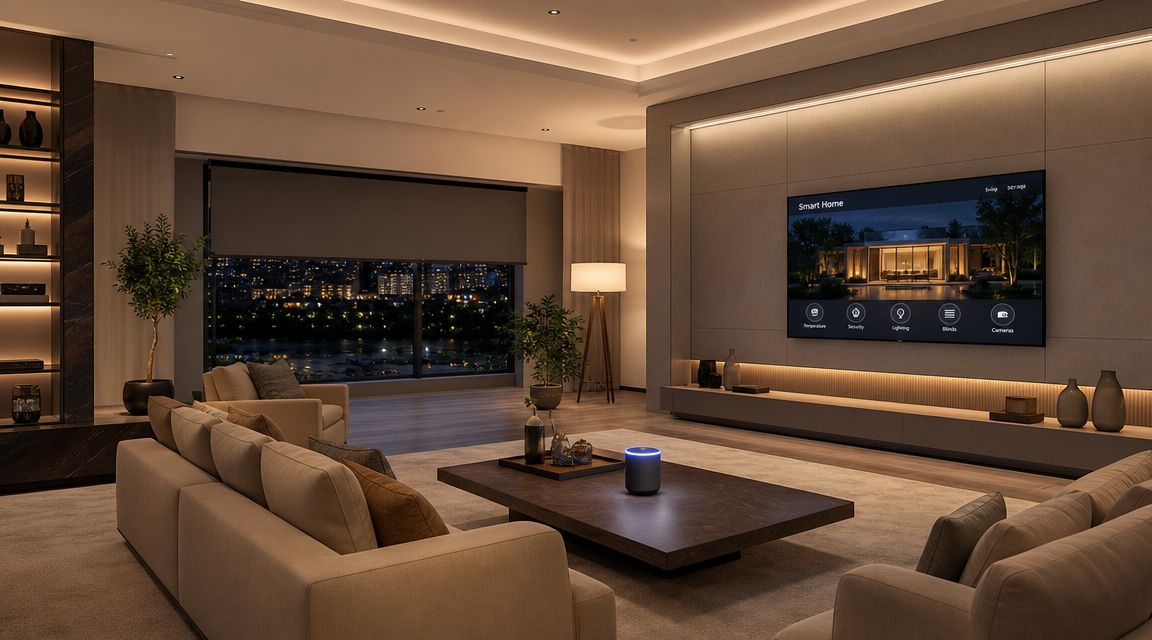
A good theater or media room scene shouldn't require four remotes and a sequence everyone forgets by the next weekend.
Say “Start movie night,” and the room can respond in layers:
That's where professional integration shines. Each subsystem is already programmed to do one clear job, and voice becomes the trigger, not the brain trying to improvise.
Outdoor voice scenes are often more useful than people expect. Homeowners don't want to open apps while carrying food to the patio or moving between the kitchen, deck, and pool area.
An “Entertain” scene might do all of this at once:
For homes where arrival and mobility matter beyond the front door, connected control can extend to the car as well. The Nimbio in-car solution is an interesting example of how access and control workflows can continue through Apple CarPlay and Android Auto.
A short video gives a sense of how these systems come together in practice.
The most-used commands are usually the least flashy.
“Good morning” can raise selected shades, bring on kitchen lighting, start music at low volume, and ease the home into the day. “Goodnight” can shut off common-area audio, secure lighting scenes, and simplify the house to just what's needed overnight.
This is also where project type matters. In homes, voice scenes need to feel personal and low-friction. In restaurants and light commercial spaces, the same concept can help staff control lighting zones, audio sources, and display systems with greater ease, but the priorities are different. The residential side is where voice has the most room to feel natural.
Home AV Pros handles projects in that lane, including custom home theater, new home builds, home audio solutions, outdoor lighting and sound, and selected commercial spaces such as restaurants. The common thread is coordinated control, not gadget count.
The question people ask is, “Is it always listening?”
The better question is, “What happens after it hears me?”
A voice assistant has to listen for a wake word. That part is normal. The main privacy issue starts after activation. Where does the audio go, who processes it, how long is it stored, and what protections stand between your home and an unwanted trigger or spoofed command?
Privacy hesitation isn't paranoia. It's a rational response to how many consumer platforms work.
A 2023 review of secure smart-home voice systems found that privacy and trust remain a major barrier to adoption. The review notes risks including spoofing, unauthorized activation, and data privacy concerns, especially when cloud processing is involved. It argues for stronger authentication and more local or edge processing to reduce exposure.
That lines up with what many homeowners already sense. Convenience is attractive, but not if the tradeoff is vague data handling and weak control over what leaves the house.
A privacy-first voice system usually includes some combination of these choices:
Security view: Don't judge a voice platform only by what it can do. Judge it by what it refuses to do without the right safeguards.
Business model matters too. A platform designed for custom integration and paid hardware has different incentives than one built around broad consumer data ecosystems. That doesn't automatically make one safe and the other unsafe, but it absolutely affects how the system should be evaluated.
For homeowners who want a broader baseline for digital habits beyond the smart home itself, these online privacy best practices are a useful companion read.
When a homeowner says voice control “doesn't work,” the voice assistant usually isn't the actual problem. The weak point is almost always underneath it.
The three most common causes are poor Wi Fi coverage, too many disconnected device apps, and no local fallback for essential functions. You can install an elegant microphone and still end up with a clumsy house if the network and control backbone are shaky.
A professional voice system depends on stable wireless coverage, clean roaming, and predictable device communication. That's why network hardware matters so much. In larger homes, dense-wall homes, and properties with outdoor AV, a properly designed system using equipment from brands like Ubiquiti is often the difference between “works most of the time” and “works every day.”
If your home has dead spots, sticky device handoffs, or overloaded access points, voice commands will feel inconsistent even when the assistant itself is fine. This guide on how to improve WiFi signal strength covers the kinds of network issues that often show up before homeowners realize the network is the bottleneck.
Lighting is the best example. A reliable Lutron system gives voice commands a dependable endpoint. The assistant hears the request, but Lutron handles the actual execution with the kind of stability homeowners expect from a switch on the wall.
The same principle applies to audio, shades, and video. Stable subsystems make voice feel smart. Fragile subsystems make voice feel random.
A lot of smart home marketing makes an underlying assumption: the internet is always available. Real homes don't work that way. Routers get replaced. Providers go down. Weather knocks out service. A premium system should keep core functions alive anyway.
A 2025 study on an offline voice-controlled home assistant described a system that could control lighting, appliances, environmental sensing, and local audio without internet dependence. That kind of resilience is exactly what high-end systems should aim for.
If lights, audio, or basic room control collapse when the cloud hiccups, the foundation wasn't built for a real house.
By the time a homeowner starts thinking seriously about voice, the project is no longer a speaker purchase. It's system design.
Someone has to decide which platform fits the house, where microphones belong, how room names should be structured, what scenes need to exist, which actions should remain local, and how the network, lighting, audio, shades, and video systems all talk to each other. That work determines whether voice feels smooth or annoying.
A professional integrator handles problems before they become daily frustrations.
This is especially important in custom homes, remodels, and dedicated entertainment spaces. New home builds give you the chance to wire for the future, hide hardware cleanly, and choose control layers that won't age out the moment you add another subsystem.
For homeowners in southern Wisconsin and nearby northern Illinois, working with smart home automation installers makes the process more practical because the same team can plan the low-voltage side, coordinate with the builder, and support the finished system after move-in.
That matters whether the project is a primary residence, a custom home theater, whole-home audio, outdoor lighting and sound, or a focused upgrade to key living areas. A restaurant or light commercial space can benefit from similar thinking, but the home is where customized voice control usually makes the biggest quality-of-life difference.
Smart gadgets can be purchased one box at a time. A smart home has to be designed.
If you're planning voice control home automation for a new build, theater, whole-home audio system, or a broader smart home upgrade, Home AV Pros can help you map the right combination of network, control, lighting, audio, and privacy-first voice platforms for your specific lifestyle.

Copyright © 2026. Home AV pros. All rights reserved.