
You're probably in one of two places right now. Either the house looks great during the day and disappears after sunset, or you already tried a basic lighting kit and the result feels scattered, harsh, or underwhelming.
That's where low-voltage outdoor lighting starts to separate itself from “a few lights in the yard.” Done well, it gives a home shape at night. It makes entries easier to access, keeps patios usable after dark, and lets the architecture and plantings read with intention instead of glare. Done poorly, it creates bright dots, dark gaps, dim fixtures at the far end of the yard, and controls nobody wants to use.
For homeowners building or upgrading a connected home, the bigger opportunity is integration. Outdoor lighting shouldn't live on an isolated timer while the rest of the house runs on Lutron keypads, Josh.ai voice control, whole-home audio, surveillance, and scenes that already manage the interior. A well-designed low-voltage system belongs in that ecosystem.
Low-voltage landscape lighting is the residential standard for a reason. North American homes typically provide 120V power, but low-voltage systems use a transformer to step that down to 12V or 15V for outdoor fixtures, which means the cable can often be direct-buried in shallow trenches and the shock risk is much lower than with line-voltage systems, as outlined in Volt Lighting's low-voltage vs line-voltage overview.
That one design difference changes almost everything about a home installation. It affects safety, flexibility, serviceability, and how easily the system can grow with the property.
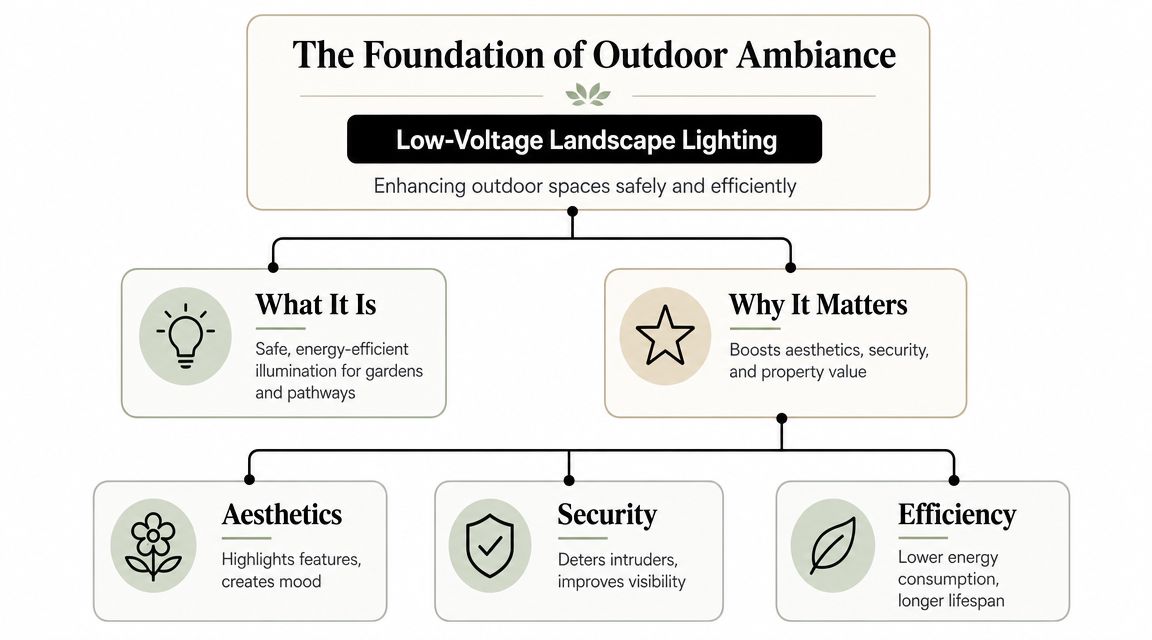
Line-voltage outdoor lighting still has a place, but usually not around a typical home. It's more often used for commercial, municipal, or security-focused applications. In a residential setting, low voltage gives you better design freedom without turning the yard into a full electrical construction project.
A practical comparison looks like this:
| System type | Typical fit | What homeowners notice |
|---|---|---|
| Low voltage | Residential landscape lighting | Flexible fixture placement, simpler trenching, easier future changes |
| Line voltage | Commercial or high-output applications | More infrastructure, less forgiving to modify |
| Solar | Decorative or temporary use | Limited consistency, limited control, limited design cohesion |
Solar lights can be fine for a short path or seasonal accent. They usually fall short when the goal is a unified nighttime scene. Output varies, batteries age, and control options rarely match what a discerning homeowner expects.
Practical rule: If you want the yard to feel designed rather than dotted with light, wired low-voltage is usually the right starting point.
Low voltage is easier to work with than line voltage, but “easier” doesn't mean casual. The transformer still needs to be matched to the lighting load. Wire runs still need to be planned. Fixtures still need to be aimed and layered so the yard feels calm, not overlit.
That matters even more if your home already includes integrated technology. A patio scene, gate camera view, pathway lighting, and music zone should feel coordinated. The outdoor environment should respond like part of the house, not like an afterthought added from a big-box carton.
Homeowners also ask a fair question before hiring anyone to touch exterior electrical work. License and credential checks matter. If you want a clear overview of how to verify a contractor's standing before a project begins, HomeProBadge contractor trust is a useful reference.
The hardware determines whether the lighting scene still looks intentional three years from now.
At the system level, four pieces form the core: the transformer, wire, fixtures, and connections. Get those right and the property looks consistent, service stays manageable, and smart control platforms such as Lutron or Josh.ai have a reliable foundation to work with.
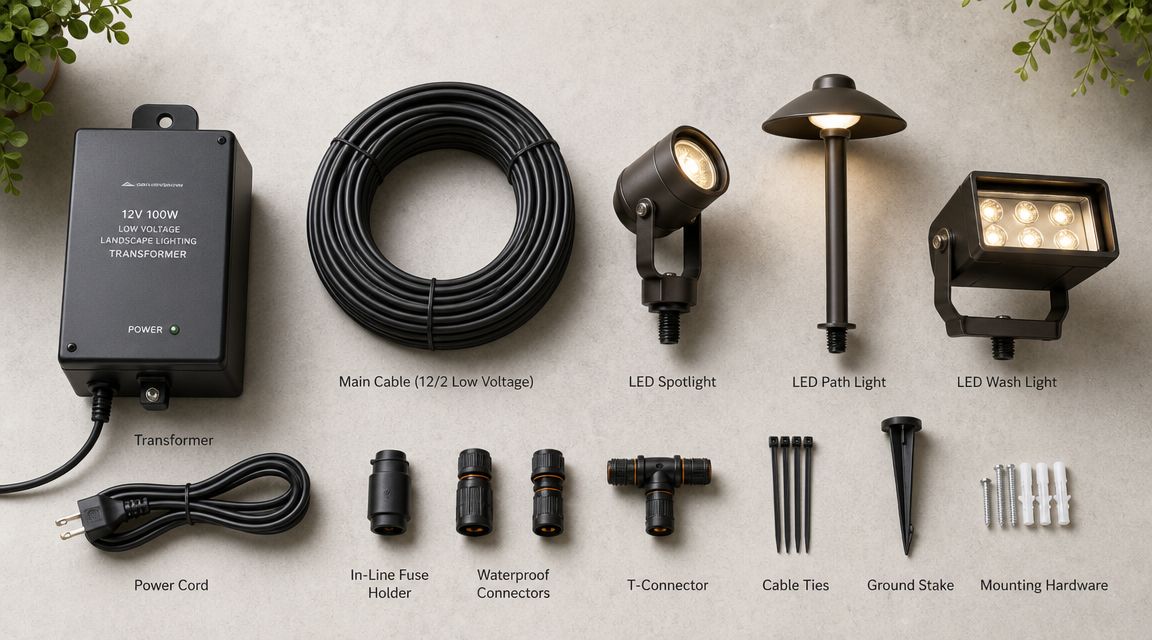
The transformer sets the electrical baseline for the whole outdoor system. It converts line voltage to low voltage, but in a well-designed project it also does something more important. It gives the lighting plan room to operate cleanly as fixtures age, loads shift, and future additions come into play.
A transformer should be sized with headroom, not right at the calculated fixture load. That extra capacity helps with stable performance and leaves space for additions such as a gate accent, a new tree uplight, or patio step lights added after the initial install.
In integrated homes, transformer choice also affects control strategy. Some projects call for simple scheduled operation. Others need zoning that ties into a Lutron scene or a Josh.ai voice command so exterior lighting responds with entry lighting, shades, and audio as one coordinated event.
Wire layout affects performance just as much as wire quality. Long runs, uneven fixture distribution, and casual branching can produce visible differences in output across the property.
Here, good planning pays off.
Front entry lighting, pool terrace accents, and rear entertaining areas often should not share one oversized run. Separating those zones makes voltage management easier, simplifies service later, and creates cleaner control options if the homeowner wants different scenes for arrival, dining, security, or late-night path lighting.
Homeowners who want a closer look at fixture placement and layout strategy can review this guide on how to design outdoor lighting for a cohesive property.
Fixtures shape the visual result, but core specification work is in beam spread, glare control, finish durability, and aiming hardware.
A narrow beam can bring out the bark and branching on a mature oak. A wider beam may be better for a stone façade or layered planting bed. Downlights at a seating area create a very different effect than path lights along a walk, even if the lumen output looks similar on paper. That is why fixture selection is rarely a one-type-fits-all decision.
Material quality matters too. Brass and copper age differently than powder-coated aluminum. Integrated LED modules reduce maintenance in some applications, while serviceable lamp designs can still make sense where replacement access is easy and long-term flexibility matters. The right answer depends on the location, exposure, and how the homeowner wants the system maintained over time.
Poor connections create a large share of outdoor lighting service calls. Moisture intrusion, loose terminations, and hurried splices usually show up later as flicker, intermittent failure, or a dead branch circuit that takes time to trace.
Good connection work is quiet and boring. That is exactly what you want.
Use weather-rated connectors, protect splice points, and leave the system serviceable for future adjustments. At Home AV Pros, that systems mindset carries over from broader low-voltage work such as distributed audio, shading control, and home automation. Outdoor lighting performs better when it is built like part of the house, not like a stand-alone add-on.
A well-lit property should feel composed from the street, calm at the entry, and comfortable once people settle onto the patio. That effect comes from selective lighting, disciplined aiming, and a scene plan that supports how the home is used after dark.
Professional design starts with hierarchy. The entry gets clarity. Architectural details get emphasis where they deserve it. Plantings, trees, and gathering areas fill out the view without turning the whole yard into a stage set. That restraint matters even more if the system will later tie into Lutron or Josh.ai, because good automation depends on scenes that already make visual sense.
Strong outdoor lighting usually combines several quiet effects instead of repeating the same fixture everywhere.
A front walk may need low, even guidance light. A mature tree often looks better with a tight uplight that catches bark and branching instead of flooding the whole canopy. Stone and stucco benefit from grazing or gentle cross-lighting that brings out texture. Dining and seating zones usually feel better with downlighting from above, where the source stays out of sight and the table remains usable.
That mix creates depth and gives the eye a natural path through the property.
If you want a closer look at placement strategy and fixture roles, this guide on designing outdoor lighting with purpose is a practical next step.
Overlighting is the fastest way to lose refinement. Too much brightness, visible lamp sources, and broad washes of cool light flatten the house and make outdoor spaces feel harsher than the interiors they connect to.
The fix is usually simple. Use warmer color temperatures. Shield the source. Aim light downward or across a surface instead of into normal sightlines. Keep the beam tight where precision matters, and let darkness do some of the work.
A few design rules hold up on almost every project:
The property should read clearly at night, with focal points, depth, and contrast. It should never feel floodlit.
Refined outdoor scenes usually work in three layers:
| Layer | What it does | Where it works |
|---|---|---|
| Guidance lighting | Supports safe movement and orientation | Walks, steps, entries |
| Accent lighting | Pulls attention to focal points | Trees, columns, specimen plantings |
| Ambient lighting | Makes outdoor rooms feel comfortable and usable | Patios, seating areas, outdoor dining |
The best results also leave some areas intentionally dark. That contrast frames the lit elements, preserves the character of the night, and gives automation more range later. A late-night “Goodnight” scene, for example, can leave just enough guidance light at the walk and entry while accent layers fade back. That only works when the original design has discipline.
Professional planning separates itself from a kit approach. A DIY layout often treats each fixture as an isolated decision. A well-designed system treats the whole exterior like part of the home, with scenes that look right at full output, dimmed for entertaining, or trimmed back for late evening.
A low-voltage lighting system becomes much more valuable when it behaves like part of the house. Basic timers and photocells still exist, and they can be useful. But for a connected home, they're the floor, not the ceiling.
When outdoor lighting is integrated into automation, it stops being a separate utility and starts becoming part of how the property lives every day.
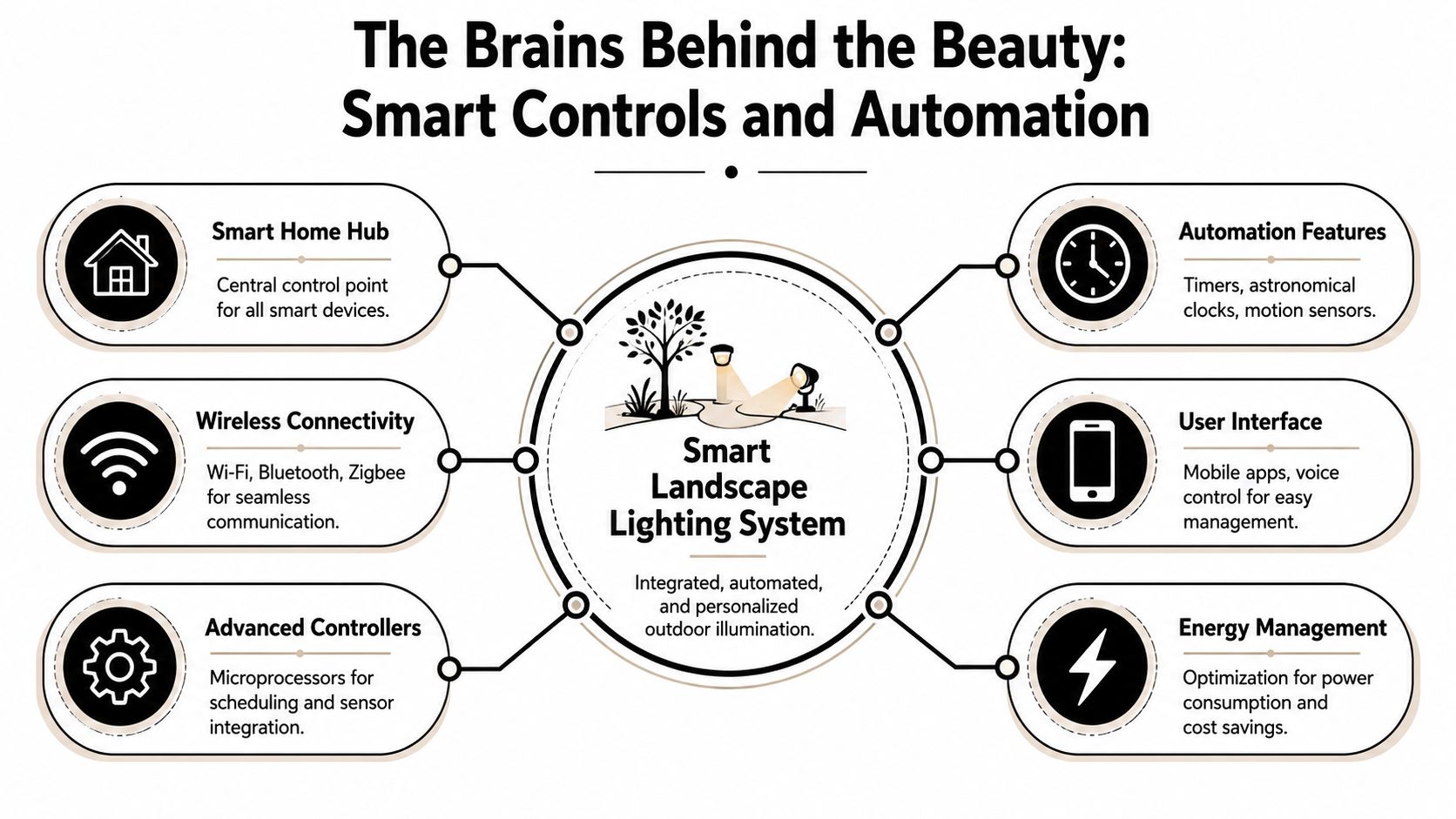
A simple on-off schedule can turn lights on at dusk. It can't decide that the patio should brighten for guests while the side yard stays subtle. It can't coordinate exterior lighting with interior dimming, music, or bedtime routines.
That's where platforms like Lutron and Josh.ai change the experience. Instead of treating each circuit as an isolated task, they let you build scenes around moments.
Examples homeowners use:
A system like this is easier to live with because nobody has to remember five separate apps or walk around pressing switches.
The more systems a home has, the more important interface quality becomes. If your house already includes distributed audio, shades, security cameras, and media, you don't want outdoor lighting to sit outside that logic.
Integrated control earns its place:
For a broader look at how these systems come together, smart home automation lighting control shows the control side more clearly.
Here's a useful walkthrough on the category as well:
Once lighting is scene-based, the design itself improves. You're no longer forced to pick one brightness level that has to serve every use case. A pathway can be comfortable late at night and still support a brighter arrival scene when guests come over. A patio can stay subtle on weekdays and feel more social on weekends.
That flexibility matters because outdoor spaces do different jobs at different times. One property can shift from quiet family use to entertaining to security-minded travel mode without anyone reprogramming the yard manually every evening.
A smart lighting plan isn't just control layered on top of fixtures. It changes how the fixtures should be grouped, aimed, and dimmed from the start.
For homeowners who want one team that handles both the physical lighting system and the automation layer, Home AV Pros works in that overlap, with residential projects centered on integrated lighting, audio, networking, and control rather than treating each system as its own silo.
A system can look polished in the first 20 feet and fall apart at the property line. The usual symptom is uneven output. Fixtures near the transformer look crisp, while the far run turns dim and flat. That is rarely a fixture defect. It is usually a load and cable-planning problem.
In low-voltage lighting, voltage drop decides whether the design you approved on paper still looks correct after installation. Long runs, undersized wire, and too many fixtures on one path all pull the far end of the system down. Good installers address that early with heavier cable where needed, shorter run lengths, and smarter distribution patterns rather than one long daisy chain, as explained in PDH Online's low-voltage lighting engineering guide.
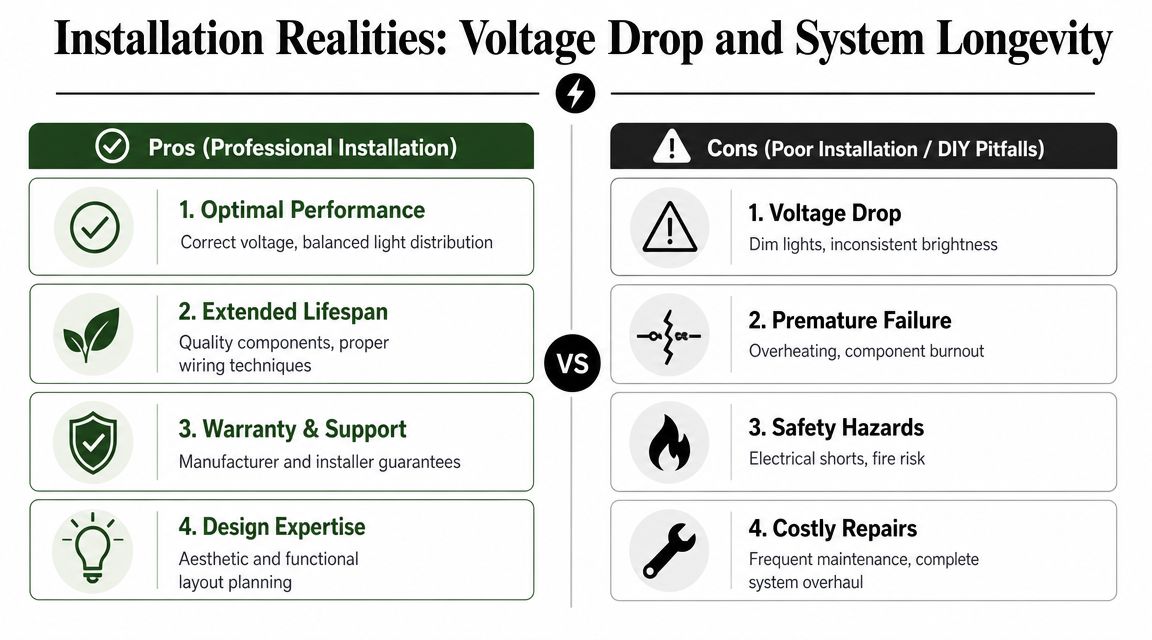
This problem shows up to the homeowner as a visual inconsistency, not an electrical one. A path may start bright and end dull. Uplighting on the front trees may match, while the rear courtyard feels weaker even with the same fixture family and lamp type.
The fix is usually layout, not guesswork. Separate zones, hub layouts, tee methods, and balanced runs keep fixture performance more consistent across the property. That matters even more when the lighting is tied into a smart home system. If a Lutron scene sets the entire exterior to a defined level, or Josh.ai triggers an arrival routine at sunset, uneven circuit performance becomes obvious immediately. The control layer can only work well if the electrical side is stable first.
For homeowners who want the wiring fundamentals explained clearly, our guide on wiring low-voltage lighting covers the basics in plain language.
Outdoor lighting fails slowly. Moisture gets into poor connections. Mulch crews disturb shallow cable. Roots shift fixtures. A transformer that was loaded too tightly on day one leaves no room for additions later. The result is not always a full outage. More often, it is a system that becomes harder to service and less consistent each season.
A durable installation usually gets four things right:
That last point gets missed in DIY planning. Homeowners often add a gate light, step lights, or a few accent fixtures later, then discover the original transformer and wiring plan had no headroom. A professional design accounts for growth from the start, especially if the exterior lighting will eventually work alongside audio, surveillance, and control. If you are also comparing broader landscape lighting solutions, it helps to judge them by serviceability and long-term system behavior, not just fixture style on install day.
What separates a polished outdoor lighting system from a collection of fixtures is control logic. Key to the design work is deciding how the front walk, entry, patio, steps, and trees respond together, then tying that behavior into the rest of the house. A Lutron keypad by the mudroom can trigger an arrival scene. Josh.ai can bring up a dinner setting on the patio without pushing every fixture to full output. That level of coordination has to be planned from the start.
I see the integration point get missed all the time. A homeowner adds path lights first, then wants gate visibility tied to cameras, softer dimming for late-night use, or one command that sets exterior lights, outdoor audio, and a pool area to the right levels. Those requests are straightforward if the lighting zones, transformer capacity, control interface, and network path were considered early. They are awkward and expensive if the system was built as a stand-alone project.
Good design also protects the look of the property once automation enters the picture. Smart control is not just app access. It is scene composition, dimming behavior, scheduling by use case, and making sure fixtures near windows, seating areas, and architectural surfaces sit at the right intensity. Too much output feels harsh. Too little leaves the property uneven. Integrated control lets those scenes change by time of night, entertaining mode, or security needs without making the yard feel overlit.
That broader planning mindset also helps when comparing landscape lighting solutions. Fixture style matters, but so does whether the system can join the home's lighting, shading, audio, surveillance, and voice control in a way that stays easy to use.
For homeowners who want that kind of coordinated result, outdoor lighting design and integration services are the practical starting point.
Home AV Pros designs and installs lighting that works as part of the smart home, including Lutron control, Josh.ai voice scenes, outdoor audio, networking, and whole-property automation.

Copyright © 2026. Home AV pros. All rights reserved.